

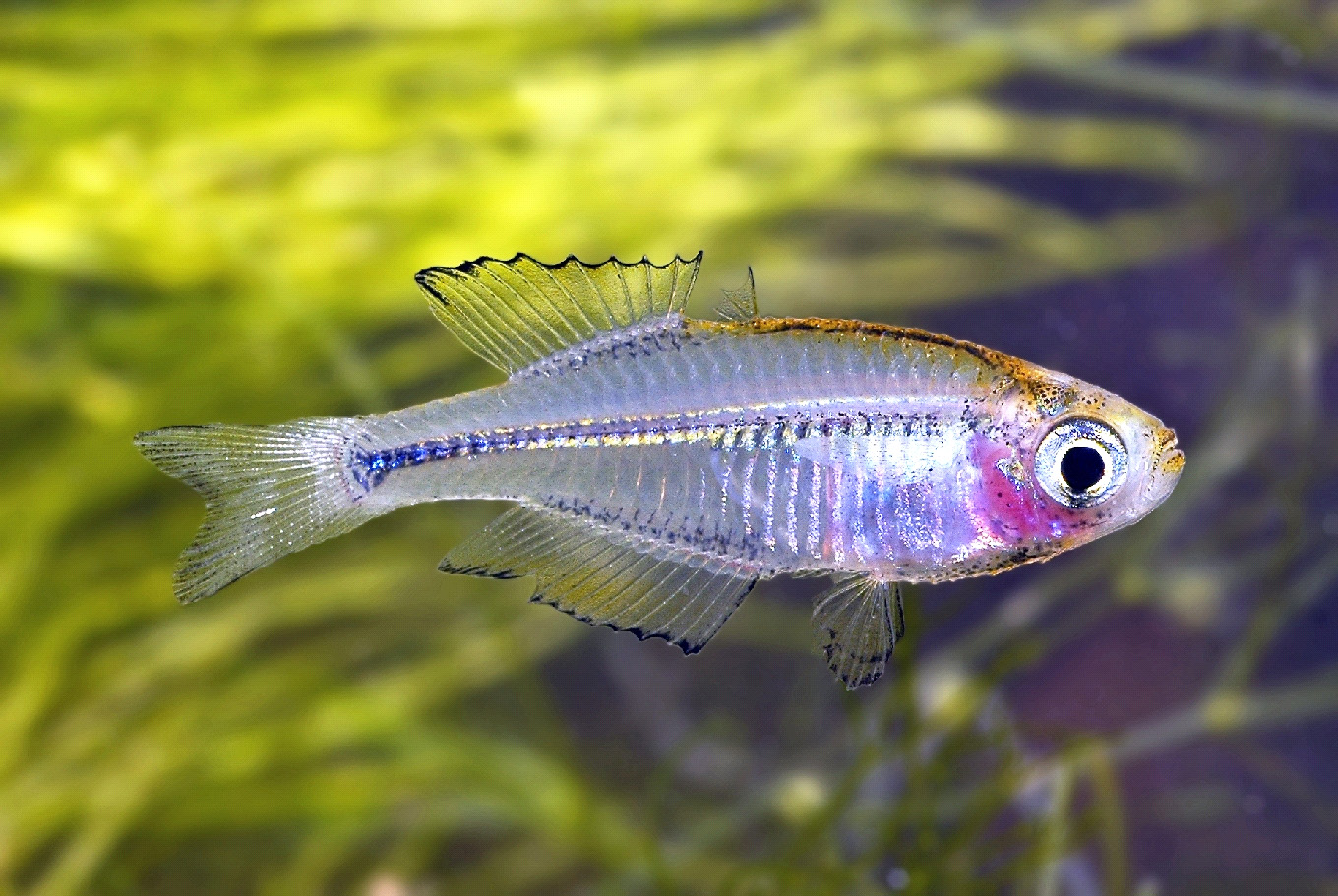
Kiunga bleheri
Bleher’s Blue Eye
Species Summary
Gerald Allen described this species in 2004. On first glance their general appearance looks similar to Kiunga ballochi. However, the morphological differences, nevertheless, are also obvious. It differs from Kiunga ballochi, also from the Kiunga area, on the basis of its much shorter second dorsal and anal fins, significant modal difference in the number of second dorsal fin rays, 6 versus 5 transverse scale rows on the body, and in usually having most of the second dorsal and anal fin rays unbranched. Body colour is general semitransparent with the second dorsal fin faintly yellowish on outer portion with irregular black margin. Maximum size about 2.8 cm.
Etymology
The species is named in honour of German explorer and ornamental-fish wholesaler and supplier Heiko Bleher (b. 1944), who collected the holotype and was the first to observe this species in the wild.
Etymology compiled from C. Scharpf (2024), “Fishes of Sahul: an Etymological Survey (Part 7), Pseudomugilidae and Telmatherinidae”, Fishes of Sahul 38(2): 2176–2189, and etyfish.org.
Distribution & Habitat
Specimens of Kiunga bleheri have been collected in clear, shallow rainforest streams along the Kiunga-Konkonda Road, approximately 12 km west of Kiunga, Papua New Guinea. However, the full extent of their distribution range is unknown.
Kiunga bleheri were reportedly first collected by Heiko Bleher in 1991 from Tare Creek. Unfortunately on that occasion the live specimens were lost by the airline. On a second attempt in 1993 he caught just three individuals and they didn’t breed. Then in 2003 he managed to catch a larger number in the same stream and these were successfully transported to Europe and eventually released into the aquarium hobby. Additional specimens were collected in 2003 by Heiko Bleher. Water parameters recorded in 2003 were: pH 5.9; conductivity 29 µS/cm; temperature 27°C.
Live specimens of this species were collected by Charles Nishihira in 1994 and released into the aquarium hobby. In 2007 Mark Allen and Philip Atio also collected this species. However, today there are no live specimens in captivity.
References
- Allen G.R. (2004) Kiunga bleheri, a new Blue-Eye (Pisces: Pseudomugilidae) from fresh waters of Papua New Guinea, aqua, Journal of Ichthyology and Aquatic Biology 8(2): 79-85.
- Allen G.R., A.W. Storey and M. Yarrao (2008) Freshwater Fishes of the Fly River, Papua New Guinea. Ok Tedi Mining, Tabubil, PNG.