
History of Rainbowfishes in Captivity

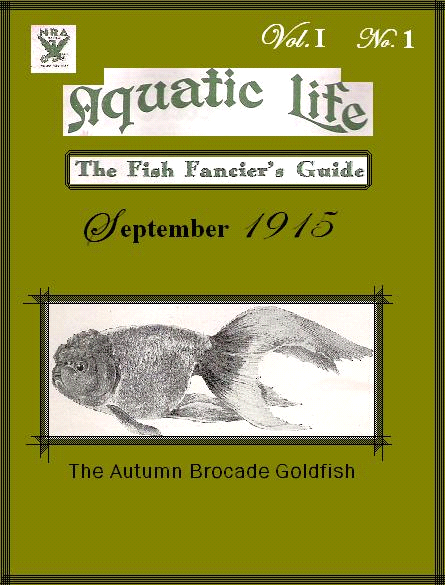
Australian rainbowfishes have been maintained in home aquaria at least since the beginning of the last century. As early as 1915, Albert Gale in his book Aquarian Nature Studies & Economic Fish Farming made known the hobby of keeping Australian freshwater fishes. This book covered many subjects on the captive maintenance and care of a number of species. A section of the book also explored the possibilities of commercially breeding Australian freshwater fishes for the aquarium hobby. Albert Gale was a member of the Royal Zoological Society of New South Wales and regularly wrote articles about Australian freshwater fishes for Aquatic Life. This magazine was edited by W. A. Poyser and published by Joseph E. Bausman in the USA during the early part of the last century.
During the late 1920s and early 1930s large Aquarium Societies were established in major cities all around the world. Fish shipments at the time were in old-fashioned flat metal “German” cans, with a small neck and very wide body to give maximum air surface. As sea voyages were long and no oxygen was used, the fish generally arrived in poor condition. However, some survived the journey and were bred by experienced hobbyists.
During this early period rainbowfishes were known as sunfish. When exactly this group was called rainbowfish nobody really knows. In January 1934, National Geographic Magazine published an article written by Walter H. Chute, then director of the Shedd Aquarium in Chicago USA, called “Tropical Fish Immigrants Reveal New Nature Wonders” in which appeared a reference to the Australian rainbowfish. However, the earliest record that has so far been found is in the German aquarium magazine “Wochenschrift für Aquarien und Terrarienkunde” in September 1931 by Erich Henzelmann, who wrote an article about the ‘Regenbogenfisch’ Melanotaenia nigrans (which was actually Melanotaenia duboulayi). The earliest reference to the name rainbowfish that I have been able to find in Australia is in an excursion report of the Aquarium and Terrarium Society of Queensland. It was written by the then secretary, Amandus Rudel, and referred to a collecting trip on March 6, 1932. After this date, all collecting reports generally referred to the name rainbowfish. The common name of ‘Sunfish’ was designated to Rhadinocentrus ornatus, e.g., Moreton Island Sunfish.
Amandus Rudel was a founding member of the Aquarium & Terrarium Society of Queensland, and in 1927 he introduced the Australian rainbowfish to the international aquarium hobby when he sent specimens of Melanotaenia duboulayi by steamship to Germany, and which were later bred by the Berlin Aquarium. Speaking of Melanotaenia duboulayi, Amandus said, “I was astonished at the beauty of this fish the first time I saw it. Like a living rainbow, there is no other fish which can compare with its beauty. Naturally it has been my favourite ever since.” It is believed that from this initial shipment Melanotaenia duboulayi were introduced to the organised aquarium hobby throughout Europe, and then to North America.
They are probably the species upon which today’s common name “Rainbowfish” is based. In 1930, three specimens of Melanotaenia duboulayi were collected in the Mississippi River. This was one of the earliest accounts of an introduced ornamental fish found in the USA (O'Donnell 1935).
Amandus Rudel was also responsible for introducing another rainbowfish to the international aquarium hobby. In 1934, he sent 12 specimens of Melanotaenia maccullochi, collected by him near Cairns, in northern Australia, to Fritz Mayer in Hamburg, Germany. Four arrived alive and developed into two pairs. They were one of the most popular aquarium fish from Australia. In the German aquarium magazine “Wochenschrift für Aquarien und Terrarienkunde” in May 1935, Fritz Mayer gave the first account of their breeding, which was translated by F. H. Stoye in Innes’ “The Aquarium” in December 1936.
The hobby went into recess during the Great Depression and following war years, and very few aquarium specimens survived that period. The aquarium hobby didn’t really recover until the late 1950s when shipment with plastic bags and oxygen, in insulated containers was developed. This, together with faster air travel, enabled the aquarium hobby to flourish and was considered one of the most popular hobbies of the period.

During this growth period however, due to limited availability, rainbowfishes were never readily available to the general aquarium hobby. The only rainbowfishes that were available in the retail trade were a colourless assortment bred in Southeast Asia fish farms that looked nothing like the wild species, and were never very popular with fishkeepers.
Rainbowfishes from New Guinea started to arrive in Australia around the mid 1950’s. They were being maintained by only a handful of enthusiasts and were virtually unknown to the international hobby. There are some reports that specimens of Melanotaenia affinis, M. goldiei, M. rubrostriata and M. sexlineata (although probably M. papuae) were being maintained in the Australian hobby as early as 1959. During the 1960’s and 70’s a small trickle continued to arrive in Australia from New Guinea. However, the publication in 1982 of Rainbowfishes of Australia and Papua New Guinea by Gerald Allen and Norbert Cross, greatly increased the popularity of keeping rainbowfishes, and the desire for the newly discovered New Guinea species, turned that trickle into a flood. ANGFA, the Australia New Guinea Fishes Association was also formed in 1982; further promoting the keeping of rainbowfishes.
The importation of New Guinea rainbowfishes into Australia during this period did not have any significant restrictions and a number of different species were brought into the country by private collectors, which were subsequently distributed in the hobby. However, the increasing importation of New Guinea rainbowfishes eventually attracted the attention of the Advisory Committee on Live Fish (ACOLF), the then Federal Government body responsible for controlling the importation of live fishes. In late 1983, ACOLF for some obscure reason decided to ban the importation into Australia of all species of freshwater fishes from New Guinea. Despite the ban, however, new rainbowfish species from New Guinea continue to be imported, bred and distributed widely in the general aquarium hobby around Australia.
During the mid 1980s, Heiko Bleher, an intrepid aquarium fish collector started collecting the newly discovered New Guinea species, breeding and distributing them into the International aquarium hobby. This trend has continued over the past two decades, developing side by side with the increase in the discovery of numerous new species. More than 68 species have been discovered and the possibility of this number increasing in the next decade is almost certain.
Most rainbowfish species that have been introduced to the aquarium hobby has been by various private collectors. Rainbowfish enthusiasts travel to far-off places in Australia and New Guinea to collect new and different coloured forms. Many of the rainbowfishes that are available in the hobby today have resulted from the activities of these enthusiasts. These same hobbyists generate a substantial amount of data on habitat conditions, collecting locations, colour varieties and reproductive biology.
Keeping rainbowfishes in an aquarium can be a fascinating activity for the whole family with a number of advantages over the keeping of more conventional pets. Relatively little space is required; an aquarium can be aesthetically pleasing, and the fish themselves are clean, quiet and non-demanding, given a few simple requirements. Rainbowfishes have very similar breeding habits, their food requirements are similar, and water that suits one particular species will suit all. All are of good-natured temperament and will live harmoniously, more or less, with one another. They also possess all the attributes we look for in aquarium fishes; ease of breeding, hardy, beautiful colours, peaceful disposition, and they won’t destroy your plants or move the gravel around in your aquarium. They also come in a variety of sizes to suit almost any aquarium.
Most rainbowfishes available in the retail hobby today are bred in captivity. This is due in the main to the difficulties involved in collecting and transporting live rainbowfishes from their natural habitats in remote areas of Australia and New Guinea. This is even more relevant in New Guinea where dense rainforests, virtually no infrastructure like roads and airports has meant that organised collecting for the aquarium trade is just simply not possible. There is probably some limited collecting of wild fish in New Guinea, although reliable data is lacking.
Rainbowfishes spawn readily in captivity and there is now a large captive breeding pool that generally satisfies most of the commercial demand, thus negating the need for wild-caught fish.
One of the major problems affecting the popularity of rainbowfishes is that they generally don’t display their best colouration when kept under normal retail store conditions. Most retail stores maintain their fishes in bare, over-crowded aquariums. This is done mainly for economic reasons and to facilitate their ease of capture and sale. However, rainbowfishes maintained under these conditions will feel stressed and lose the beautiful colours that they are renowned for. In addition to this, too many species are offered for sale at a small size before they have developed their full adult colouration. Unless the general fishkeeper knows what they will look like when taken home they will more than likely be passed over for some other species.
Blue-eyes (Pseudomugilidae) are small colourful fishes rarely exceeding 5-cm in length. Their natural habitats are similar to that of rainbowfishes, although they are usually found in shallower water. Some species are found in brackish and marine waters. Blue-eyes are so called because of the striking blue colour of the iris. They are close relatives of the rainbowfishes and were previously classified with them but were given family rank by Saeed et al. (1989). Although, Dyer and Chernoff (1996) consider pseudomugilids as a subfamily of the Melanotaeniidae.
In general, male blue-eyes are brightly coloured, and their fins have elongate filaments that are utilised in elaborate courtship displays. They are valued as aquarium fishes due to their beauty, small size, and peaceful disposition and are easy to maintain and breed in captivity. They are hardy aquarium fishes despite their small size, and adapt well to captivity showing their colouration at all times. Ideally, they should share their aquarium with similar sized tankmates and be kept in small groups. Unfortunately, they are not as prolific as rainbowfishes and it is for this reason that most commercial breeders have ignored them and therefore are not generally available in the retail aquarium trade.