

Kiunga leucozona
White-banded Blue-eye
Species Summary
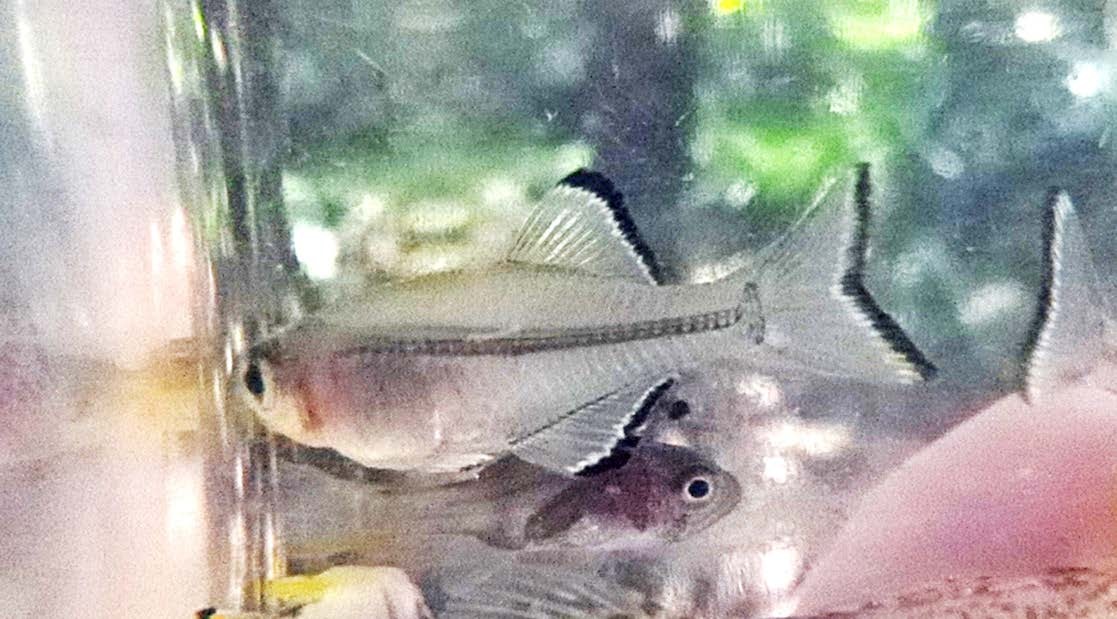
Kiunga leucozona is a tiny blue-eye described in the 2024 revision of the genus Kiunga, and is the westernmost member of the group. Adults reach about 33 mm in standard length. It is the closest relative of K. ballochi and closely resembles it, but differs most obviously in the colour of the median fins: Kiunga leucozona has a clean WHITE submarginal band on the second dorsal, anal and caudal fins where K. ballochi shows yellow — the character that gives the species its name. It also usually has two (rather than three) dorsal spines and a slightly different fin-ray and scale count.
Distribution & Habitat
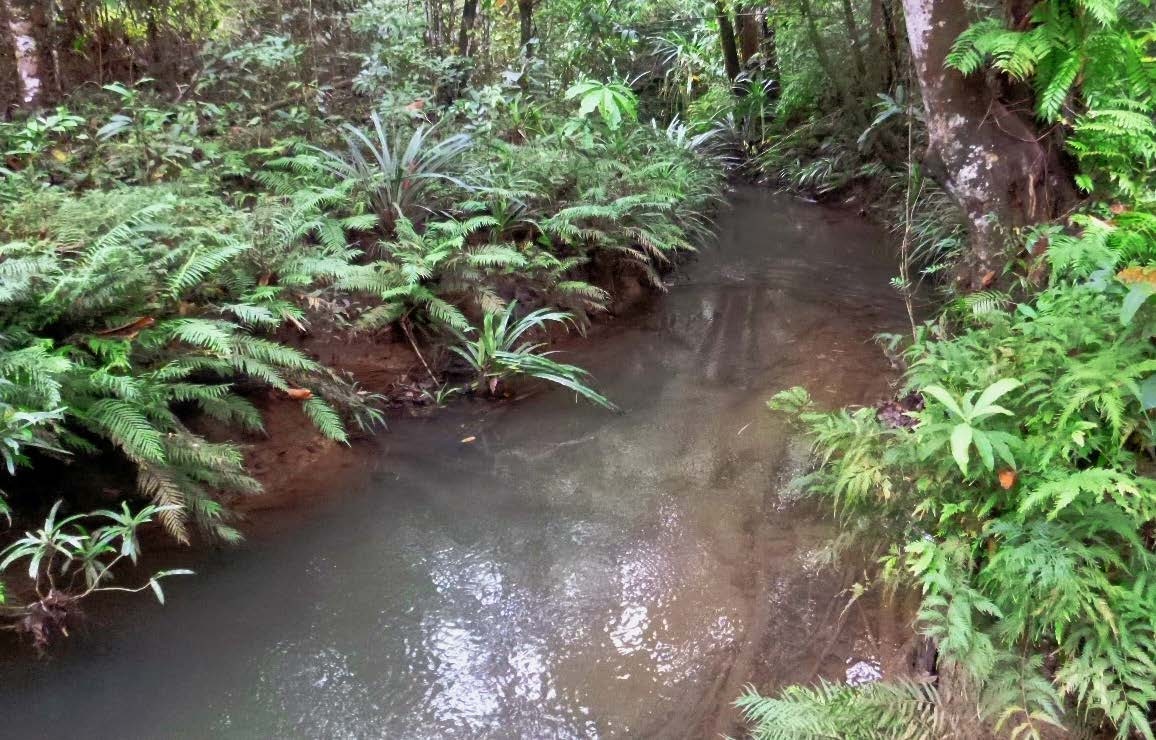
Kiunga leucozona occupies a small area of about 23 km² in the lower Ok Birim catchment, among western tributaries of the Ok Tedi (including Ok Indok, Ok Yep, Ok Birim and Ok Teelleck), roughly 12–15 km west-south-west of Ningerum and only about 2 km from the Papua Province (Indonesia) border. These are the only Kiunga known from west of the Ok Tedi, which had been thought to be a barrier to the genus; the nearest populations of its eastern sister K. ballochi lie about 21 km away. The creeks, documented during 2014–2015 surveys of the Ok Birim area, are clear to slightly turbid, slow-flowing rainforest streams with full canopy cover, dense bankside and trailing vegetation, abundant woody debris, an organic bed and some beds of submerged water plants.
Description
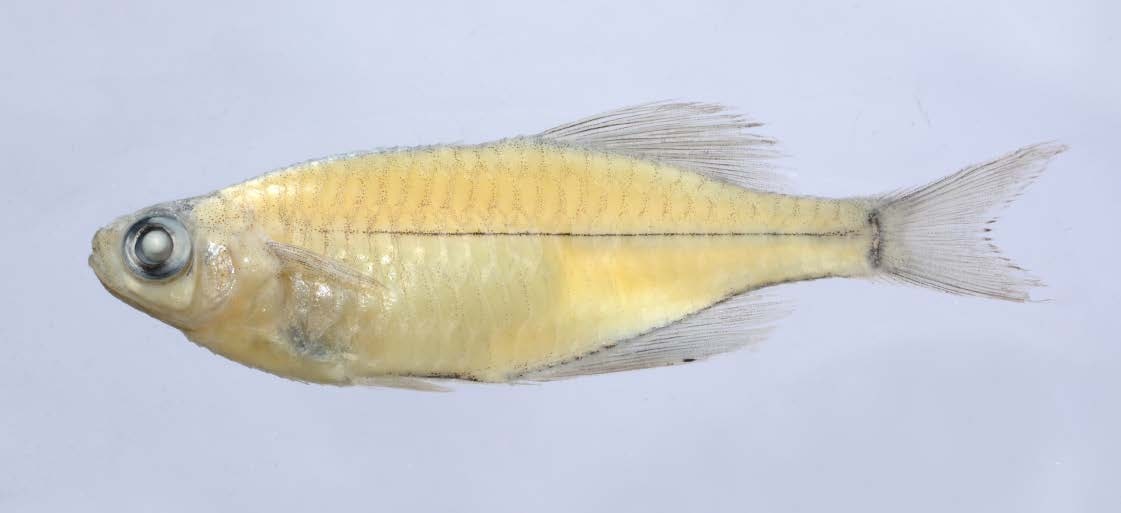
Adults to about 33 mm SL. The second dorsal fin usually carries 12–14 segmented rays and the anal fin usually 15–16, both tall with a triangular profile; there are 28 lateral scales and the caudal fin is forked; greatest body depth averages about 29% of standard length. It usually has two dorsal spines (three in only about 18% of specimens, against about two-thirds of K. ballochi) and most often 11 pectoral rays. The clearest field character is the white, rather than yellow, submarginal zone on the median fins.
Etymology
The species name leucozona combines the Greek leuco-, from leukós, white, and zona, Latin for belt or girdle (i.e. band), referring to the white submarginal zone on the median fins.
Etymology compiled from C. Scharpf (2024), “Fishes of Sahul: an Etymological Survey (Part 7), Pseudomugilidae and Telmatherinidae”, Fishes of Sahul 38(2): 2176–2189, and etyfish.org.
Remarks
The Ok Birim populations were first reported in the 2020 review of the genus as records of K. ballochi west of the Ok Tedi; the 2024 revision, drawing on genetic and morphological data, showed them to be a distinct species. Its very small range, close to the international border, makes it of particular interest for conservation.
Account compiled for Home of the Rainbowfish from G. R. Allen, M. P. Hammer, P. J. Unmack & A. W. Storey (2024), “A remarkable radiation of five species in the genus Kiunga (Teleostei: Pseudomugilidae) from the Fly River system, Papua New Guinea with descriptions of three new species”, Fishes of Sahul 38(2): 2137–2157, with discovery history from P. K. Amick, M. Yarrao & A. W. Storey (2020), “A review of the genus Kiunga (Teleostei: Pseudomugilidae), with notes on distribution, potential environmental impacts and recommendations for research and conservation”, Fishes of Sahul 34(3): 1626–1636.