

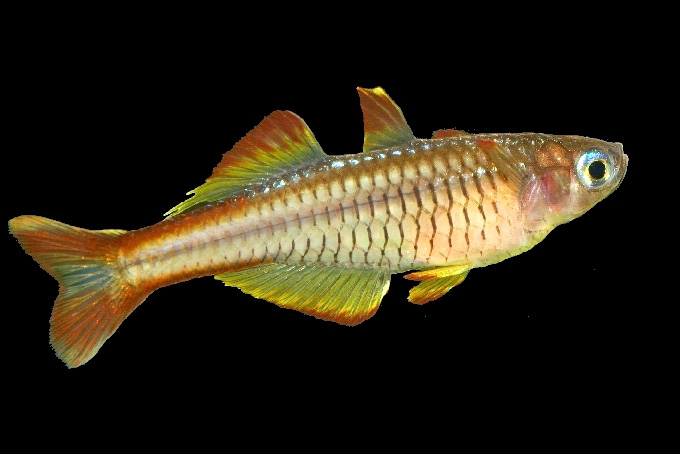
Pseudomugil ivantsoffi
Ivantsoff Blue Eye
Species Summary
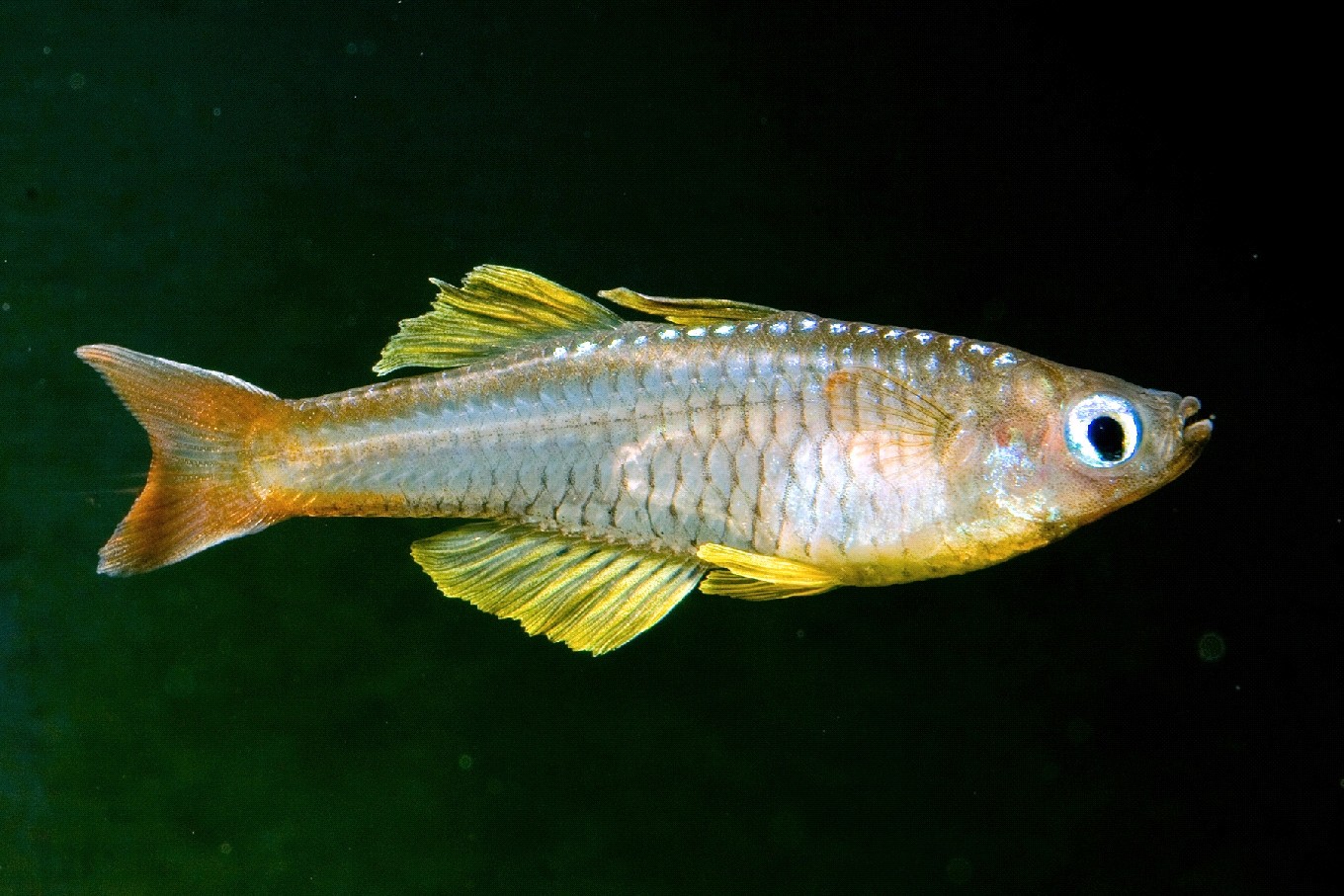
The head and body of male Pseudomugil ivantsoffi is semitransparent, often with a bluish or reddish hue. Iris of eye intensely blue. The opercle, abdomen and swim bladder region are silvery. The upper half of first dorsal and anterior half of second dorsal fins, and edge of anal fin are bright red. The dorsal and ventral contour posterior to second dorsal and anal fins edged with similar red; the upper and lower third of caudal fin also red. The pelvic fins are pinkish. The edges of some scales on abdomen with narrow black margins. Females overall semitransparent, lacking bright red shades of male; opercle, abdomen and swim bladder region silvery; some scales on anterior half of body with faint, fine black margins; fins mainly translucent to faintly yellowish, the outer tips of the first and second dorsal fins yellow. This is a small species, slender and laterally compressed, growing to a length of around 3 cm SL. Named “ivantsoffi” in honour of Walter Ivantsoff, of Macquarie University, Sydney, Australia, in recognition of his valuable contributions to the knowledge of atherinoid taxonomy.
This fish was initially identified as Pseudomugil reticulatus, based on the close resemblance of females from the Timika area to the single known example of that species collected about two kilometres east of Ayamaru (Ajamaru) Lake in the centre of the Vogelkop Peninsula. However, collections in 1999 near the type locality of Pseudomugil reticulatus, which lies some 900 km northwest of Timika, revealed that the two populations are distinctive.
Etymology
The species is named in honour of Australian ichthyologist Walter Ivantsoff, of Macquarie University, Sydney, for his valuable contributions to our knowledge of atherinoid taxonomy.
Etymology compiled from C. Scharpf (2024), “Fishes of Sahul: an Etymological Survey (Part 7), Pseudomugilidae and Telmatherinidae”, Fishes of Sahul 38(2): 2176–2189, and etyfish.org.
Distribution & Habitat
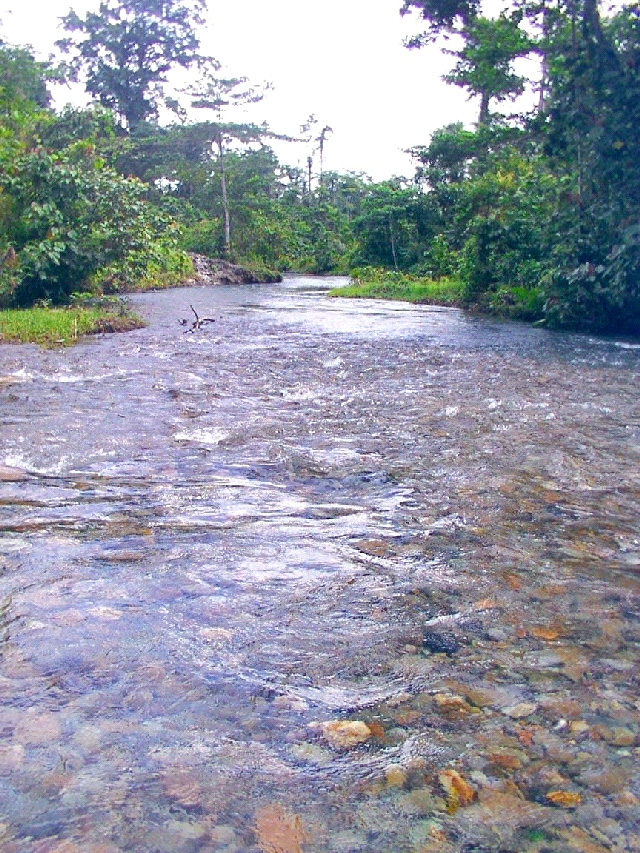
Pseudomugil ivantsoffi have been found in the tributaries of the Ajkwa, Iwaka and Kopi Rivers in the Timika-Tembagapura region of West Papua. The habitats consist of small (1-2 metre wide) shallow, slow-flowing streams in dense rainforest. Water is generally clear, but some are tannin-stained, with sparse aquatic vegetation. Bottom conditions included sand, gravel, cobble, and rocks. Water temperature and pH values ranged from 24–28 °C and pH 6.7–7.8 respectively. Other fishes collected from these habitats include Pseudomugil pellucidus, P. novaeguineae, Melanotaenia goldiei, M. splendida rubrostriata, and M. ogilbyi.
The Timika region includes the following rivers: Kamora River (Kamora, Tuaba, Wataikwa, Iwaka) Wania River, Tipuka River, Ajkwa River, Minajerwi River (Minajerwi, Kopi, Aimua) Mawati River, Otokwa River, Mamoa River (Mamoa, Seruka) Atuka River (Atuka, Wapuka) [The Atuka River meanders north to its junction with the Kamora River, very close to the village of Mioko.]
The dark colouration in ‘blackwater’ streams is due to the presence of organic substances. This black or tea colouration (these rivers are called kali kopi in Indonesian, or coffee stream – kali is Indonesian for river) is quite common in the area, due to extensive heath forest. These streams start in the heath and are shorter and narrower than the rivers which begin in the mountains and have enough volume from rainfall to dissolve the colouration. The blackwater streams all drain into the rivers.
Remarks
In 2004, Iain Wilson and Charles Nishihira collected live specimens of Pseudomugil pellucidus, P. ivanstoffi and Melanotaenia goldiei from the Iwaka River (Deky Creek), which is a tributary of the Kamora River. Melanotaenia goldiei, M. rubrostriata, P. novaeguineae, P. pellucidus and P. ivantsoffi were collected in small streams of the Kopi River, which is a tributary of the Minajerwi River.
A different colour variety of Pseudomugil pellucidus was collected from the Kamora River catchment. Males had spotted red and black on the dorsal fin. The anal fin colouration was also different with lots of yellow. They were collected from two streams only metres apart and actually intersect further downstream. A yellowcoloured form of Melanotaenia splendida rubrostriata was also found. It may have been an environmental issue as their stream was red with iron seepage from the mine site. ~ Iain Wilson
Live specimens have also been collected Heiko Bleher. Although a very attractive species if kept under suitable conditions, they are rarely seen in the retail aquarium trade.
References
- Allen G.R. & S.J. Renyaan (1999) Pseudomugil ivantsoffi (Pseudomugilidae), a new species of blue-eye from the Timika region, Irian Jaya. Aqua, Journal of Ichthyology and Aquatic Biology 3(4): 163-168.
- Allen G.R., K. Hortle and S. Renyaan (2000) Freshwater Fishes of the Timika Region, New Guinea. P.T. Freeport Indonesia, Timika, Indonesia.
- Ivantsoff W., Aarn, M.A. Shepherd and G.R. Allen (1997) Pseudomugil reticulatus (Pisces: Pseudomugilidae), a review of the species described from a single specimen from Vogelkop Peninsula, Irian Jaya, with further evaluation of the systematics of Atherinoidea. Aqua Journal of Ichthyology and Aquatic Biology, 2(4): 53-64.
- Muller K. (2004) Biodiversity of New Guinea [unpublished document]