

Pseudomugil tenellus
Delicate Blue Eye
Species Summary
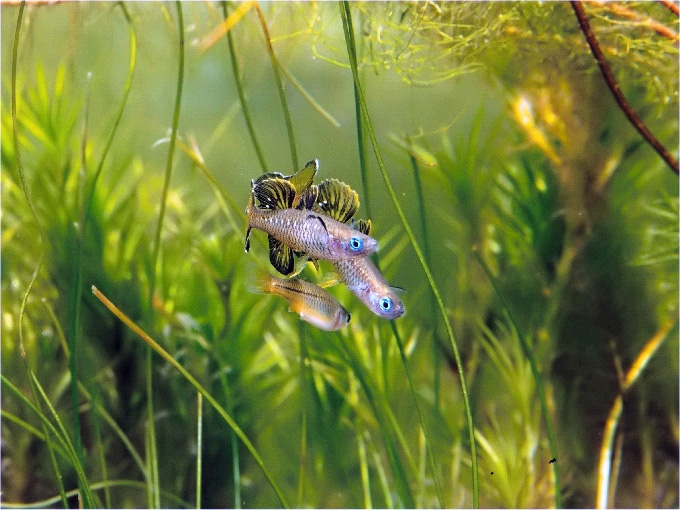
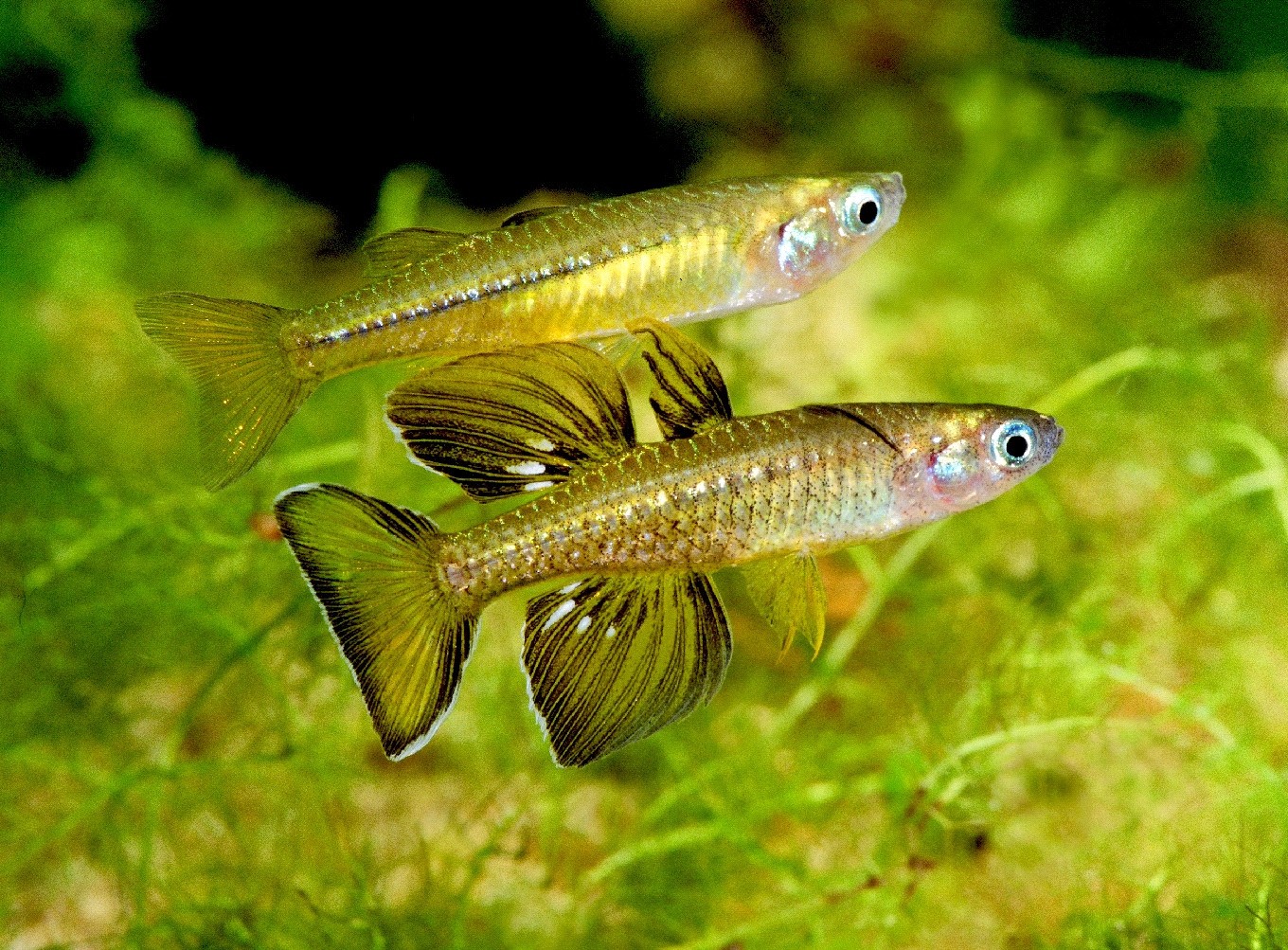
Pseudomugil tenellus is a small fish growing to a length of around 4-5 cm. Adult males generally have a translucent golden-brown body colour above the mid-lateral line and yellowish-brown with a silver sheen below. The mid-lateral line consists of a series of discontinuous silvery, reflective scales that become larger in older fish. The body scales are edged in black and form an attractive latticework pattern. They have two dorsal fins, very close together, the first much smaller than the second. The fins have a background colour of golden burnt-orange, with the outer margins light yellow; often edged with white. The second dorsal and anal fins have a semi-circular pattern of several small white spots. The caudal fin has a black margin that is fringed with white. The pectoral fins are fringed along the anterior edge with orange. As the common name suggests, the iris is blue. The operculum and belly region are silvery.
Colour can be variable however, and will depend upon the mood of the fish, water conditions and diet. Females and juveniles have a similar body colour but not as intense, and have much smaller uncoloured rounded fins with no markings. Females generally have a deeper body than the males whilst the adult males have larger dorsal, anal and pelvic fins. The differences in colour of the body and especially the larger size of the males’ fins make the sexes of P. tenellus easily distinguishable.
Etymology
The species name is Latin for somewhat tender or delicate, referring to its small, dainty or delicate appearance.
Etymology compiled from C. Scharpf (2024), “Fishes of Sahul: an Etymological Survey (Part 7), Pseudomugilidae and Telmatherinidae”, Fishes of Sahul 38(2): 2176–2189, and etyfish.org.
Distribution & Habitat
Pseudomugil tenellus was first collected from the East Alligator River near Oenpelli, in the Northern Territory during the American-Australian Scientific Expedition of 1948. They were reportedly abundant in large billabongs and creeks below escarpment waterfalls in the Oenpelli area. However, they were not scientifically described until 1964. They have patchy distribution throughout the northern areas of the Northern Territory, around the Gulf of Carpentaria to Cape York Peninsula in Queensland. In New Guinea they have been found in the Bensbach River and the Aru Islands; although I suspect that their distribution in southern New Guinea will be much wider.
In Australia, P. tenellus has been recorded from catchments of the Alligator, Blyth, Daly, Finniss, Howard, Liverpool and Mary river systems in the Northern Territory, where they are commonly found in riverine floodplain billabongs. They have also been collected from Leanyer Swamp, a tidal swamp north-east of Darwin; Rapid Creek, Benjamin Lagoon and a number of other minor streams in the Darwin region. In Queensland they have been collected in the Coleman, Edward, Jardine, Lockhart and Watson river systems; Jacky Jacky and Scrubby Creek (near Coen).
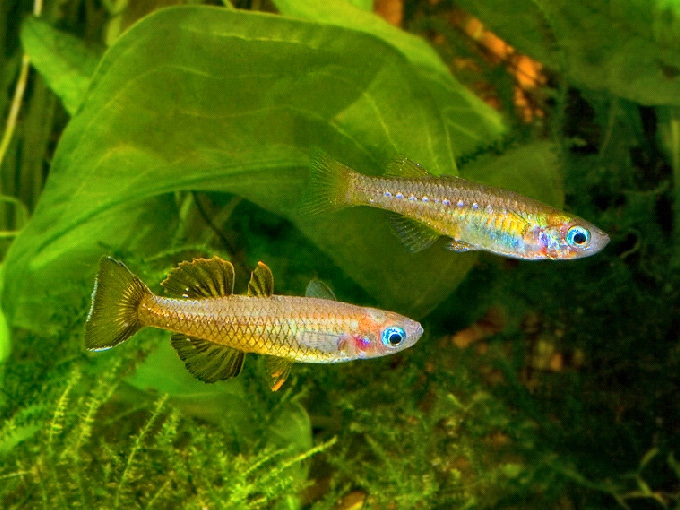
Pseudomugil tenellus are usually found inhabiting coastal brackish or fresh waters. They are most common in the lower riverine floodplain swamps and in slow-flowing streams, generally in areas with dense aquatic vegetation. They are usually found in the greatest numbers during the mid-wet season.
Juveniles have been collected in all seasons with a peak in the late-wet to early-dry season. Juveniles are mainly found in floodplain billabongs. Larger juveniles can be found in mainchannel waterbodies. Adults are found in essentially the same habitats as the juveniles as well as in the upper reaches of freshwater streams. Both adults and juveniles have been collected in estuary and tidal salt marshes; presumably they can spend their entire lives in these brackish habitats.
Water conditions recorded in their natural habitats are: Temperature 27–38°C; pH 5.0–7.1 and Conductivity 6–120 µS/cm. This indicates that this species has a preference for warmer waters.
Keeping & Caring
Pseudomugil tenellus are a relatively short lived species in the wild and most die in their first year, even if conditions are ideal. Mortality becomes more predictable for most fish after the first two years of life. Natural factors affecting them include disease, parasites, predation and competition for food and space. Females may only spawn once, usually at around one year of age, rarely living to spawn a second season. Males often live around two years. In captivity, life expectancy can increase up to four years if appropriate aquarium conditions are provided. The key for successfully maintaining P. tenellus is excellent water conditions. This can be easily provided with regular partial water changes.
Pseudomugil tenellus have a generalised diet in their natural habitat feeding opportunistically from the lower and mid-water areas of the waterbodies. The main items are algae, microcrustaceans and aquatic insects. The identifiable algae were green filamentous and blue-green algae and dinoflagellates. The microcrustaceans were mainly cladocerans, ostracods and copepods. Chironomid larvae were the main aquatic insects eaten. Other food items found in the stomachs were terrestrial insects and miscellaneous organic matter.
One study found that the diet in the late-dry season was mainly based on detritus (with associated unidentified organic material) and small quantities of chironomid larvae and pupae, and algae; no micro-crustaceans were eaten. In the early-wet microcrustaceans appeared in the diet and detritus decreased in importance; aquatic insects also appeared in the diet during this season. In the mid-wet season P. tenellus ate mainly microcrustaceans (particularly cladocerans) with smaller amounts of terrestrial and aquatic insects. By the late-wet—early-dry season algae were the main component of the diet.
An ideal diet for Pseudomugil tenellus in captivity could include foods such as live and frozen brine shrimp, daphnia, mosquito larvae, bloodworms and microworms. Spirulinabased foods flake, and bite-sized pellets designed for ornamental fishes are also acceptable. Obviously, no single food will meet their needs at all life stages, and the best way to ensure that they are getting a well-balanced diet is to feed them as wide a variety of food as possible. I fed all the different varieties that I kept with my homemade fish food, which was a blend of fresh/frozen fish, shrimp, shellfish and spinach. This was supplemented with live tubifex, blackworms, mosquito larvae and frozen bloodworms. The larvae and juveniles were fed fine powdered foods, phytoplankton (greenwater), newly -hatched brine shrimp and microworms.
Breeding
Very little is known about the breeding biology of this species in their natural environment. Most information is mainly based on aquarium observations. In their natural environment, P. tenellus are most likely aseasonal spawners, breeding continuously at intervals throughout the year. However, a peak in reproductive activity usually occurs during the early-wet season from October to December. The spawning season will vary from region to region, but will usually coincide with the conditions that offer the greatest amount of protection for the eggs, and food and shelter for the newly hatched young. Spawning in captivity usually begins when water temperature are maintained above 24°C.
Pseudomugil tenellus are an egg-scatterer, generally spawning amongst aquatic plants and grasses. Ovaries examined in one study contained 33–45 eggs with a mean diameter of 1.0 mm. However, the number of eggs released at spawning is small, usually between one and five, especially when the females are smaller than 25 mm. The number of eggs shed by a single female is directly related to the size of the female. The total number of eggs released will increase with the maturity and size of the fish. This species seems to prefer to lay their eggs amongst the roots of floating plants such as Ceratopteris thalictroides or any other floating species with fine roots extending into the water. Plant species other than Ceratopteris, however, were less preferred and the incidence of mortality of eggs laid on other plants was greater. Java moss appears to be a totally unsuitable spawning medium for this species (Ivantsoff et al. 1988).
Breeding this species under suitable aquarium conditions is generally uncomplicated. Group spawning with multiple males and females is probably the preferred method for breeding.
This will allow the females to choose their own mate and in doing so; a variety of genetic factors will be passed on to the next generation. Spawning pairs is possible but group spawning should provide you with more eggs.
Males commonly remained near a suitable site for spawning and exhibit territorial behaviour towards other males such as lateral fin-flaring displays and pursuits. The males swim parallel to each other in a circular pattern; frequently changing direction. This display is a ritualised test of strength between the males and usually comes to an end when one of the males retreats. The males do not actively care for the eggs other than through defence of the spawning site. They may eat their own eggs, or fail to defend the spawning site against other egg predators. They may also cannibalise their young and whilst larvae may survive in a heavily planted aquarium it is a better to transfer the mops or spawning medium to a hatching container or aquarium, at least until you have established a sizeable population. Spawning mops are my preferred spawning method as better survival rates can be expected if the eggs are removed. Several spawning mops should be provided to offer the males a choice of spawning sites and females a choice of hiding places. The mops can be attached to a block of styrene foam and floated in the aquarium.
In captivity, males displayed during the daylight hours with the peak of activity occurring in the late morning and early afternoon. Pre-spawning behaviour begins in an open area of water adjacent to a spawning mop or floating plants. The male approaches the female from the side as she either attempts to flee or accepts the male as a suitable spawning partner. Nonreceptive females will move away and swim to the surface remaining motionless to avoid detection, often in the corners of the aquarium; begin schooling with the other fish or hide amongst the aquatic plants or spawning mops.
Direct spawning activity involves the male raising his dorsal and anal fins while actively pursuing the female. Once the female accepts the male she will move into the spawning medium. The male follows beside and parallel or slightly behind the female. During the egg release the females’ body quivers as she releases 1 to 30 eggs. The male will remain beside and parallel to the female, his fins erect as he fertilises the eggs. During this procedure the colour intensifies in both sexes. Males will often spawn with other females more than once a day; however females appeared to only spawn once a day. Spawning may continue over several days followed by a period of 1–2 weeks inactivity. A water change or slight change in temperature will sometimes induce spawning after a period of inactivity.
Eggs have adhesive filaments that attach to aquatic plants or amongst the strands of the spawning mops. Spawned eggs are relatively large; negatively buoyant in freshwater and average 1.2 ± 0.5 mm in diameter, and are usually clear to light amber in colour. Eggs are best left attached to the spawning mops to minimise handling stress and removed from the spawning tank to avoid egg predation. The removed mops can be placed in another aquarium for incubation and larval rearing. Maintain a constant temperature ± 1°C and gently aeration. Hatching will begin after an incubation period of around four to six days at a temperature range of 25–30°C (10–12 days @ 26°C Ivantsoff et al. 1988).
Temperature is one of the major factors that influences the embryonic period of blue-eyes. Although P. tenellus are only small their newly hatched larvae are rather large at around 4 mm. Upon hatching the larvae swim at the surface of the water, generally within the upper 1-cm water layer. The mouth is well developed and functional, and they begin feeding within hours of hatching. They can be fed finely powdered dry foods, phytoplankton and/or infusoria. From about 10 days after hatching they can be fed newly-hatched brine shrimp, copepods and microworm until large enough to accept the normal diet.
Pseudomugil tenellus grow fairly rapidly and reach maturity in about three months; at a size of around 18–24 mm. They can attain a length of 20–30 mm in around 4-5 months, and by the end of 12 months they should be around 40–50 mm. It has been reported that P. tenellus can attain a total length of around 19–28 mm in 144 days in captivity with a water temperature of 26°C. From about 18 mm, the fish can be sexed on colour pattern and the size of the dorsal fin in males. The smallest male spawned successfully when 20 mm; the smallest female spawned when 18.5 mm.
References
- Allen G.R. (1989) Freshwater fishes of Australia. T.F.H. Publications, Inc., Neptune City, New Jersey.
- Allen G.R. (1991) Field guide to the freshwater fishes of New Guinea. Christensen Research Institute, Madang, Papua New Guinea.
- Allen G.R., S.H. Midgley and M. Allen (2002) Field guide to the freshwater fishes of Australia. Western Australian Museum, Perth, Western Australia.
- Bishop K.A., S.A. Allen, D.A. Graham and M.G. Cook (2001) Ecological studies on the freshwater fishes of the Alligator Rivers Region, Northern Territory: Autecology. Supervising Scientist Report 145, Supervising Scientist, Darwin.
- Dostine P.L. (2003) The fauna of freshwaters in the Darwin Harbour catchment. In 'Proceedings: Darwin Harbour region: Current knowledge and future needs'. Department of Infrastructure, Planning and Environment, Darwin.
- Hansen B. (1987) Werneri from the wild. Fishes of Sahul 4(2): 164-168.
- Herbert B.W., J.A. Peeters, P.A. Graham and A.E. Hogan (1995) Freshwater Fish and Aquatic Habitat Survey of Cape York Peninsula. Queensland Department of Primary Industries, Brisbane.
- Ivantsoff W., L.E.L.M. Crowley, E. Howe and G. Semple (1988) Biology and early development of eight fish species from the Alligator Rivers Region. Technical memorandum 22, Supervising Scientist for the Alligator Rivers Region, AGPS, Canberra.
- Larson H.K. and K.C. Martin (1990) Freshwater Fishes of the Northern Territory. Northern Territory Museum of Arts and Sciences.
- Northern Gulf Resource Management Group (2004) Northern Gulf Region Natural Resource Management Plan.
- Saeed B., W. Ivantsoff and G.R. Allen (1989) Taxonomic review of the family Pseudomugilidae (Order Atheriniformes). Australian Journal of Marine and Freshwater Research 40: 719-787.
- Semple G.P. (1985) Pseudomugil tenellus - maintenance, reproduction and early development of the delicate blue-eye. Fishes of Sahul 3(2): 109-113.
- Tappin A.R. (2011) Rainbowfishes - Their Care & Keeping in Captivity. Art Publications, Australia.
- Taylor W.R. (1964) Fishes of Arnhem Land. Records of the American-Australian scientific expedition to Arnhem Land. Vol. 4.