
Nursery Aquarium
The ideal nursery tank should be bare with only a sponge filter. In this way the tank is easily kept clean and helps prevent any disease or water quality problems. During this time, rinse the sponge regularly under lukewarm running water to keep the surface area clean and free of blockage. A small trickle of air bubbles is sufficient because more air will agitate the water too much and the juvenile fish will have to fight the current. As they grow you can increase the airflow rate.
To achieve the best growth and survival, an initial stocking density of not greater than one juvenile fish per litre of water is recommended, and water temperature should range between 24 -28° Celsius. Juvenile fish can remain in the nursery tank until they are large enough to be transferred into a regular aquarium. However, this period should not exceed 90 days due to the increased growth, and the potential for the occurrence of adverse conditions of water quality. Generally, 95% survival should be expected at the end of the nursery period.
General maintenance consists of changing a little of their water every second day with a small siphon tube, removing any uneaten food and faeces, and adding pre-treated replacement water. Any mortalities or deformed fish should be removed regularly. Clean and disinfect all hatchery equipment with a chlorine solution, or other suitable disinfectant before using them for another batch of fish.
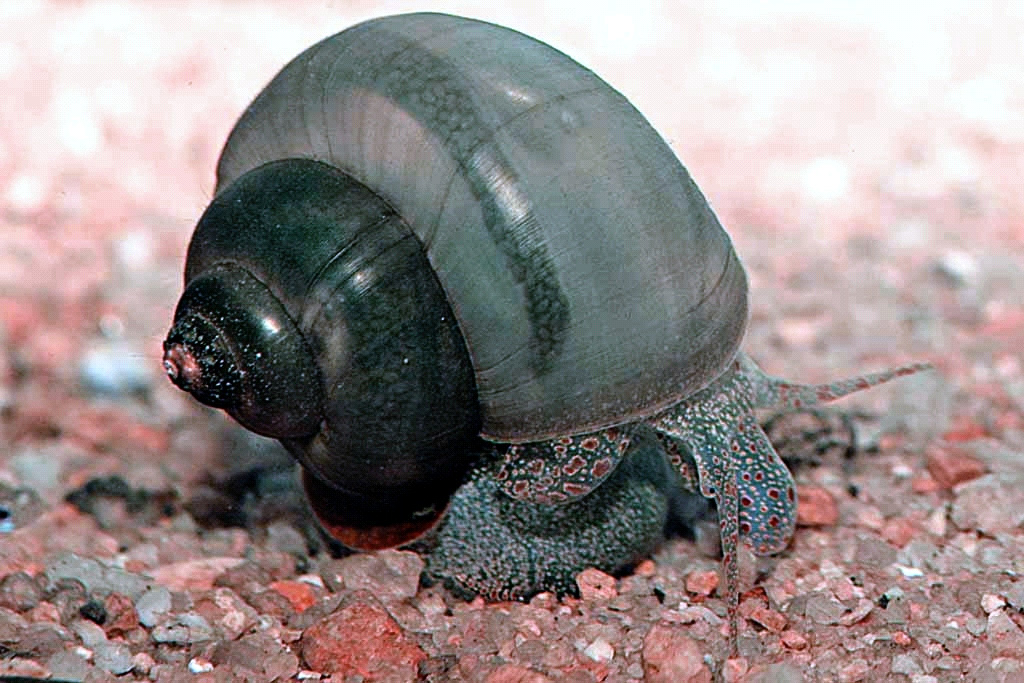
Mystery Snails (Pomacea bridgesii) can be a useful addition to the nursery aquarium as they help clean the tank of detritus and eat any surplus food, which has a very positive effect on water quality. As an added bonus, mystery snails will often breed in the tank in which the juvenile fish are being raised.
A native Australian snail (Notopala sp.) can also be used. Notopala River Snails are endemic members of the family Viviparidae and are found predominantly in the northern tropical region of Australia. However, their distribution includes the large drainage basins of the central and northern regions, and in much of south-eastern Australia.
They are absent from Tasmania, southern Victoria and southwestern Australia. They are mainly found in riverine habits inhabiting permanent and ephemeral waterholes, where they can be found along the banks, attached to logs and rocks or crawling in the mud. They appear to be able to resist drought, possibly by burrowing themselves in drying mud and sealing the operculum shut in order to reduce the risk of dehydration. However, it is unlikely that they would be able to survive prolonged drying periods.
These large snails resemble Mystery Snails; however, they do not lay eggs. They release fully developed small snails, hence the name “viviparous” (live-bearing snail). Like other species in the family Viviparidae, the females brood their young to a crawl-away stage, rather than having drifting or swimming larvae. The young remain with the female until they are large enough to survive independently. Very little is known of the growth rates or longevity of the species.
The body of the animal is similar to other snails but it possesses a prominent snout and short eye stalks on the outside of the tentacles. The radula is shaped like a rake and is used to scrape soft organic matter from surfaces. As a filter feeder the river snail feeds on bacteria suspended in the water and also grazes on the bacterial ‘biofilms’ that occur on hard surfaces in free flowing waters. They can function both as grazers, consuming algae growing on any submerged surface, and detritivores, utilising fine particulate organic matter and the bacteria and other microorganisms therein. They also filter feed on suspended matter.