
Collecting Rainbowfishes
While aquarium shops or fellow enthusiasts can offer a wide selection of rainbowfishes suitable for stocking your aquarium, if you live in the appropriate area, you may wish to collect your own. Field collecting is an interesting, educational, and enjoyable activity for aquarists so long as a few simple but important rules are followed. Collecting rainbowfishes from their natural habitat is only the first step, the second, and perhaps the most rewarding, is keeping and breeding them once they have been established in your own aquarium.
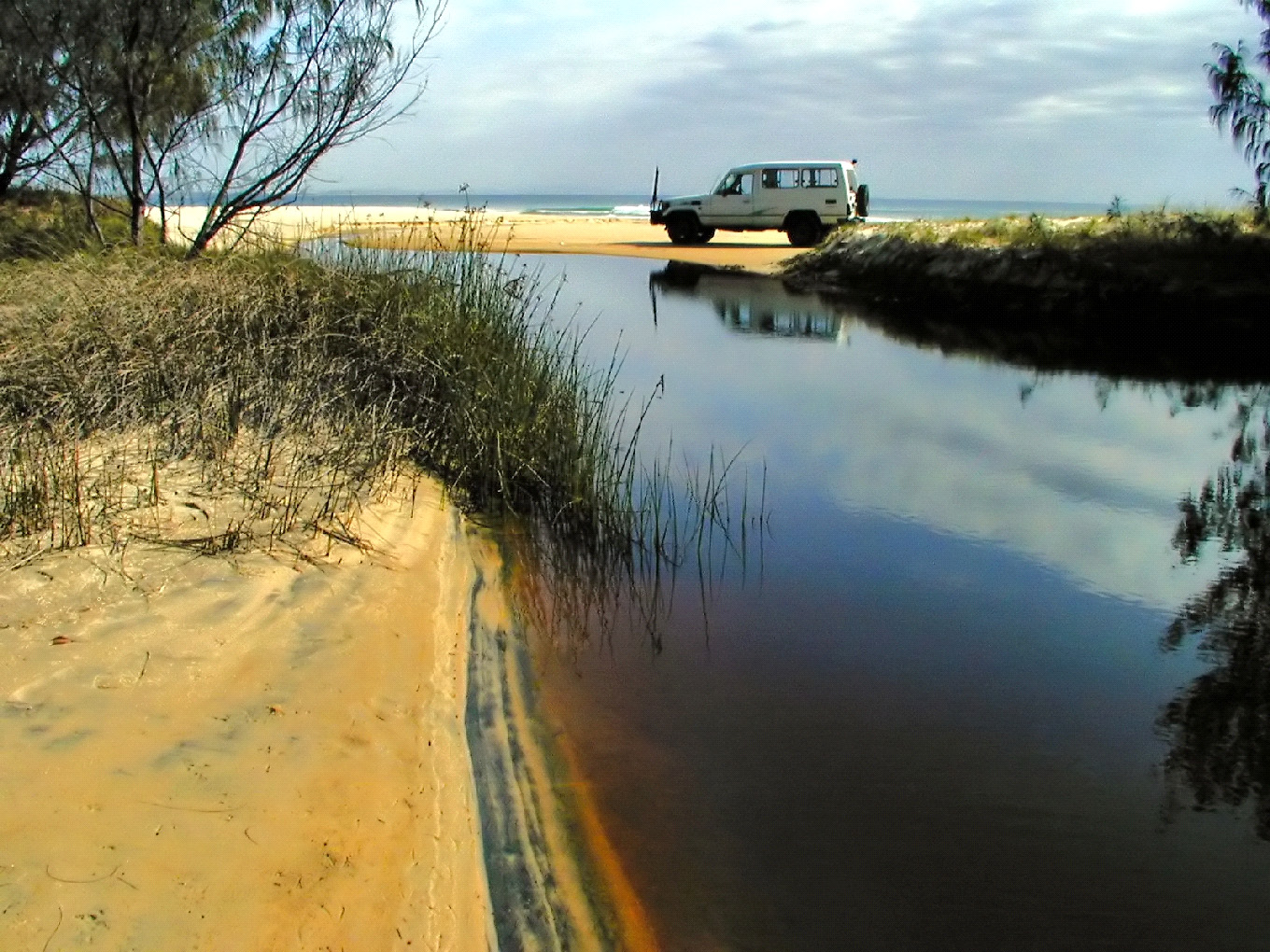
Australia still has many pristine freshwater habitats where one can find rainbowfishes. Visiting one of these unpolluted streams, collecting a new species for your aquarium, or just studying the aquatic flora and fauna, I’m sure, is the dream of every rainbowfish enthusiast. As well as major and minor rivers, the coastal plains are threaded by innumerable smaller streams, lagoons and swamps. These areas contain different species of fish, crustaceans, plants and many other forms of aquatic life. Within each of these environments there are different habitats that influence the fish species composition. There can also be large seasonal changes in the composition and abundance of fish communities at different times of the year.
This raises the issue of deciding on when is the most appropriate time to collect. It is advisable to schedule your collecting when fish abundance and diversity is known to be highest. Avoid collecting at times when conditions are out of the ordinary, like during drought or flood periods. Safety is also important when collecting fishes from secluded areas, always have a good quality first aid kit and wear suitable footwear when collecting in water.
Rainbowfishes have strong associations with certain habitats. The major habitat features influencing rainbowfish distribution are temperature, water quality, depth, current and density of aquatic vegetation. Therefore, the collecting should include a range of habitats present at a site. In deep pools of streams this would include the deep open water zone and the margins, both shallow and deep, with associated vegetation, woody debris and rocky substrates. In flowing streams shallow riffles and runs should be sampled as some species aggregate in the faster currents present in these areas. In lagoons both the open water zone and densely vegetated littoral zone should be sampled. These habitat features also affect the performance of different collecting equipment and methods. Consequently, different habitats may require collecting by different methods.
Many northern rivers and wetlands in Australia are dry for a large part of the year and need to be visited at an appropriate stage of the wet season when (a) water and fish are present and (b) it is possible to obtain access. Access to riverine sites is very difficult during the wet season due to high flow rates and risk of flooding that can make collecting difficult. Consequently, the end of the wet season is when access becomes possible and declining water levels make collecting easier. Fortunately this is when fish diversity is highest in lowland river habitats making the late-wet or early-dry season the optimal time for collecting from riverine locations. Later in the dry season fish diversity and abundance declines. There is also a peak in fish activity in the hour before sunrise and after sunset and some species are likely to be missed if these times are not included.
Government regulations control the collection of certain aquatic animals and plant species with regulations varying considerably from State to State. Be sure to check regulations with the local wildlife, fisheries, and/or natural resources departments. In general, a permit will be required to undertake the collection of rainbowfishes from their natural habitat. The collecting permit will probably state the maximum number of fish of any species per location that can be taken as well as the methods used to collect the fishes. In Queensland, most rainbowfish species have a take and possession limit of 20.
Collecting should always conform to an accepted standard of behaviour and guidelines:
- Know State and Federal Government regulations. Federal and (or) State laws govern the collection of endangered or threatened species.
- Before removing animals or plants from their native habitat, prepare a suitable environment for them and be aware of their needs for survival.
- Do not collect any restricted, vulnerable, or endangered species. Special care should be taken in areas where a threatened species of fish has previously been recorded or are predicted to occur.
- Obtain the owner’s written permission to collect on private property.
- Collecting should always be conducted so as to leave the habitat as undisturbed as possible. Put rocks, driftwood, etc. back in the position in which they were found.
- Never take more than you need and do not take all specimens at a site; always leave the majority of the fauna and flora undisturbed.
- Try to keep the handling of the fish to a minimum to reduce the potential for stress and to increase the survival chances of unwanted specimens released back into the water.
- Release unwanted organisms at the collection site (only release organisms into an area from which they originated).
- Treat all animals, collected in a humane and ethical manner.
Equipment
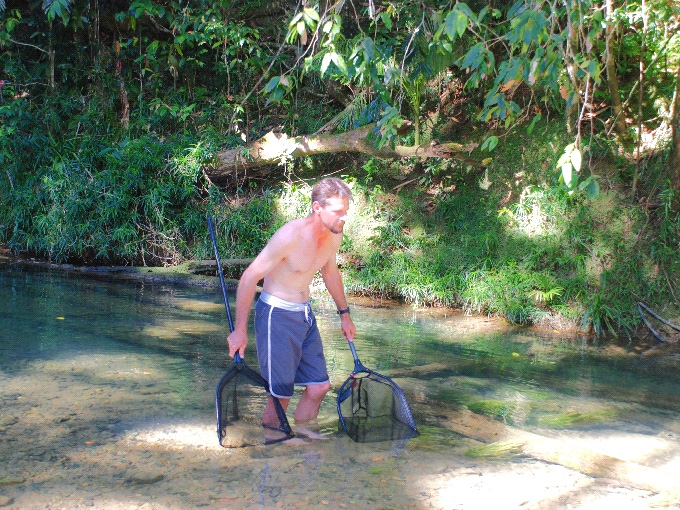
The type of collecting equipment you decide to use will depend largely on the type of habitats you are surveying and your target species. Different equipment is effective under different conditions. For example, when collecting in vegetated or non-vegetated areas, you may need to use different types of equipment. I have a homemade net that consists of a rectangular stainless steel frame about 75 x 45 cm to which some soft plastic insect screen has been affixed. To complete the set-up, a long broom handle is attached to the frame. It can be used either as a long-handled dip net or without the broom handle in the same manner as a hand-held scoop net. However, the following collecting equipment can be used individually or in combination to ensure that a wide range of species can be collected, even though conditions may prevent you from using some types of equipment.
Seine Nets
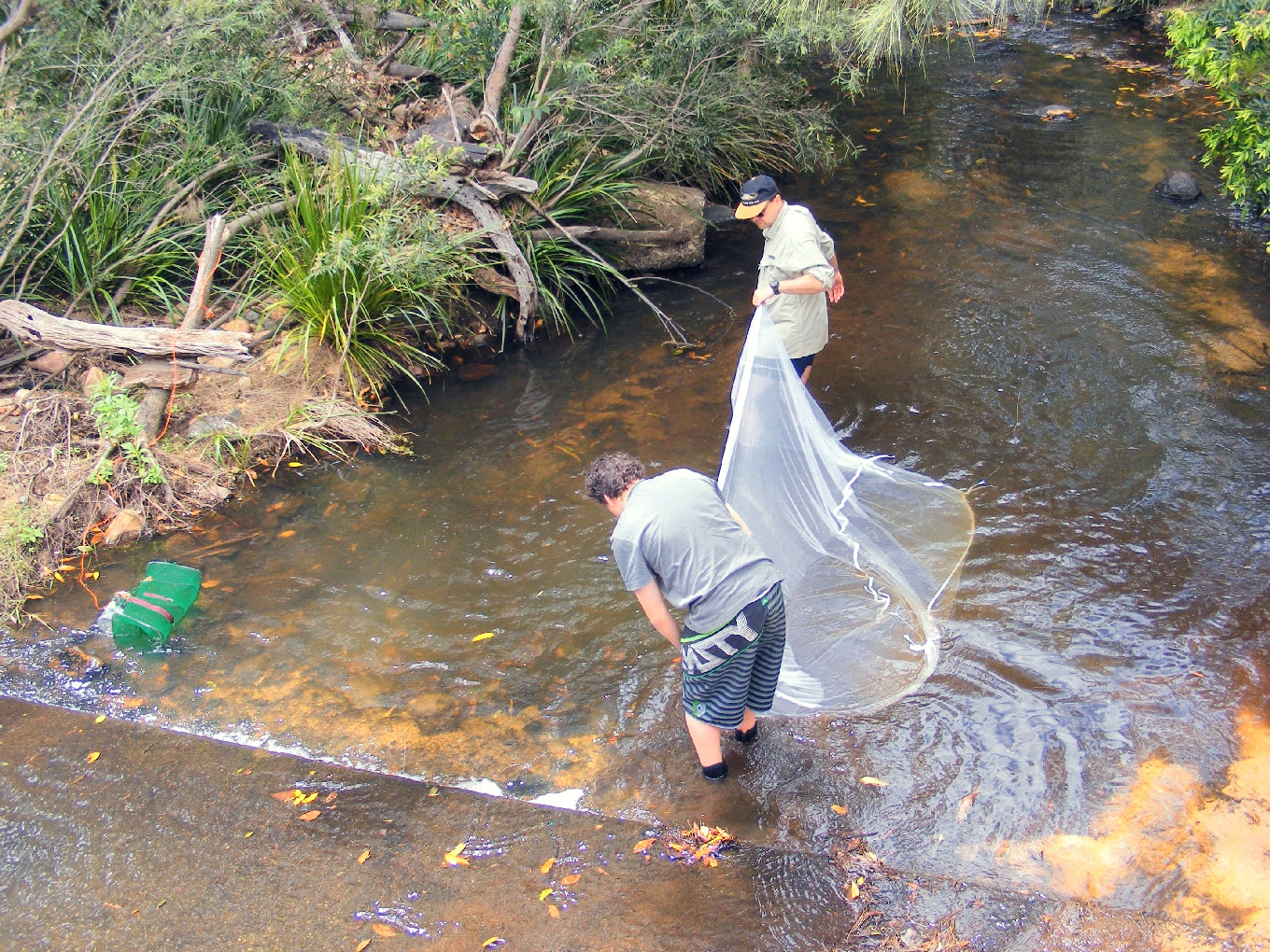
Seine nets are lengths of netting weighted at the bottom and supported by floats at the top which is set to enclose an area and then dragged to the shore. Scientific researches rely heavily on this type of seine in certain freshwater and coastal environments, and have learned that disturbing the bottom in the path of the seine (by shuffling their feet) or adding a weight to the lead line may increase the size and diversity of the catch, especially in streams with rocky bottoms. On larger nets there is often a deep pocket built into the centre for fish to collect in and minimise their escape. Catch is dependent on mesh size but is also biased towards slower fish that are less able to avoid the net. Seine nets are good in habitats that are relatively shallow yet open water about one to two metres deep and along the edge of emergent vegetation. Small mesh seine nets can be used to collect rainbowfishes and other small bodied fish that are more abundant in shallow and bank edge habitats. Seine nets of varying lengths can also be pulled through the water with two or more people or smaller pole seines can be pushed through the water by one person. This technique is ineffective in areas densely covered in submerged plants and logs and can be difficult if used in habitats with extremely soft sediments.
Dip/Scoop Nets
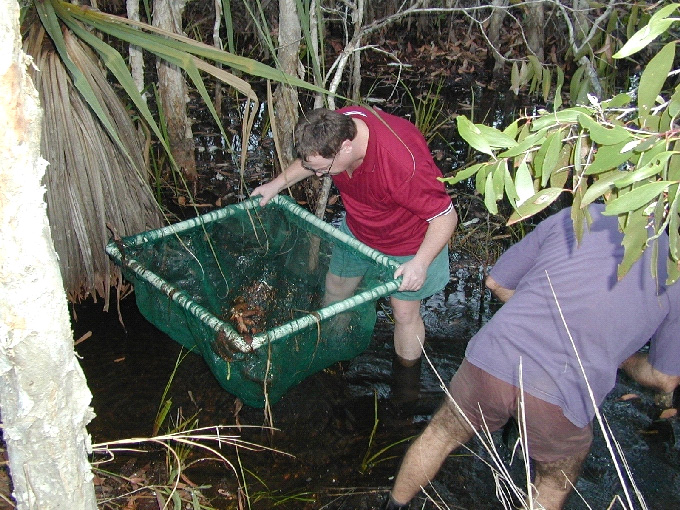
The simplest of all nets, the dip net is also the most versatile, with shapes and sizes that allow use in capturing a wide variety of species. Dip or scoop netting is a useful technique in areas where water is shallow and or contains vegetation, thus making it too difficult to apply other trapping methods. These can be used to net through submerged vegetation, under and near the banks of rivers and streams. Using a mesh size of 5 to 10 mm allows the net to be dipped into and dragged through the water rapidly, increasing the chances of catching fish. Long-handled dip nets may be used from the bank, eliminating the need to enter the water.
Bait (Shrimp) Traps
Small bait traps (40 cm x 20 cm x 20 cm, 3 mm mesh) can be highly selective and variable in effectiveness. These work well for many rainbowfish species. They are very good in shallow littoral habitats. Bait traps may be set in areas difficult to sample by other methods and can be left while other tasks are performed or overnight. Bait the traps with dry dog or cat food and then situate them among overhanging vegetation or amongst submerged logs and vegetation. Baited traps can be set individually, or in a group attached to a set line. Ensure that you flag their location adequately so they can be found easily later. Nearly any container can be baited and used as a trap. Low numbers of fish are caught in bait traps compared to other techniques. Traps need not be baited to successfully capture fish; sometimes fish enter unbaited traps out of curiosity, for companionship (schooling behaviour), or to eat smaller organisms already in the trap. Often unbaited traps catch just as many fish.
Cast Nets
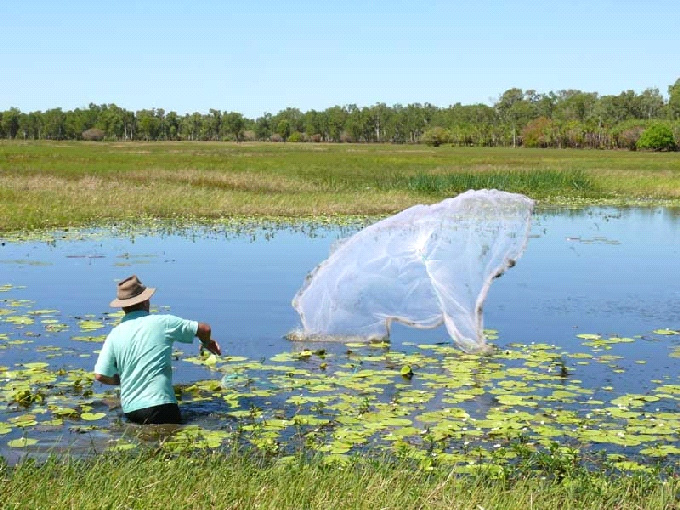
Cast nets are circular nets that are heavily weighted along the perimeter and thrown over fish from shore or boats. The retrieval mechanism pulls the weights into the centre of the net, trapping the enclosed fish. Cast nets are usually fished by a single individual, and typically require practice by the user to make the net take on a flat or umbrella shape when cast. Floating patches of vegetation may harbour fishes that can be collected by covering the vegetation with a circular net, and then sorting through the plant matter or shaking it.
Collecting Procedure
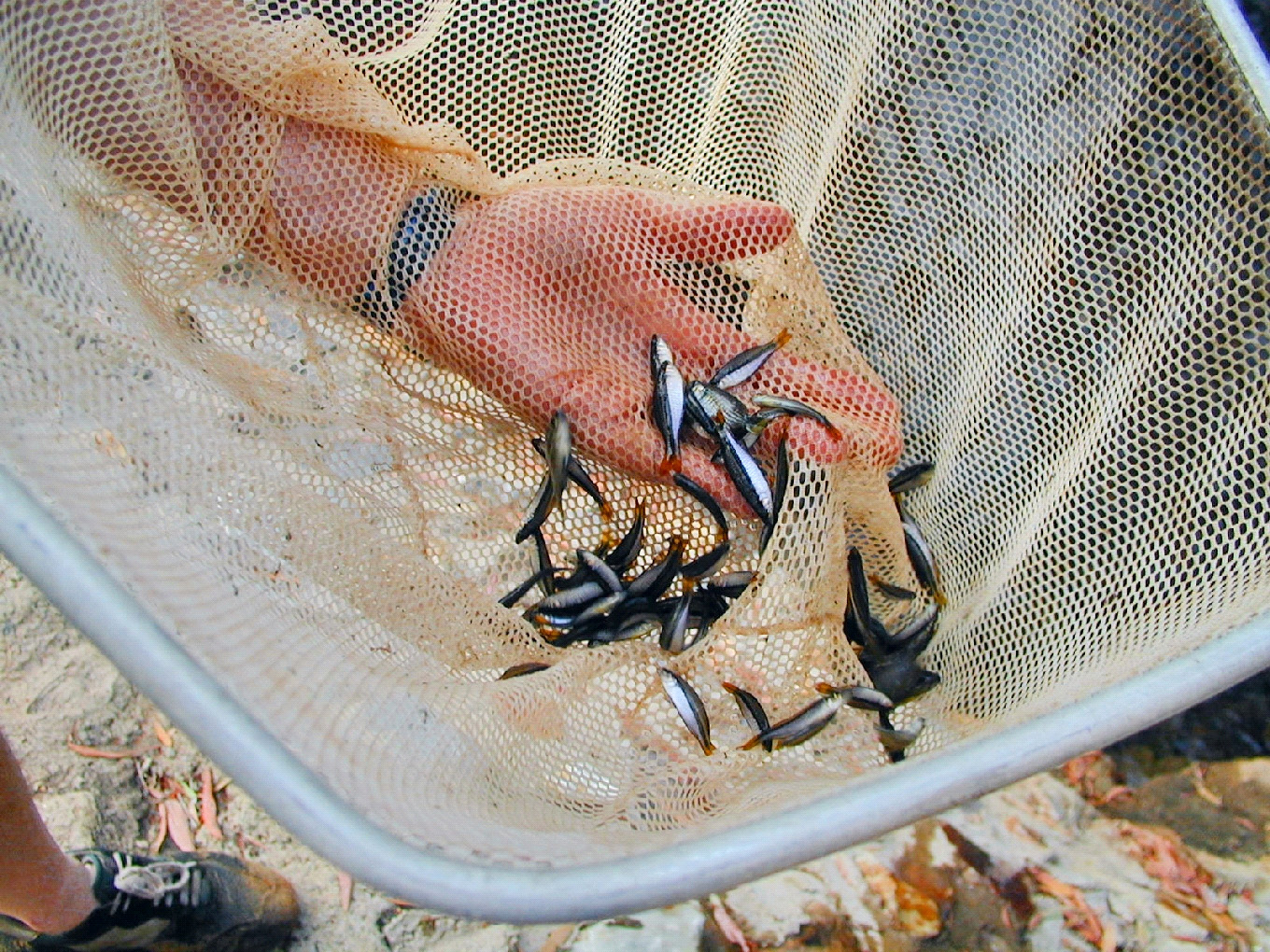
I have found the best way to catch rainbowfishes is with the scoop net technique and bait traps. Choose a spot and go downstream a few metres. Open, reasonably shallow water is best for collecting. Manipulating a net through areas with rocky substrate, abundant aquatic plants or sunken tree branches etc. requires practise and patience. These areas are more suitable for the placement of the bait traps. Wade out and position the scoop net with the bottom edge slightly ahead of you. As you move forward the net will trap whatever is in its path. Move forward walking upstream from deeper to shallower water. When you can see some fish caught in the net, carefully lift the scoop net while keeping the fish submerged. Move to where you have stored the holding containers, and then transfer the fish from the net. Use a small plastic bowl for this purpose and avoid handling the fish by hand if possible. Handling a fish with dry hands or abrasion from a net will remove its protective mucus coat. The use of surgical gloves may enable better handling of active fish, help prevent injury to the fish during collection, and reduce loss of protective mucus, thereby minimising the likelihood of bacterial or other infections in fish following their capture.
Try to keep the handling of the fish to a minimum to reduce the potential for stress and to increase their chances of survival. Research has shown that simply exposing fish to air can be stressful. The point here is that while some handling is unavoidable, it should be kept to a minimum, and fish should not be exposed to air any longer than is absolutely necessary.
If heat and/or accumulated wastes diminish the water quality in the holding containers, partial or complete water changes can be made by using clean water from the habitat, or if necessary, water from a different habitat. Common sense should be used such as shading the holding containers from the sun. If you are collecting in the summer time and its very hot weather, the temperature in the holding containers can rise significantly. The higher the water temperature the faster the metabolic rate and oxygen requirements of the fish contained. At the same time the waters oxygen content will decrease as the temperature rises causing increased stress levels. Therefore, holding them at a cooler temperature will often mean the difference between partial losses and the total loss of specimens. Fish can be held temporarily in insulated coolers or styrofoam containers with aeration and (or) frequently changing the water. Styrofoam allows gas exchange and plastic bags do not, bare boxes will support fishes longer than boxes lined with bags. Aerators are usually not necessary, but when using non-styrofoam containers or containers with little surface area, a D-cell battery powered aerator is helpful.
Accidental death of fish can occur during the collecting process. If this occurs, you could preserve some of the specimens to increase museum records on fish distribution. The preferred way of preserving fish involves storing them in 70% ethanol or 50% isopropanol for processing later. If you have difficulty in obtaining ethanol, preservation in an 80:20 methylated spirits to water mix preserves the fish adequately. If you find new species it is extremely important to get confirmation on their identification. It is also important to check your identifications for accuracy by preserving specimens or keeping photographs of the fish you catch. Most Australian museums can identify specimens if you can provide a well preserved sample.
Good collecting practice always involves the use of detailed field notes. Specific information about seemingly unimportant facts such as the time of day or weather conditions is often important when interpreting data. Take along some test kits to test the water parameters and a camera to record the collecting site and those wonderful memories. Recording of habitat parameters such as temperature, pH, etc., and collecting method is also advisable for later analysis, especially where comparison of different sites is involved. Record this information on a habitat survey datasheet.
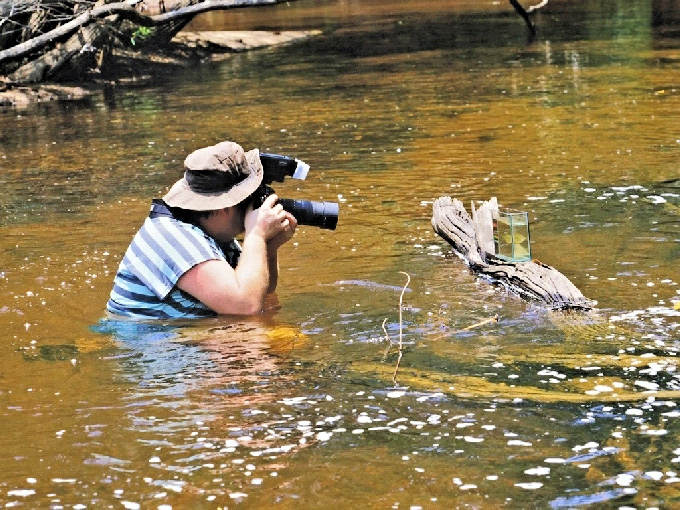
A small glass tank comes in handy also, to be used as an observation or photographic tank. Specimens can be placed in the tank to check for skin damage or disease, and to make identification and photography easier. Colour photographs of each species collected should be taken and documented. Any fish that is unable to be identified, or of any diseased or parasitised fish should also be photographed. Photographic documentation of fish specimens can be an important means of validating field identifications. Each photograph should include an object of scale, such as a ruler, to indicate the relative size of the fish. Collectors also are encouraged to take photographs of the collecting sites. Photographs of habitats have the benefit of documenting localised conditions.
Record the dominant emergent and submergent aquatic plant species, and an approximate percentage of their coverage of the habitat’s surface area. Identify plants to the genus level or to species level if possible. If required, a representative specimen of all unidentifiable plant species may be collected and submitted to a herbarium. Do not leave them out in the sun even briefly as they will wither very quickly and become useless as specimens. Generally, the whole plant should be collected. Some groups cannot be identified to species without mature fruits or flowers. Emergent plants should not be submerged, but kept in a bag with a little water in the bottom to maintain high humidity. It is best to keep each species in its own bag.
Transporting Home
Netting rainbowfishes from their natural habitat and transporting them home often causes them considerable stress. The effects will vary from species to species and from fish to fish. The intensity of the stress created will determine whether the fish lives, dies immediately, or dies later. The most common cause of death among newly caught specimens is over-crowding in the holding or transport containers. Collect only a small number for your own requirements and you will have a much better chance of success.
Fish are coated with a protective layer of slimy mucous that protects them from infection, certain parasites and the effects of water. Any handling of the fish removes this mucilaginous layer and when the animal is returned to water it suffers “waterburn”, which is similar to sunburn that humans experience. Without their protective mucilaginous layer, the fish are prone to infection and disease. Further, minor scratches and wounds as a result of the fish thrashing about when collected may take longer to heal and may be predisposed to infection.
The effects of handling can be reduced by the addition of sodium chloride (salt) to the transport water. Salt will often reduce the effects of stress, osmotic imbalance, and surface damage. Bacterial and parasitic infection can also be reduced by the addition of ordinary salt. The higher the water temperature, the more salt is required, and a salt concentration of 7 grams/litre has been used with success at temperatures of 25°C. A salt concentration of 3 grams/litre was found to be sufficient at lower temperatures of 10°C while 5 grams/litre can be used at intermediate temperature levels. Commercial salt (about 98% NaCl), cooking salt or ordinary table salt can be used for this purpose.
There are a number of water conditioners that are reported to calm the fish, reduce stress, replace lost mucus coating, help regulate salt balance, and fight infections. I have never used any of these additives and some do not list their active ingredients so it is impossible to make any kind of recommendation on their use or efficacy.
Even the clearest and cleanest water is home to bacteria and fungi that can cause primary or secondary infections. Methylene blue and salt can also be used to prevent the proliferation of bacteria during fish transport.
Research has shown that both methylene blue and sodium chloride were effective in reducing bacterial load during transport of fish. Methylene blue is a redox dye which raises the oxygen consumption of cells. This means that the hydrogen to be oxidised is passed on to the oxygen. Each molecule of the dye is oxidised and reduced about 100 times per seconds. Thus, while disinfection results from this, methylene blue is also excellent against methaemoglobin intoxication (methemoglobinemia) during transport. Dosages rates of 2 grams/L sodium chloride and 1 mg/L methylene blue are generally recommended, while 1 grams/L sodium chloride and 3 mg/L methylene blue have also been used.
Antibiotics should not be used in the transport water as there is little evidence to support any benefits. Using a single antibiotic may have no effect, as it may not be effective against the existing bacteria. The mixing of antibiotics is not really desirable either and is not recommended. The most effective way of introducing antibiotics to fish is either by feed or injection and not usually as substances dissolved in water. Bioavailability varies from drug to drug and where absorption through the skin or gills does occur, it can be affected by water chemistry and temperature making the delivery of the drug unpredictable. If a bacterial infection is suspected the fish should not be transported at all. However, many factors affect the survival of fish during transportation and there is no substitute for careful handling and good water quality.
While out collecting, try to collect some natural water from the site to take home. 20 litre buckets with tight fitting lids are perfect for transporting water. The reason for doing this is to provide similar water conditions for the fish when you return home. Try to collect about two-thirds the capacity of the aquarium in which they will be housed on arrival at home.
By far the best method for transporting rainbowfishes home is polyethylene bags packed in styrofoam boxes. With the lid in place, there will be little temperature change to worry about, and the fish will remain restful in the darkness. Clear, clean water for the bags should be collected in buckets before anyone enters the stream and stirs up any sediment. The buckets are placed aside in a shady position until the fishes are ready to be bagged. If you have a battery operated air pump to provide aeration, then all the better, although it is not usually necessary.
The arrival of the fish at home can be the most critical stage of the collecting process. The rainbowfishes will be under some degree of stress and sudden exposure to water of differing characteristics can further stress the fish, often beyond what they can stand. Draining two thirds of the water from the aquarium and refilling it with the water that you bought home can ease the harmful effects of differing water conditions. Carefully place the fish into their new aquarium, which incidentally, should be a quarantine tank. All wild-caught rainbowfishes should be quarantined for at least three weeks. As you do your normal water change routine on the quarantine tank, you will slowly replace the stream water with your local tap supply. This makes it easier for the newly captured fish to adapt.
The vast majority of problems with wild-caught rainbowfishes having settled into an aquarium can be traced directly or indirectly to poor aquarium management. Good aquarium management is keeping the tank conditions relatively constant. Many well-meaning hobbyists in their quest to duplicate the water conditions of the fish's natural habitat fiddle about with various chemicals and compounds trying to maintain pH and hardness levels. Duplicating the water conditions under which the specimens were collected may seem ideal, but this often causes more problems than it solves.
Consistent Biological Nomenclature
Biological nomenclature used to document fish species collected should follow the “Australian Fish Names Standards” (AS SSA 5300–2007), or the “Codes for Australian Aquatic Biota” of common and scientific names published by the CSIRO Marine and Atmospheric Research Committee. Use of the standardised list of common and scientific names is critical to maintaining consistency and uniformity across Australia. New fish species are occasionally discovered, and systematic studies frequently lead to changes in fish taxonomy and nomenclature. Thus, the most recent edition should be used.
Codes for Australian Aquatic Biota - is a continuously maintained and expanding 8-digit coding system for aquatic organisms in the Australian region maintained by CSIRO Division of Marine and Atmospheric Research. Initially developed to cover fishes and selected other organisms of research or commercial interest, it has more recently been expanded to provide more comprehensive coverage of a number of aquatic groups, as information is available.