

Lernaea
Lernaeosis is a disease of freshwater fishes caused by parasitic copepods of the family Lernaeidae. Lernaeidae is a major family of cyclopoid copepod parasitic groups associated with freshwater fish. Some of them are among the most harmful parasites of fishes. Lernaea species occur on all continents, with the majority being found in Africa. There are about 105 nominal Lernaea species (The World of Copepods 2002) of which only about 37 are thought to be valid. The only cosmopolitan species is Lernaea cyprinacea. Originally, L. cyprinacea was not present in South America or Australia, but was accidentally introduced there with cyprinids. Lernaea cyprinacea has been recorded from a large range of native and cultured fish species across Australia. The effects of floods and droughts can intensify an infestation of Lernaea cyprinacea in native fish communities.
This parasite is easily visible to the naked eye and may be more than two centimetres in length. The parasite invades the skin, usually at the base of a fin. The head, equipped with “antlers” that anchor the parasite in the subdermal tissues of the host fish, earned the parasite its vernacular name of “anchor worm”. Fish will exhibit flashing behaviour at first, although emaciation and weight loss will occur over time with heavy infestation.
The metamorphosis of Lernaea cyprinacea is rather complex, with three nauplii and five copepodid stages. On the host the female anchorworm matures and produces two large egg sacs (2 finger-like projections attached to the end of the body) containing approximately 300–700 eggs. Each egg hatches into nauplius larvae which undergoes several moults through copepodid stages before attaching permanently as females to the fish host. The copepodid larva must find a host and attach itself for further development into freeswimming cyclopid stage.
Mating takes place during this stage, after which the males die and the females penetrate the skin of fish. Settling in the muscle, the parasite transforms into an unsegmented, wormlike form, usually with a portion hanging from the fish’s body. There are no immediate hosts for the species and the free-living larvae parasitise any species of fish, and occasionally tadpoles.
Lernaea have a direct life cycle lasting about 100 days at 14° C, 20 days at 24°C and 7-14 days at 28°C. It is generally a warm water parasite. However, young females (both attached and free-living larval stages) and eggs can survive the winter. This parasite is absent or rare in waters with pH below 7.0 and salinity above 1.8%.
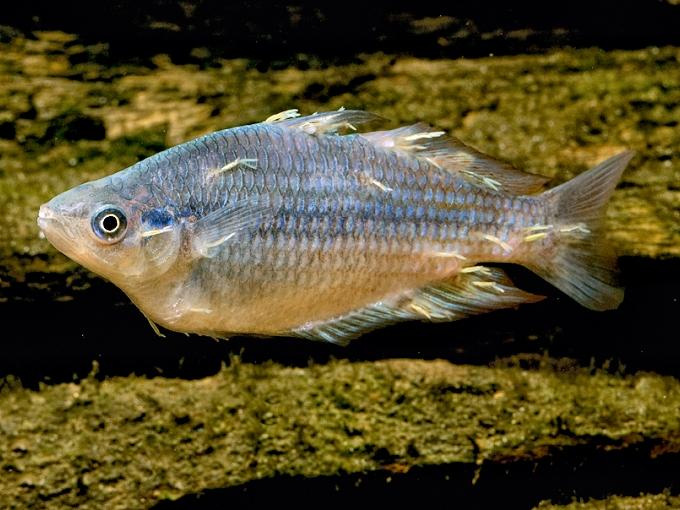
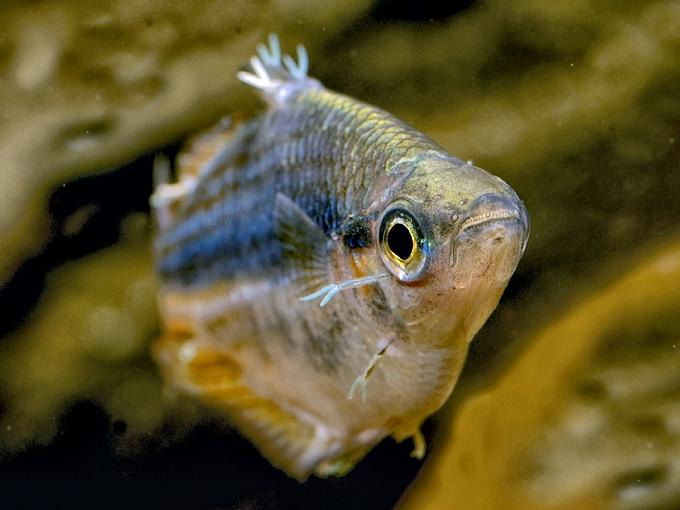
Most infested fishes contain a single parasite attached to the base of the fins or to the general body surface. The parasite seems to have an affinity for the heart region of small fish and kills them by piercing the heart or other vital organs. The destructive activity of anchor worm infection is due to its relatively large size and its mode of attachment and feeding. When it penetrates the skin of the host, deep ulcers, abscesses or fistulas are formed at the point of attachment. The margins of the ulcer are bright red or greyish in colour. The inflammation at the point of penetration results in the formation of parasitic fibrous nodules. Secondary infections may include anaemia, retarded growth, loss of weight and loss of equilibrium.
As the maximum damage to the fish is caused by the adult parasite which remain attached to the host tissue with an anterior holdfast organ and also by the developmental stages that remain attached to the host, any reliable and effective prophylactic measures should aim at killing the free living stages of the parasites at nauplii and copepodid stages before it gets attached to the fish host. Lernaea is very difficult to control due to different stages of life cycle showing different susceptibility to chemicals. It is difficult to eradicate adult parasites as they are very hardy and resistant to most chemicals. Generally, only the free-living larvae are susceptible to treatment. Further the concentration of these chemicals required to kill the developmental stages can be toxic to fish. Temperature dependant development of larval stages and the lethal effects of even low salinity on larval stages etc. can be utilised for the control of fresh infections.
Anchor worms should be carefully removed manually with forceps and the remaining wound treated with an antiseptic such as iodine to prevent any potential secondary bacterial infection. Treatment methods include chitin inhibitors such as lufenuron (0.1–0.2 mg/L prolonged immersion) and diflubenzuron (Dimilin®), trichlorfon 0.25 – 0.5 mg/L active ingredient as an indefinite bath; formalin dips, and potassium permanganate. Potassium permanganate baths at a concentration of 2 ppm for 1-2 hours may kill most of the parasites. They are also very sensitive to salinity. Use a short bath treatment for the infected fish with a 10 g/L salt (NaCl) solution for 60 minutes. A prolonged immersion of 2-3 g/L salt may control re-infection to the fish host. Praziquantel used at 2-3 mg/L has also been reported as effective for control of anchor worm and has a wide margin of safety for fish. It can be used as a short-term bath treatment at a concentration of 10 mg/L for 3 hours. Change 50-75% of the water in between the chemical treatments. It may be necessary to treat once a week for four weeks to eliminate this parasite. Diflubenzuron is available as the active ingredient in some proprietary parasite treatments. Care should be taken when using a chitin inhibitor that nontarget invertebrate species such as shrimps, etc., may also be affected.