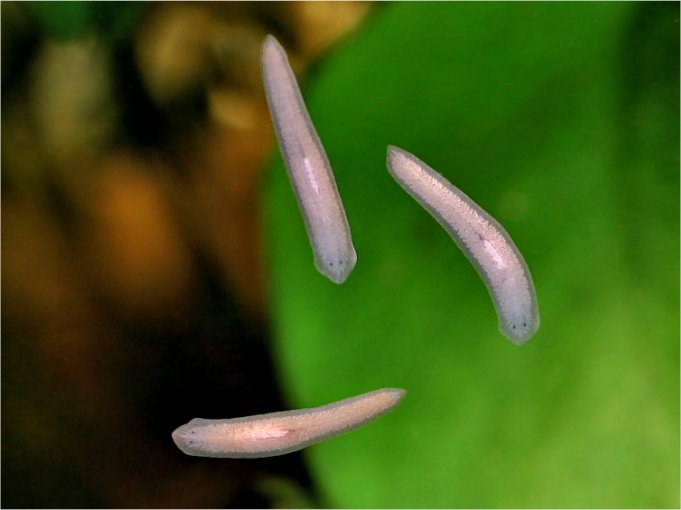

Planaria
Planaria are a free-living flatworm found in almost every kind of environment, on land and in fresh and salt water. They are a very small black or brown flatworm that look very similar to leeches and often appear in freshwater aquariums. They are generally around 3 to 5 mm long, but some grow as large as 10 mm. In a normal aquarium situation they usually don’t cause any problems and probably even go unnoticed. However, if you get them in a breeding aquarium, they can destroy a whole spawning of eggs within hours. They are usually seen crawling around on the front of the aquarium after the lights have been turned off. They feed on anything organic but can also infect the mucous membranes of the fish’s gills.
Planaria belong to the Phylum Platyhelminthes, Class Turbellaria, and Order Tricladida. The genus Planaria, has apparently has been replaced by an older name, Dugesia. Planaria come in a number of species and strains, some of which are albino. The following species have been reported from freshwaters, Dugesia tigrina, Dugesia dorotocephala, and Dugesia tigra. Dugesia notogaea has been recorded from northern Queensland.
They are carnivores and feed by sucking food through a tube called the pharynx located on the mid-ventral surface that opens into a blind gut, or gastrovascular cavity. Excretion is via protonephridia. Planarians have two protonephridia composed of branched tubules that empty wastes through excretory pores on their surface. The protonephridia contain numerous bulblike flame cells with clustered, beating cilia that propel fluid into the tubules. These structures function in waste excretion and osmotic regulation. The body is cylindrical in the small species, dorsoventrally flattened in the large ones. The epidermis is ciliated. There is no blood vascular system and transport is via diffusion, a mechanism made possible by the small body size and/or flattening. Food is delivered to the tissues by the gastrovascular cavity. Oxygen diffuses across the body surface to the tissues, none of which are more than 1 mm from it. The nervous system consists of a brain and longitudinal nerve cords. There may be light-sensitive ocelli in various positions on the body.
Planaria typically reproduces asexually by architomy. This is a type of fission is which the worm divides into two fragments without any prior differentiation of new parts. A transverse cleavage just posterior to the pharynx divides the worm into an anterior, nearly normal, worm with head, mouth, pharynxm and most of the gut, and an incomplete, headless posterior mass of tissues, which must produce the missing parts. The posterior portion remains immobile until it replaces most of the missing structures whereas the anterior end behaves normally and moves about.
Planaria are also able to reproduce by regeneration, producing an entire new worm from a piece that has been cut off. If the head is split, both halves will grow back the other half. Movement may be accomplished either by muscular contractions of the body wall or the use of cilia along the ventral surface. When using the cilia the planarian appears to be gliding across the surface.
Spawning mops are commonly used by hobbyists for breeding many rainbowfish species. However, before using them in different breeding tanks, it is advisable to always sterilise the mops to kill any planaria, or other pests that may be present. This can easily be accomplished by washing them in boiling water. Another method is to soak them in a chlorine solution, then thoroughly rinsing them before being sun-dried. This is where spawning mops offer a significant advantage over live plants as a spawning medium.
Treatment Flubendazole is a veterinary drug and can be found under a number of synonyms: Fluvermal; Flubenol; Flumoxal and Flumoxane. Flubendazole 5% is very effective in killing planaria and is very safe to use with small rainbowfish fry used at 1–2 mg/L. I have used both these products with rainbowfish fry only 10 days old, without any problems. Pre-dissolve the flubendazole 5% in a container with some aquarium water, and then pour it in the aquarium. After 5–7 days, following treatment, do a 50% waterchange.
Flubendazole is a “wettable powder” and as such does not completely dissolve. It may leave a white residue in the aquarium, but this can easily be removed with following waterchanges. Remove any deposit of white powder left on the aquarium walls with a sponge and siphoning the bottom with a gravel siphon. I did not have any problems with the residue and it also had no effects on brine shrimp nauplii when fed to the fry. However, these chemicals can be very toxic to snails.
Flubendazole (15%) is specifically designed and developed for aquarium use. This medication will kill flukes, camallanus worms, tapeworms, anchor worms and other helminthics commonly found in tropical and coldwater fish. One should follow the manufacturer’s instructions for treatment, as different manufacturers use different concentrations of the active ingredient.
If you are unable to obtain Flubendazole there are a number of other products that have been reported to have similar effects on planaria. Panacur (fenbendazole) has also been reported as an effective control for planaria used at 2 mg/L. This chemical is available in various formulations and trade names. Praziquantel is another chemical that is very effective for control of planaria used at 1–2 mg/L, while having a wide margin of safety for fish. It is available as an aquarium formulation under a number of brand names. However, before using any of these products consult a veterinarian.
A proprietary product called Dactycid® is also very effective, use according to manufacturer recommendations.