
Tropical Rivers
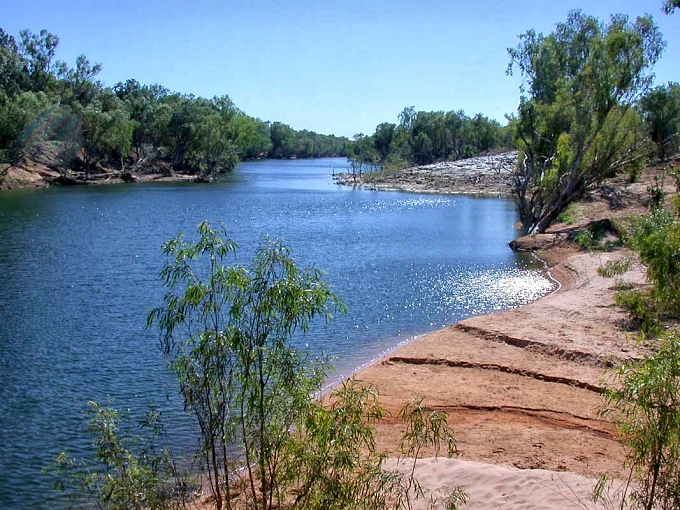
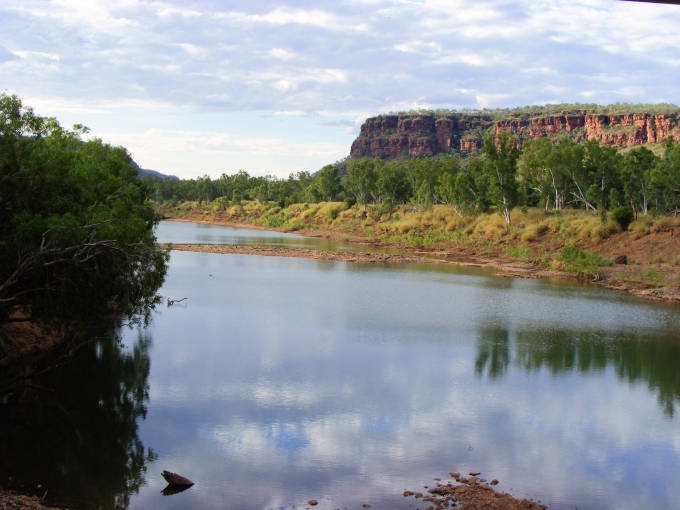
Freshwater river systems in northern Australia are considered to be the most biologically diverse and healthy aquatic ecosystems in Australia today. These systems are dominated by monsoonal rainfall patterns and consequently have the most seasonally-restricted discharges in the country. More than half the annual flow occurs within just a three-month period, followed by a relatively long period of little or no flow. The marked seasonality of rainfall and subsequent discharge drives massive changes in the extent of river and wetland habitats; often leaving floodplains inundated for several months each year.
The majority of Australia’s tropical river systems are characterised by large catchments, with expansive, seasonally-inundated floodplains. The tropical rivers region includes more than 60 major rivers and hundreds of smaller streams flowing directly into the sea. These extend across all catchments from the Fitzroy River near Broome in Western Australia to the Fitzroy River near Rockhampton in Queensland. It includes some of Australia’s largest river systems, which are (by area size) the Flinders, Roper, Victoria and Fitzroy Rivers and (by volume) the Nicholson and Mitchell Rivers. Combined, these rivers and their tributaries extend over 1.3 million kilometres and the discharge from these rivers represents ~70% of the continent’s freshwater run-off, which is highly seasonal in almost all catchments.
In tropical rivers, one of the most important temporal phenomena affecting fish is seasonality of the flow regime. The duration and magnitude of elevated flows determine the availability of various habitat types, by regulating lateral and longitudinal connectivity, influencing local hydrology and geomorphology, removing instream vegetation, and affecting water quality. After the first flush of water in the wet season, surface waters in the region generally have very low levels of dissolved solids reflecting the highly leached land surface of the region (Conductivity 5–20 µS/cm). The waters are slightly acidic (pH 5.2) with a very low buffering capacity and generally very clear with low levels of suspended solids (5–60 mg/L). The soft, acidic water probably contributes to a low diversity of molluscs in the region. With each flood event, there is a further general decline in the concentration of solutes.
Most of the surface water at this time is derived from surface runoff (or direct precipitation on parts of the floodplain) rather than ground water. Consequently, the proportions of major ions of surface waters closely resemble that of local rainwater.
During the dry season the water chemistry changes and the pattern of change varies with different kinds of waterbodies. The spring-fed permanent headwaters and the deep channel billabongs change very little over the year. On the other hand, the standing waters of the shallower floodplain billabongs and backflow billabongs of the lowlands evaporate to some extent and concentrate their dissolved salts steadily during the season. In some billabongs the addition of ground water from seepage may cause the solutes to increase ten-fold or more. As the waters concentrate there is a steady progression towards the composition of seawater. In some billabongs there is a sudden marked rise in conductivity at the end of the dry season; pH also rises slightly over the dry.
When flow begins early in the wet season the composition of the first flush water depends on the manner in which it arises. When the downstream progression is at a steady pace the advancing water may develop a front with high solute concentrations leached from the soils over which it passes and the pH may also be quite low (3.5–4.5). Consequently, when this mixes with the water in the billabongs, the water quality for the biota may be very unfavourable for a time until it is diluted by following, more dilute, waters.
In some floodplain areas with jarosite soils, oxidation of sulphide to sulphate occurs after the soil becomes wet again after drying out during the dry season and allowing aeration of the soil. This causes very acidic conditions in the soil and water allowing aluminium to dissolve. High levels of aluminium and sulphate can then be leached from the soil by the slowly advancing water and transported to billabongs. When this happens the water is potentially toxic to fish and massive fish kills may occur.
These fish kills are invariably associated with very low oxygen levels in the water which is probably also caused by the influx of organic matter with the new water. Fish kills can also occur at this time solely from oxygen depletion resulting from influx of organic matter with storm events. When, as often happens, the first flush occurs as a large flood with rapid progression across the floodplain, there is less potential for these harmful conditions to arise.
With the exception of an initial short-lived pulse of algal production at the start of the wet, during the wet the combination of low nutrients and flushing flows prevents development of large populations of phytoplankton. As flows cease and the dry season commences, nutrient levels rise (from about June). Primary production consequently increases until water levels drop enough to allow wind induced resuspension of fine sediments. In some billabongs, this results in a high turbidity from tripton (non-living suspended fine particles) which in turn reduces the amount of light penetration and primary production.
In seasonal water bodies growth and production of submerged and emergent aquatic macrophytes begins in the early wet season each year when dry ground becomes saturated by rain or floodwater. Maximum biomass of the dominant grasses occurs in the late wet–early dry season. With the senescence of these plants there is a large increase in decomposing detritus. In some billabongs this decomposition results in the water becoming anoxic for a period and this can also be a cause of fish kills.
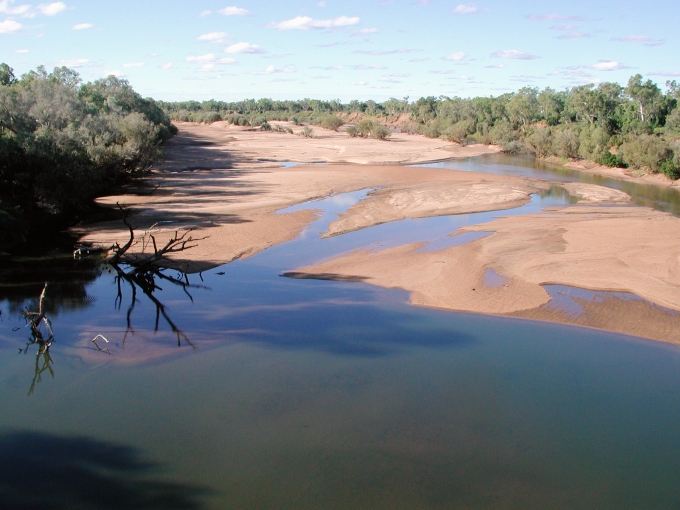
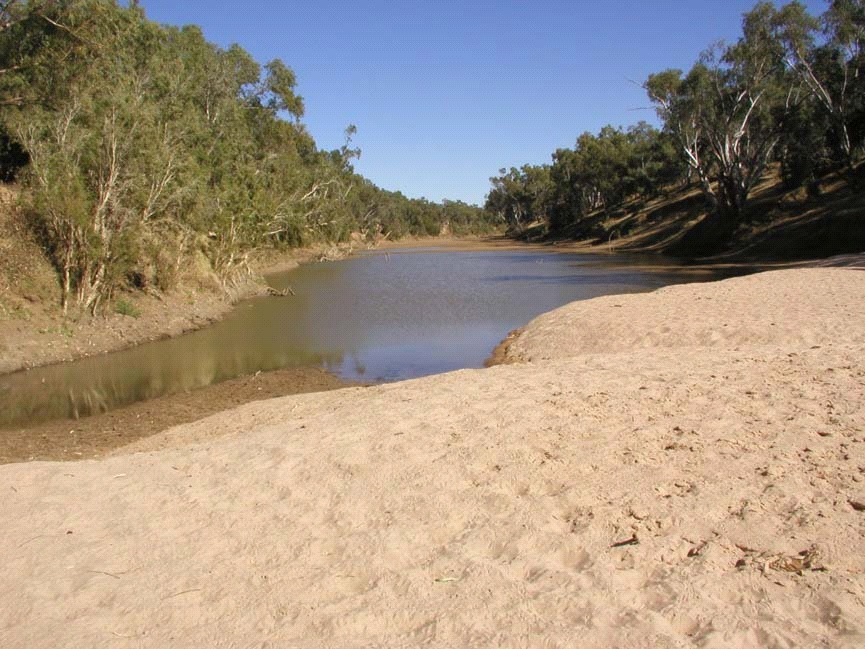
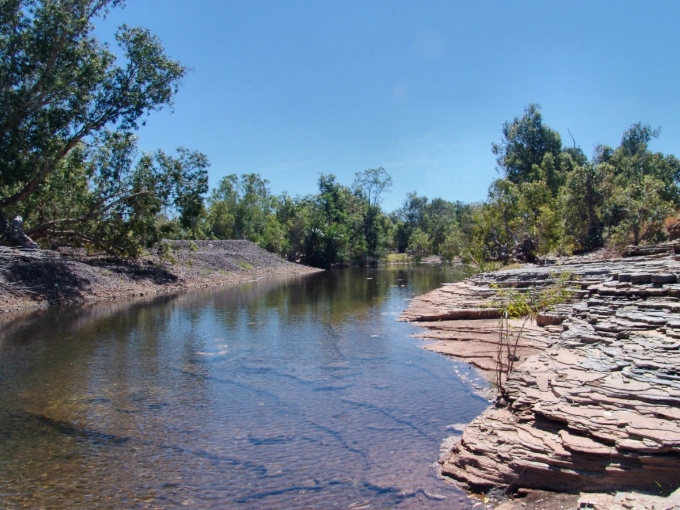
Surface water temperature averages around 30°C but may range from 25°C to 38°C depending on location and time of year. Highest temperatures are recorded late in the dry season. Thermal depth gradients are typically absent during the wet season but frequently develop during the dry. There is some diurnal variation in this gradient as surface waters cool at night. However, even small temperature differences of 1–2°C may be sufficient for stratification to occur and this can cause deoxygenation of deeper waters. This happens in many billabongs.
Dissolved oxygen levels are generally at their lowest levels at dawn after a night of steady oxygen consumption by respiration by the aquatic community and before any photosynthesis have occurred to produce more oxygen in the water. Oxygen levels typically then begins to rise soon after sunrise and reach maximum levels around mid afternoon. There are not much data on the frequency with which total oxygen depletion occurs by this process, but it has been observed on a number of occasions. Whenever this occurs many fish species can be seen gulping at the water surface flushing their gills with the oxygenated surface film of water. The effect of these short periods of anoxia on fish has not been examined in detail.
Fish can recover from short periods of this stress but more frequent and prolonged periods may have more harmful effects. Fish have been observed to jump out of the water and strand themselves on fringing vegetation in response to this oxygen depletion.
Rivers in the wet tropics region of Queensland are the exception to this general trend. Here, ‘dry’ season base flows are maintained at relatively high levels by orographic rainfall on high peaks in catchment headwaters. Freshwater fish diversity is high in the region: at least 103 native species, representing 37 families, are known to occur in the area. These species account for approximately 45% of the continent’s freshwater fish species, 70% of the genera and 70% of the families.
Species assemblages are quite consistent across catchments, with each river featuring upstream reductions in species richness caused by the presence of natural barriers to upstream fish movements. There are a greater number of river systems in Queensland than in any other Australian State and run-off from these rivers accounts for more than 45 percent of the total discharge from all Australian rivers.