
Drosophila
Drosophila are small flies about 3-mm long, of the kind that accumulates around spoiled fruit. They are cultured in public Aquariums and Zoos around the world and are one of the most popular feeder insects for a variety of captive amphibians, reptiles, and fishes. The adult flies and their larvae can provide rainbowfishes with an excellent variation to their diet and supply natural vitamins and fatty acids they otherwise may not get in large enough quantities.
Drosophila melanogaster is one of the better-known species and is cultured in laboratories around the world. It is used extensively in biological research, particularly genetics and developmental biology. Intensive biological research into Drosophila melanogaster isolated a genetic mutation that only had rudimentary wings and could not fly; the mutation bred true and was further selectively bred so that a totally wingless variant was established.
The reproduction time for Drosophila melanogaster is rather quick and small cultures can yield large amounts of flies. Another species (Drosophila hydeii) is also cultured. Drosophila hydeii is 1.5–2 times larger than Drosophila melanogaster with red eyes and full wings, but their wing muscles are genetically impaired. Both species are prolific breeders, producing hundreds of offspring during their life period. Neither species can fly but they hop, climb, and attempt to fly.
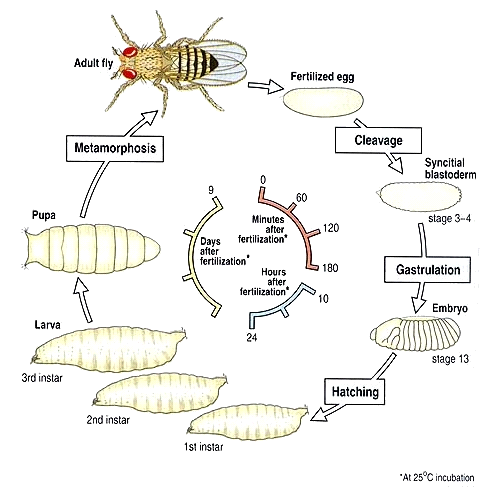
Drosophila melanogaster has a shorter life cycle (14–15 days) than Drosophila hydeii (approx. 25 days). Female Drosophila lay an egg about half a millimetre long. It takes about one day after fertilisation for the embryo to develop and hatch into a worm-like larva which can be seen in the medium or on the inside of the culture jar.
The larva eats and grows continuously, moulting on day one, day two, and day four after hatching (first, second and third instars). After two days as a third instar larva, it moults one more time to form an immobile pupa. Over the next four days, the body is completely transformed to give the adult winged form, which then hatches from the pupal case and is fertile after another day. From laying the eggs, hatching, and the larva emerging and pupating can take six to ten days dependent on temperature. The pupae require another six days before the adult fly emerges and the females lay eggs and the cycle begins again. The flies can live from 20 to 30 days and the female will continue to lay eggs until she dies.
Culturing Drosophila is remarkably simple, but make sure that you obtain a culture of the wingless variety. Fly generations will usually breed true as long as no winged (wild) fruit flies infiltrate your cultures.
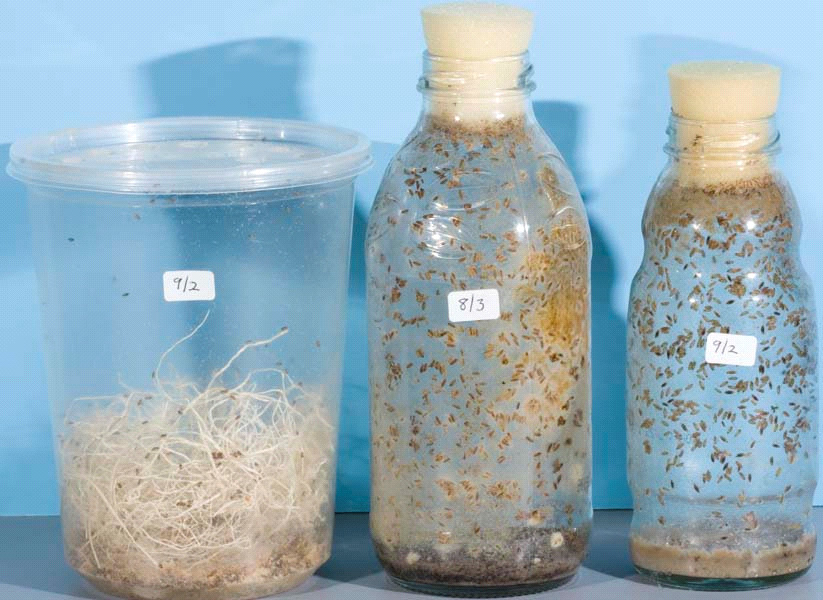
The normal method of raising the flies is to place a layer of medium on the bottom of a wide necked jar. Add 10–20 flies (females have a black band on the abdomen, which is slightly pointed), sit back and await the results.
Suitable containers for culturing include commercial fruit fly vials or flasks, open-mouth glass jars, and other small bottles (glass is better than plastic). The jars must be very clean, preferably sterile, or you could end up culturing a host of moulds, instead of fruit flies. The jars can be washed and then sterilised in a microwave oven. Cover the tops with a piece of paper towelling or fine mesh netting held in place by a rubber band. Small glass jars with plastic lids are very suitable. A small opening can be cut out of the plastic lid and covered by a piece of netting or fine mesh either glued or held in place with tape. This provides ventilation and prevents regular fruit flies access to the culture as they will breed with the wingless variety and ruin the culture.
Maintain the cultures at between 20 to 30ºC. The optimum temperature for good reproduction without accelerating mould growth is 24–25°C, below 20°C; development takes twice as long. Many culturists suggest placing some sort of stiff plastic screen in the jar to give the flies a dry area to sit on and as a surface for the larvae to pupate on. The additional surface area not only provides somewhere for the flies to roost but also increases the quantity of flies considerably. However, supplying a roost is not entirely necessary as the adults and larvae will just use the sides of the jar.
As soon as the larvae are seen in the medium or climbing the sides you can feed the adult flies to your fishes. When adult flies hatch from the pupae, allow a day or two for them to lay eggs and use the first hatch to start new cultures. Once you have your new cultures set up the flies can be fed to your fish. Each jar will provide flies for two or three weeks before requiring cleaning and setting up again. Feed the flies to the fish daily from then on, as production will suffer if too many adult flies remain in the culture.
During the warmer months of the year you may get an explosion of larvae, and these can be harvested and fed directly to the fish which relish them. At anytime that you find the Drosophila are breeding at a faster rate than you can use them, it is a good idea to place them in a small plastic bag and freeze them for future use when supplies are less plentiful.
Culture jars are always under attack from unwanted predators. If your container is left open and receives a flying fruit fly that contaminates your existing culture, it becomes the dominant fly and that culture must be destroyed. If your cultures start to contain mites, just isolate those cultures and use the adult fruit flies for food only. Adult fruit flies often carry microscopic mites on their wings, which usually cause them no harm. Mites can, however, attack the eggs and larvae. They can be transmitted from one culture to another if not caught early on.
There is quite a lot of debate among culturists regarding which media is best, and like everything else, what works for some, may not work for others. There are a variety of homemade and commercial media available to use. Special culture mediums are available from biological suppliers or live food dealers. Following are a couple of simple recipes that can get you started. Other recipes are often available from Reptile and Herpetology magazines or books.
Recipe #1: Equal parts banana and apple sauce - mixed to the consistency of baby food, oatmeal is then added until the mixture is stiff enough to stay in the bottom of a culture vessel. Inoculate with a sprinkle of yeast and add flies. It is reported to yield huge numbers of flies, but can have an odour that some culturists find unpleasant.
Recipe #2: Mix one tablespoon of sugar with one cup of dried instant mashed potatoes, available from any supermarket. Add one inch of this blend to a wide mouth jar. Pour in water to the same level as the potato-sugar. Sprinkle a pinch of dried yeast on the surface of the mash.
There are several methods of harvesting the flies to feed to your fishes. Flies can be tapped directly onto the water surface from an established culture where the culture medium is still stiff. Where there is a risk of shaking out culture medium into the tank then simply place a jar of the same size on top of the culture and shut off the light to the culture jar. Drosophila are phototropic - that is they are attracted by light. To get the flies to leave the culture jar you should remove the jar's cover, place another jar mouth to mouth, above the jar containing the flies, then cover the lower jar completely with a dark cloth or paper to exclude as much light as possible. The flies migrate towards the light and when sufficient flies are in the top jar simply upturn and recap the culture. The flies in the top jar may now be shaken onto the water surface or as some aquarists prefer mixed with a small quantity of aquarium water and poured into the tank.
The body of the fly is soft and floats on the surface of the water, where it can live for several hours until eaten. Most fishes soon become accustomed to eating the flies and will feed voraciously on them floating on the water surface. In fact some species will literally jump out of the water to get at them, particularly Archerfishes. Both the fly larvae which are very good for smaller fishes and the flies can be fed.