
Microalgae Feed Supplements
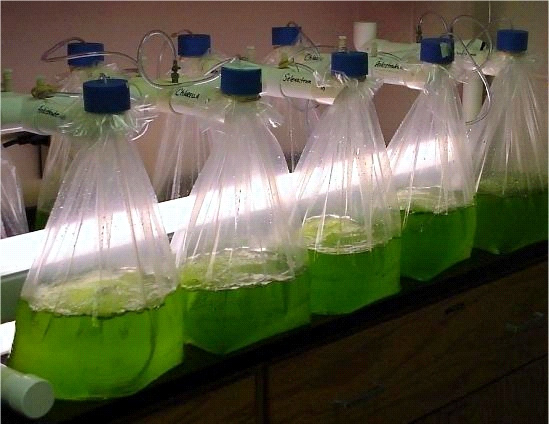
Microalgae are an important food source and feed additive in the commercial rearing of many aquatic animals. Microalgae such as Dunaliella salina, Chlorella spp., Haematococcus pluvialis, Spirulina platensis and Spirulina maxima are used as a source of natural pigments for the culture of prawns, commercial fish species and ornamental fish. The use of algae in aquaculture is not surprising as algae are the natural food source of these animals. Microalgae are furthermore used to produce mass quantities of zooplankton (rotifers, copepods, and brine shrimp) which serve in turn as food for larval and early-juvenile stages of fish.
Although several alternatives for algae exist such as yeasts and microencapsulated feeds, live algae are still the best and the preferred food source. However, all algal species are not equally successful in supporting the growth and survival of rainbowfish larvae. Mixed algal diets promoted faster growth and higher survival than single algal diets.
Other studies have confirmed the feasibility of using dried algae, and Spirulina appears to be the preferred species. Longer-term trials have shown that Spirulina was nutritionally superior to all of the diets tested. Spirulina powder is an excellent source of food for fish and shrimp larvae. In some cases, the addition of relatively small amounts of algae to prepared diets has been observed to result in significant improvements in growth and pigmentation. Thus, microalgae have a clear role in dietary supplements to fulfil specific nutritional requirements.
Rainbowfishes are recognised for their bright, brilliant and beautiful colouration. The body colours of rainbowfishes are predominantly dependent on the presence of special cells located in the dermis of the skin, above or below the scales, called chromatophores. Colour changes result from chromatosomes concentrating in the centre of the chromatophore or dispersing throughout the cell. Iridiophores contain highly reflective guanine crystals. The crystals act as mirrors, which reflect the colours of the outside environment. Iridiophores are often responsible for the bluish or silvery appearance of many fishes.
The colouration of rainbowfishes often fades when maintained under aquarium conditions. Therefore, one of the greatest challenges for the aquarium hobbyist is to accurately replicate the natural colouration of rainbowfishes that are maintained in captivity. Most of the naturally occurring colour pigments are derived from phytoplankton, zooplankton and photosynthetic bacteria consumed in their natural diet, and these are not normally available in captivity, as they are mainly dependent on artificially prepared diets. Colour intensity can also be related to the environment and will often decrease when the fish are stressed, or from the nature of captivity itself.
Keeping and raising rainbowfishes in outdoor ponds with or without supplementary feed will enhance their colour development, most likely due to the natural food items in the pond. Many aquatic food organisms ingest astaxanthincontaining algae and plankton as a major part of their diets.
Carotenoids are the most common natural pigments responsible for many of the bright colours found in fish and crustaceans in their natural environment, as well as a variety of biological functions. More than 650 different naturally occurring carotenoids are known. Carotenoids commonly occurring in freshwater include beta-carotene (orange), lutein (greenish-yellow), astaxanthin (red), tunaxanthin (yellow), doradexanthin (yellow), and zeaxanthin (yelloworange).
The importance of carotenoids in fish diets has been stressed by several researchers working in the field of fish nutrition. Carotenoids are a group of naturally occurring lipid soluble pigments that are produced primarily in phytoplankton. These pigments are responsible for the great diversity of colour seen in nature. While plants and algae can synthesise these pigments, animals are unable to produce them naturally and must obtain them from food.
Rainbowfishes are not able to synthesise carotenoids and depend completely on the presence of the necessary carotenoids in their diet. In many cases, the level of colouration is dependent on an individual’s foraging success. The level of colouration can also indicate their quality as a potential mate. Therefore, rainbowfishes maintained in captivity should be fed a complete diet that includes a colour enhancing agent, such as astaxanthin, to supplement natural feeds that might be limited in captivity. Typical commercial diets used for aquarium fish are very low in total carotenoids.
It has been recommended that feeds containing colour enhancers or pigments such as astaxanthin should be fed to rainbowfishes to bring out their full colouration. Duckweed has high concentrations of carotenoid pigments, particularly beta-carotene and xanthophyll that make duckweed an especially valuable supplement for rainbowfishes.
Feeding Chlorella vulgaris and Spirulina spp. also produces positive pigmentation results in rainbowfishes, and the microalgae Chlorococcum seems to be a promising source of astaxanthin, canthaxanthin and adonixanthin. These algae have strong concentration in particular carotenoid pigments.
It is worth noting that aside from giving an enhanced colouration, microalgae sources could provide better growth performance as has been shown in a number of studies.
Carotenoids are vital nutrients for healthy growth, metabolism, and reproduction. Male rainbowfishes use colouration to produce sexual signals associated with breeding. It is well known that the most highly coloured males have the best chances of finding a mate.
One reason why females are not usually highly coloured is that they need to pass on their carotenoids to their offspring. At the time of sexual maturation, they mobilise stored carotenoids to the ovaries and finally, on to the progeny. This active transfer of carotenoids from the female to the eggs has led to the hypothesis that carotenoids are vital for larval survival and growth.
commercially available synthetic forms of astaxanthin.
astaxanthin into various diets on a continual basis. Some species also had faster growth rates. However, more research is required to establish the optimal level of astaxanthin to use in rainbowfish diets.
Commercially available alga products (e.g., NatuRose®) can be incorporated into their diets. When these alga products are incorporated into the diet at 1~2%, an enhancement of coloration in the treated fish may be noticeable within two weeks. NatuRose algae meal is a natural source of astaxanthin derived from the microalgae, Haematococcus pluvialis. It is a spray-dried, dark red powder, and is currently used worldwide as a coloration and nutrition source for numerous species of animals. The flakes of Haematococcus pluvialis contain the largest concentrations of astaxanthin found in nature (some 40,000 parts per million).
Haematococcus pluvialis is a freshwater alga which normally grows in temporary water bodies. The widespread occurrence of Haematococcus in temporary rather than permanent bodies of water is due, at lease in part; to the fact that such pools are usually free of other competing algae. The astaxanthin is produced in a thick walled resting stage, the aplanospore, whereas maximum growth occurs in the green thin-walled flagellated stage. This necessitates a two-stage culture process, one optimised for biomass production and the other for astaxanthin production.
Commercial production of astaxanthin from the freshwater microalgae H. pluvialis is a growing business worldwide, primarily due to its high astaxanthin content. However, this alga exhibits some unfavourable characteristics like its slow growth rate and complex life cycle, when compared to other microalgae successfully cultivated on a commercial scale like Dunaliella and Spirulina species.
Other commercial ventures for natural astaxanthin production utilise fermentation of the yeast Xanthophyllomyces dendrorhous or extraction of the pigment from by-products of crustacea such as the Antarctic krill (Euphausia superba). In addition to production from natural sources, astaxanthin may be chemically synthesised, and synthetic astaxanthin is the major form currently being used in commercial fish feeds.