
Rotifers
Rotifers are valuable live food for feeding the larvae of most fish species because of their very small size. In addition, rotifers swim slowly and stay suspended in the water column, thus being available for easy capture and consumption by larval rainbowfishes and blue-eyes. They can tolerate temperatures of between 15 and 31°C and pH 6.0–8.0. Rotifers can also be used as a conditioning food to induce smaller adult species, such as Iriatherina werneri, to spawn.
The mouth size of first-feeding larvae usually restricts the size of the food particles which can be ingested. In general, mouth size is correlated with body size, which in turn is influenced by egg diameter and the period of endogenous feeding (i.e., yolk sac consumption period). There are few, if any, published information on the mouth size of rainbowfish larvae. Rainbowfishes larvae typically have a small mouth size and limited yolk reserves and therefore are dependent on the presence of abundant microinvertebrates or algal food at the time of first feeding.
The major difficulty for the aquarist is providing organisms appropriate to the size of the larvae at the first feeding stage and then supplying the large numbers necessary to maintain them.
The preferred size of prey for larval fish increases as mouth size and feeding competency increase and different types of live foods need to be cultured for the different stages in the larval development. For example, different species of microalgae range from 2~100 µm; rotifers from 50~200 µm, copepods from 100 ~ 300 µm and brine shrimp nauplii 400 ~ 800 µm. Apart from these main groups, a few other live feeds are used on a more limited scale including microworm (Panagrellus redivivus), vinegar eels (Turbatrix aceti), and small cladocerans. This group includes many species (Daphnia, Moina etc.). They can reach up to 4–6 mm but typically are much smaller than this; the smallest species is around 250 µm. Larger juveniles and even adults, will feed on these crustaceans.
Most rainbowfish larvae are not particular about the types of live food they will eat, but the animals must be small enough for the larvae to ingest. Rainbowfish larvae are usually small in size (2–5 mm, total length), have poorly developed eyes, do not swim well but are mostly present in the water column, and require easily digested food. Having such tiny mouths, the size of the food is crucial to their surviving the most difficult period in their lives.
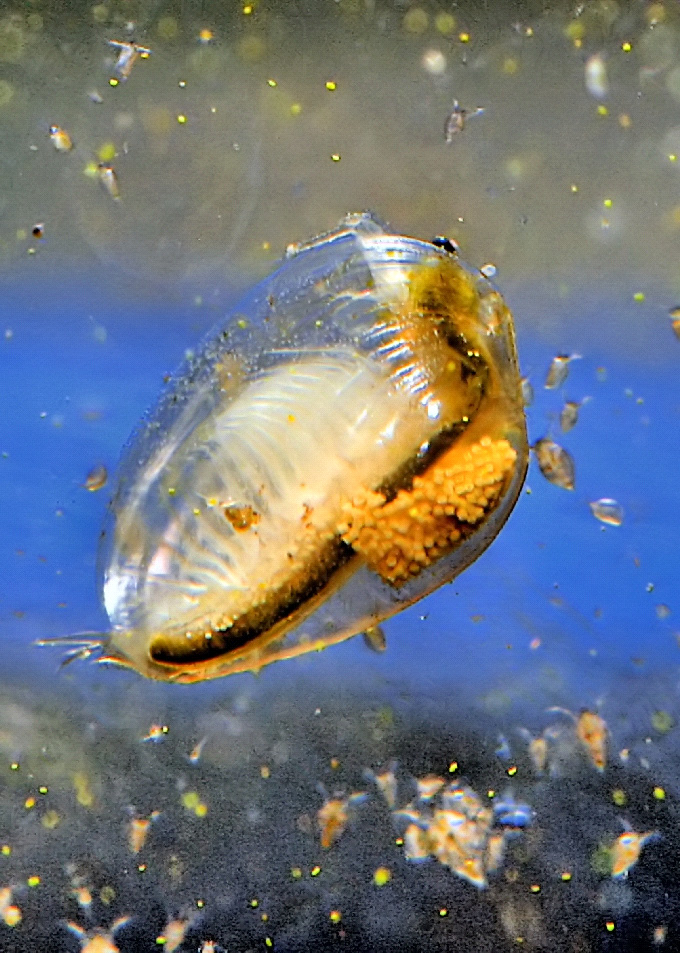
Rotifers are microscopic animals ranging in size from 50~ 2500 µm and found in aquatic habitats worldwide. They inhabit freshwater streams, lakes and ponds, brackish water and, to a lesser extent, salt water but they are predominantly freshwater inhabitants. They can be recognised by the presence of a crown of cilia at the anterior end, which is used for feeding and/or locomotion. However many species spend the majority of their lives attached to a host such as plants, rocks or even other cladocerans. In some forms the beating of the cilia, which are arranged around the edge of one or more disc-shaped lobes, give the appearance of a revolving wheel - hence the name Rotifer from Rota, Latin for wheel.
Rotifers are tremendously varied and the cilia rotifers use for feeding and locomotion can vary enormously. Some species don’t use it for locomotion but have developed very special capturing devices. The genus Collotheca live attached to a substrate and capture bacteria with their elongated cilia. For feeding rainbowfish larvae, the freeswimming kind is the only useful ones.
Rotifers are filter-feeders and feed by moving food particles into the mouth through the action of the coronal cilia. Size of the particles varies, but most are small (<25 µm). Feeding is related to food size and shape and consists mostly of algae. Some species seize and ingest whole prey or puncture the cell or body wall and suck out the contents. Asplancha, the largest rotifer, preys on algae, other rotifers, and small planktonic crustaceans and has the ability to alter its size in response to changes in size of food particles.
Most natural populations of rotifers are composed primarily of females that produce eggs, which are capable of development without fertilisation. This development is called ‘parthenogenesis’ and occurs in other freshwater crustaceans, such as daphnia. Parthenogenetic amictic females are diploid and produce amictic1 eggs that develop further into amictic females. There may be up to 20–40 amictic generations before sexual reproduction occurs. Egg development time is about 1 day under warm optimal conditions, so populations of amictic females can develop rapidly in 2–5 days under good growing conditions. This seems to be the main advantage of asexual reproduction.
As habitat conditions alter, some of the females lay eggs, which are smaller than and differ in other ways from the usual female-producing eggs. Factors that can trigger this are not clear. Stimuli appear to be species-specific and include high population of amictic females, food availability, accumulation of wastes, temperature changes, etc. Research has shown that when populations are fed paramecia, mostly amictic females are found. However, low densities of algae lead to a high proportion of mictic2 females.
If not fertilised, these smaller eggs hatch into males. Males are capable of copulating within an hour of hatching. The males then fertilise the females, after which fertilised eggs are laid. These are distinguished from the parthenogenetic ones by a hard thick shell. These ‘ephippia’ contain embryos in a state of arrested development (diapause) that can withstand drying, freezing, and other unfavourable conditions. They remain in this state and will not complete their development and hatch until favourable conditions return, which may be several years.
Because of the capacity of these eggs to resist drought, rotifers can live in places that are only temporarily wet. As soon as moisture appears they hatch into females and swim about and feed actively. Resting (diapause) eggs always produce parthenogenetic amictic females. Reproduction rates are related to the quality and quantity of food and temperature. Rates are generally lower if food volume is insufficient or of poor quality. Temperature affects the rate of egg development, metabolism, feeding, movement, longevity, as well as reproduction.
Most species are adapted to specific temperatures at which they exist best. Some are stenothermal (tolerate only a narrow range of temperatures) others are eurythermal (tolerate wide range of temperatures). Perennial species commonly exhibit maximum densities in early summer in temperate region. However, some species are seasonal, with some that develop greatest population densities in winter and early spring, and others that reach a peak in summer, often with two or more peaks, especially in late summer and often in conjunction with the development of blue-green algal species.
Culture
Rotifer eggs have been commercially available for a number of years and their use would eliminate the need to maintain culture stocks. Both the saltwater rotifer (Brachionus plicatilis) and the freshwater rotifer (Brachionus calyciflorus) are available commercially and sold as Resting Rotifers® from aquaculture or aquarium suppliers. Resting Rotifers are actually lab-cultured resting eggs, and are ideal for either direct feeding after hatching, or setting up starter cultures. Brachionus plicatilis will survive for several hours after transfer to fresh water, and are comparable to brine shrimp. Brachionus calyciflorus, in contrast to Brachionus plicatilis will stay alive in freshwater and do not sink to the bottom but stay in the water column until eaten. Any excess can be stored in the refrigerator for up to a week.
When placed in a suitable culturing environment, hatching commences over a period of 24 to 36 hours. Rotifers begin reproducing 18 hours after hatching and will continue producing eggs every 4–6 hours if properly maintained and fed. The diet of rotifers most commonly consists of dead or decomposing organic materials, as well as unicellular algae and bacteria. Cultures should be aerated and generally maintained on algae concentrate. Feed with a small amount of green-water from either concentrated algae (e.g., Instant Algae®) or live algae. They can be harvested from 7 to 10 days after hatching with a fine net (50 µm) and fed to the fishes. Keep about a quarter to start a new culture.
Most rotifers are indiscriminate filter feeders and will feed on algae, yeast, bacteria and micro-particles up to approximately 25 µm in size. There are many different methods and adaptations used to mass culture rotifers. In general, rotifer production is based on either (a) a diet of marine microalgae and bakers yeast, or (b) a single diet of commercially produced fortified yeasts. Within each of these feed types, rotifers are cultured using either batch, semicontinuous or continuous methods. In commercial fish hatcheries, rotifers are usually fed bakers yeast (Saccharomyces cerevisiae), or proprietary products as a food source. The amount of baker’s yeast fed on a daily basis is about 1 gram per million rotifers. Although baker’s yeast has a small particle size (5–7 µm) and a high protein content and acceptable as diet for Brachionus calyciflorus, it is not advisable to be used alone for rotifer culture. Rotifers raised on yeast alone often lack the essential fatty acids and vitamins required by larval fish species. Furthermore, rotifer cultures fed only baker’s yeast are characterised by varying success and the occurrence of sudden collapses of cultures. Most probably the reason for these crashes was explained by the poor digestibility of the yeast, which requires the presence of bacteria for digestion. Commercially available diets including Culture Selco, Rotimac, DHA Selco, Protein Selco and Algamac. Ground shrimp meal, flour and rice bran are some other food sources that have been used for the cultivation of rotifers. The food should be run through a 100 µm sieve to obtain a suspended feed suitable for feeding the rotifers.
More rotifers can be produced from the same volume of water with a continuous culture system. However, continuous culture systems suffer from a build-up of waste products in the form of faeces and uneaten food, contributing to contamination problems with filamentous algae and fungal infections. It is imperative that continuous culture systems have some form of bio-filtration or organic waste removal system. The use of bakers yeast causes much of the water quality problems associated with continuous culture systems. It is important to note that feed rates should be based on the actual density of rotifers in the system and care should be taken not to overfeed. The culture container should be clear of algae before the next feeding to avoid excess algae accumulation. Any algae or food that is not consumed within 48 hours will degrade, increasing the level of ammonia and this reduces the dissolved oxygen level in the water. Optimal temperature of culture is usually 20–30° C with a pH of 7.5. To get a bloom, an entirely new culture can be started with a reasonable amount of feed/algae and subsequently harvested when it becomes concentrated with rotifers.
Brachionus plicatilis Brachionus plicatilis is a euryhaline species being found in both brackish and saltwater environments. It is about one third the size of a newly hatched brine shrimp. They have been found in saline lakes in Australia with salinity levels almost twice that of seawater and also at a salinity of less than 1% of seawater. Geographic strains range in size from 90 to 320 µm in length. Hatching rates run at about 80% after 24 to 36 hours when hatched at a salinity level of 20‰ and a temperature of 28°C. Brachionus plicatilis is one of the rotifers which have become very popular for aquaculture. They can reproduce either sexually or as is more common, asexually. This organism is an excellent first feed for larval fish because of its small size and slow swimming speed and habit of staying suspended in the water column, thus being available for capture and consumption by fish larvae. Also they can be cultured in large numbers due to their high reproductive rate. Brachionus calyciflorus Brachionus calyciflorus is the most commonly cultured freshwater rotifer for both freshwater fish species and shrimps. There are several strains of different sizes of this rotifer, thus making them suitable for fry of a variety of sizes. With the increasing developments in larval rearing technology of freshwater fish species, demand for Brachionus calyciflorus is further increasing. Discus larvae are dependent on the body slime of their parents as a nutrient during the first two weeks of exogenous feeding. One study found that Discus larvae could be raised in the absence of the parent fish through feeding with Brachionus calyciflorus for 4 days (Days 4–7), followed by Artemia nauplii for a week (Days 8–14). Their growth and survival rates were comparable with those that rely on parental feeding.
1 Amictic egg: A thin shelled diploid egg which cannot be fertilised. Instead, it develops by parthenogenesis. It is produced by rotifers when living conditions are optimal, and will develop to produce amictic females.
2 Mictic egg: Pertaining to the haploid eggs of rotifers. If it isn't fertilised, the egg develops parthenogenetically into a male; if fertilised, mictic eggs secrete a heavy shell and become dormant, hatching in the spring into amictic females.