
Wonderful Worms
Any number of worm species may be readily cultured or purchased for use as a live food source for your rainbowfishes. All will provide excellent nutrition for your fishes, especially if they have been cultured under clean conditions and fed on a nutritious diet. One can also find different types of worms in streams and ponds all of which are good for rainbowfishes. Nearly all rainbowfishes go into a feeding frenzy when presented with live worms. The smaller they are the better because rainbowfishes do not masticate their food, they swallow it whole, but you can always chop or squash the worms according to the size of your fish. Chopped worms of all kinds make an excellent food for small juveniles and fry. However, although worms can be chopped into pieces so as to be readily swallowed by the smaller rainbowfishes, a whole, small worm will provide more complete nutrition than will a small piece of a larger worm. Therefore, you may wish to purchase worms in various sizes or maintain a live culture at home.
Earthworms
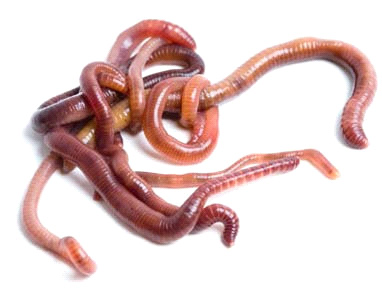
Many aquarists have had excellent results when using earthworms as food for the larger rainbowfishes. They may also be chopped into smaller pieces for feeding the smaller rainbowfishes. Earthworms may be purchased at some pet stores, or ordered in large quantities from commercial suppliers. Earthworms that are purchased and stored for later use do best when kept in a refrigerator. They usually keep for weeks in the refrigerator; simply rinse them off with tap water before feeding. Some people take the extra step of stripping the worms before feeding them to their fish. Worms usually have their stomach filled with dirt or undigested matter; to remove this, hold the worm by the thick end, pinch its body, and slide your hand down its length. The dirt will be pushed out the other end and can then be rinsed off before you feed the worm to your fish. Uneaten earthworms will remain alive in freshwater aquariums for up to eight hours, but they decompose rapidly upon death.
Earthworms can be easily cultured in any suitable container filled with alternating layers of good-quality soil and dead leaves. The earthworms will consume the leaves as well as fish food flakes, or any vegetable matter. Collection of the worms can be simplified by feeding them on the surface of the soil, below a layer of damp burlap.
Blackworms
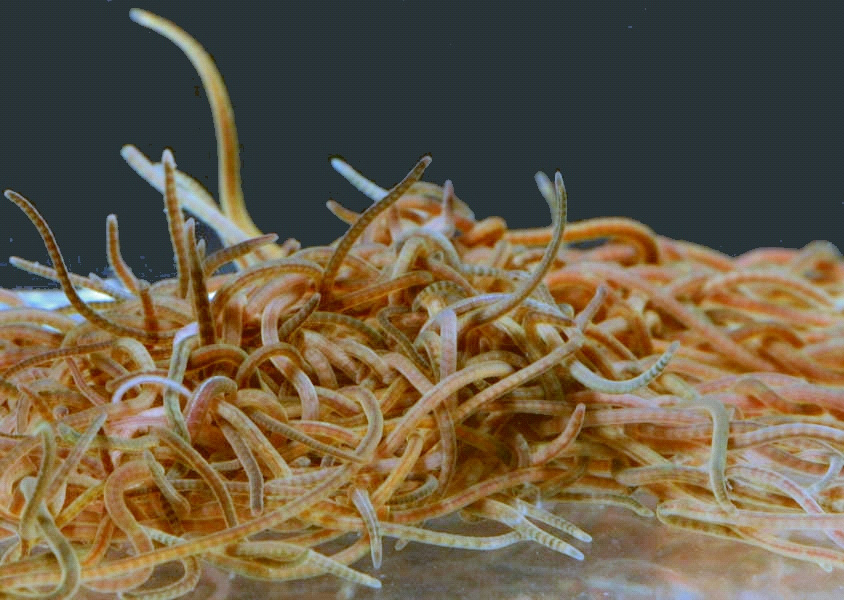
Blackworms (Lumbriculus variegatus) are small, aquatic relatives of earthworms. They are found in sediments and submerged organic debris - especially along the shallow margins - in ponds, marshes, and lakes throughout North America and Europe. This family of some 18 genera and about 170 described species is represented in Australia by only two species: Lumbriculus variegatus are usually small (4–6 cm in length), green anteriorly with the remainder red to black and Stylodrilus heringianus, (3–4 cm in length), and pale to white in colour. It is very likely that both these species have been introduced in modern times. Lumbriculus variegatus is commonly cultured and sold in Australia as a live food for aquarium fishes. Although, some blackworms sold in aquarium stores in Australia are actually Limnodrilus udekemianus, a species of tubifex. Blackworms are readily accepted by all rainbowfishes.
Lumbriculus variegatus is often readily identifiable in the field by its vigorous thrashing when handled and the greenish-brown anterior end and reddish posterior end, the latter due to the branched blood vessels in each posterior segment. This species is commonly found in disturbed habitats and is particularly common near urban centres or in catchments associated with major cities and towns of eastern and southern Australia. Stylodrilus heringianus, with its pair of permanently exposed penes on mature specimens, is distinctive but less common.
Blackworms will live well in freshwater aquariums, where they burrow into the substrate and provide foraging opportunities for bottom dwellers such as catfish and even rainbowfishes. It is possible that they will develop their own self-sustaining population. At normal aquarium temperature populations can double in about 3–4 weeks or less. The worms are also excellent scavengers, burrowing under rocks and deep into the substrate to consume uneaten food and wastes.
Tubifex Worms
The type species of this family, Tubifex tubifex was one of the first aquatic oligochaetes described and is well known to aquarists as an excellent live food. It is cosmopolitan in distribution, as are several of these species in Australia. The Australian tubificid fauna appears to have biogeographic affinities with northern hemisphere tubificids. The Australian fauna is relatively small, with only about 29 described freshwater species. Tubifex tubifex has been the subject of intensive research because of its role as the intermediate host of the myxozoan parasite (Myxobolus cerebralis) that causes whirling disease in salmonid fish. The presence of this species in Australia is thus of interest to the aquaculture industry, although the parasite itself has not yet been recorded here.
Freshwater tubificids are often called sludge worms for the propensity of some widespread species, such as Limnodrilus hoffmeisteri, to occur in organically polluted waters, even sewage sludge. This has sometimes led to all tubificids being labelled as ‘pollution tolerant’ whereas in fact many species are sensitive to organic enrichment and tubificids show a wide range of sensitivities to other pollutants such as pesticides and heavy metals.
Tubificids occupy a wide range of aquatic habitats, from deep lakes to small streams and ponds and have recently been found in Australian groundwater. In these ecosystems the worms are a food source for a range of organisms including crustaceans, fishes, insects and other annelids. In its natural habitat the tubifex has a bi-annual life cycle although the period of breeding is influenced by several environmental factors. Most adult tubifex die after breeding, others are able to re-absorb their reproductive organs and return to the immature condition. These individuals are then able to reproduce more than once in their life time.
Tubificids are small burrowing worms often about 2–5 cm long and roughly 1-mm in diameter when fully mature. They typically feed by placing their heads down into the sediment and leaving their tails protruding into the overlying water. Although, the worms can also remain totally submerged during feeding. Particles of sediment ingested at depth then pass through the worm and are egested onto the sediment surface in small mounds of faecal pellets. The worms use the dissolved oxygen present in the ingested water to breathe. Once isolated outside their protective sediment the worms come together and form a protective ball.
Many aquarium books advise aquarists to avoid feeding these worms. Years ago, these worms were collected from the mud of polluted waters and fed to aquarium fishes. If they were not thoroughly rinsed and purged, they would often cause disease problems. Many of these worms are hosts for a number of parasites including cestodes, flagellates, microsporeans and myxozoans. However, because tubificids are directly exposed to contaminated sediments and are at the bottom of the food chain, the greatest threat I would think would be from the bio-accumulation of toxic substances that can cause a wide range of health problems.
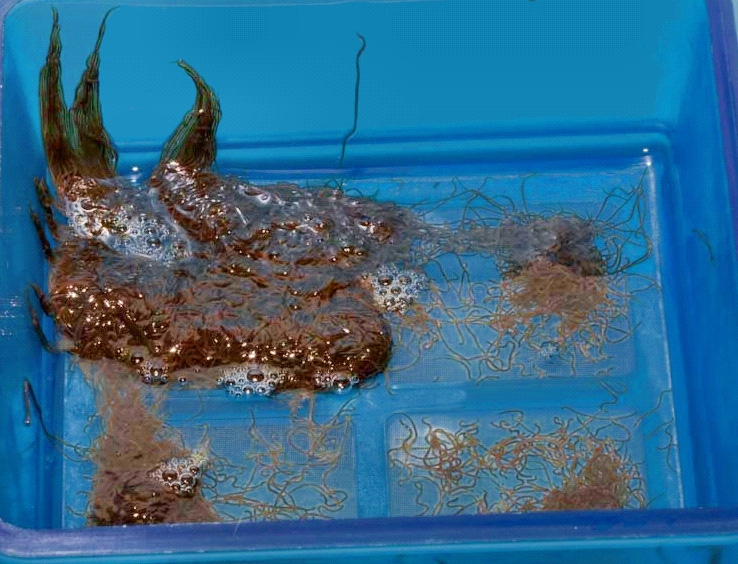
Tubifex worms such as Limnodrilus udekemianus and L. hoffmeisteri are commercially cultured as a food source for aquarium fishes. However, live worms commonly sold as ‘tubifex’ may comprise a mixture of species including Tubifex tubifex, Limnodrilus hoffmeisteri, L. udekemianus, Rhyacodrilus coccineus, Dero digitata or Lumbriculus variegatus.
Feeding Worms
Blackworms and tubifex are not usually cultured by the home aquarist as they are readily available in the aquarium trade. However, with a little research, successful cultures can be easily maintained. Generally they are just purchased as required and stored in a pan of shallow water in the refrigerator, where they should live for at least two weeks.
Optimum water temperature is 18–20°C with an upper lethal temperature of 35°C; at 5°C the worms become inactive. Tubifex and blackworms are very sensitive to chlorine or chloramine, so treat the water with a suitable chlorine neutraliser. Change the water after 24 hours and thereafter once a week should be adequate. An airstone can be used to help circulate and aerate the water. However, keep the airstone off the bottom of the container; otherwise the tubifex will clump tightly around the airstone cutting off the air supply. A small piece of boiled potato can be added to water if the worms are to be kept for any length of time.
When feeding the worms to your rainbowfishes, a plastic cone worm feeder will help retain the worms up at the top of the aquarium until the fish have had time to eat them. If the worms are simply added directly to the tank, many will fall to the bottom and bury themselves in the gravel where the fish will be unable to find them.