
Brackish Water Aquarium
Most of the Australian fish fauna is contentiously hypothesised to be derived from marine descendants, and are sometimes labelled as “secondary” freshwater fish. The rainbowfishes are one of the groups considered to have been derived from relatively recent marine ancestors, and therefore could be expected to retain at least moderate salinity tolerance. However, there is limited scientific information of salt tolerance available for rainbowfishes.
One study (Kefford, et al.) on the sub-lethal effects of salinity on both male and female fish of M. splendida was undertaken in 2006. Preliminary results found that better growth rates occurred at low salinities than in higher salinity. It was also found that egg numbers and hatching rates were reduced at the higher salinity levels. Poor hatching rates of eggs and survival rates of fry has also been reported from moderate increases in salinity. It is important to note the sensitivity of earlier life stages because the occurrence of adult fish at a given salinity at a particular site on a given sampling day may not necessarily indicate a viable population. The most sensitive stages appear to be eggs and larvae (particularly when the yolk sac is exhausted). Another study found deaths occurred at salinities between 4.4 and 13.2 mS/ cm. There is also evidence that the salinity tolerances of younger fish is less than the acute tolerances of older fish.
Salinity tolerance refers to the ability of an animal to withstand exposure to salinity for an indefinitely long period without dying. Tolerance to salinity is in part due to the physiological mechanisms and morphological adaptations that act to balance concentrations of salts in the cells and tissue of an organism against the external environment. In this way, salinity tolerance can vary between species, populations and to some extent can vary between individuals of the same population. Salinity tolerance may also be due to environmental factors that affect the duration of exposure and rate of increase in salinity concentrations.
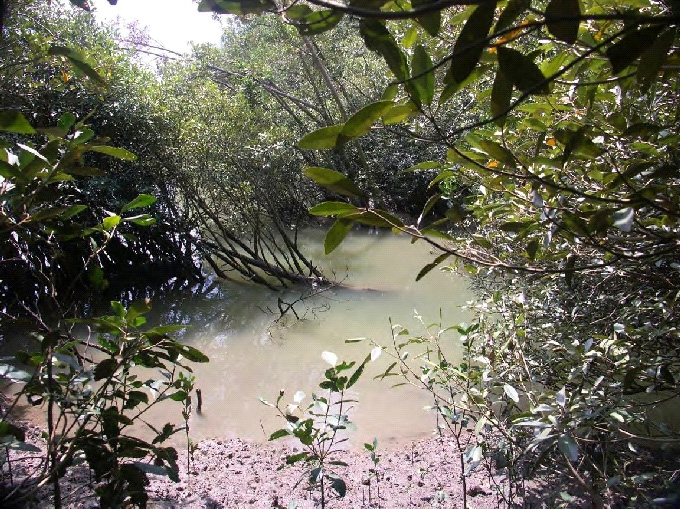
Vast stretches of mangrove estuaries are common around Australia and New Guinea where fresh and salt-water mix producing a unique brackish environment containing its own distinctive fauna. These estuaries are tidal, but during the wet season, freshwater flowing in from the flooding rivers dilute the saltwater to fresh, water thus varies from saline through brackish to fresh.
The thought of setting up a brackish water aquarium may seem more trouble than what its worth. However, a brackish water aquarium suitably set-up with treated mangrove roots, rocks, and sandy substrate can make a very attractive display. It is very simple to maintain a brackish water aquarium. However, like any aquarium, if you do not understand the animals, their needs and what it takes to keep them successfully, your brackish water aquarium can rapidly turn into a nightmare. The secret of success is to provide good quality water and to keep only a limited number of compatible animals in the aquarium.
Brackish water conditions can be obtained by mixing freshwater with seawater. Seawater is more than just Sodium chloride, and for this reason adding ordinary salt is not an adequate substitute. Seawater contains a variety of salts, and the best way to make brackish water is to use sea salt (marine mix) sold for saltwater aquaria.
Typically seawater has a density of around 1.025, which means one litre of seawater weighs 1.025 kilogram (approx). For the record, seawater has about 35 grams of sea salt dissolved in one litre of water. If you want one-tenth seawater, or about 1.002 to 1.003, you would make full strength (1.025) seawater and then dilute it with freshwater in the ratio one part salt to nine parts fresh. One half seawater, about 1.012, would be made by mixing one part salt water to one part fresh.
The salinity of the water required will depend on the fishes being kept. Blue-eyes are from the fresher end of the range and will enjoy a salinity of less than 1.005. Fishes that live mostly in seawater prefer a salinity of over 1.010. One litre of seawater to every nine litres of freshwater makes an acceptable mixture for most brackish fish. Always make the saltwater up separately, following the instructions on the package. Saltwater is highly corrosive and most metals will corrode quickly when continuously splashed by salt water. It is therefore important to make sure that no metal objects are used inside the aquarium and metal lighthoods and stands should be avoided.
Water temperature should be maintained between 20–24° Celsius. A pH of 7.8–8.4 will be acceptable. Like any other aquarium, levels of ammonia, nitrite and nitrate should be kept to a minimum. Most brackish water fishes appreciate moderately hard, alkaline water conditions. Sea salts contain carbonates and bicarbonates which tend to buffer the water well, so hardness and pH shouldn't be too much of a problem. A good way to buffer the water is to use calcareous media in the filter. This can consist of crushed coral, shellgrit, or similar material in the filter or as part of the substrate.
The most natural substrate for a brackish aquarium is fine sand, but this is not ideal for use with an undergravel filter. If you wish to utilise an undergravel filter, you could use a sheet of fine mesh plastic flyscreen to stop the sand from being pulled below the undergravel plate. Coarse-grained calcareous beach sand is also useful (the type used in marine aquariums). This will produce a buffering substrate to a moderate extent.
Partial water changes should be made every 14 days and when changing the water do not forget to add salt supplemented water. Remember that this is for doing a water change, not for replacing evaporated water. Do not use brackish water to replenish water lost to evaporation. Use freshwater only as dissolved salts do not evaporate with the water. If brackish water is used to top up the tank, the salt concentration will increase, and before long you will have a saltwater aquarium.
Typical P. cyanodorsalis and P. inconspicuus habitat