
pH of Water
The term pH derives from a combination of p for the word power and H for the symbol of the element Hydrogen. Together the meaning is the power or exponent of hydrogen. The pH value can be defined as ‘a number used to express the concentration of ionised hydrogen in an aqueous fluid and is thus indicative of the reaction of that fluid, that is, the neutrality or the degree of acidity or alkalinity’.
According to the theory of electrolytic dissociation all liquids of which water is a constituent contain free, positively charged hydrogen (H+) ions and negatively charged hydroxyl (OH-) ions.
Much mystery has been made about the pH value of aquarium water, but, in reality, there is nothing very mysterious about it, nor is the subject so complicated, as some would have us believe. pH serves as a convenient way to compare the relative acidity or alkalinity of a solution at a given temperature. Absolute neutrality has a pH value of 7.07 (usually taken as 7.0). The addition of acid increases the hydrogen (H) ion concentration; consequently the pH of all acid solutions is less than 7.07. The addition of alkali increases the concentration of the hydroxide (OH-) ions, and decreases that of the H+ ions, so that the pH of all alkaline solutions is greater than 7.07. The range of pH values extends about equally on each side of 7.07; for the complete range of pH values forms a graduated scale from about -0.3 to 14.5.
Since the pH of water is critical to the survival of most aquatic animals and plants, monitoring pH values in the aquarium is an important part of successfully maintaining rainbowfishes in captivity. The testing is quick and easy and can establish a valuable baseline of information so that unanticipated water quality changes can be better understood.
Practical Application of pH
pH is one of the most common aquarium measurements because many chemical processes are dependent on the pH. Aquarium conditions can often be significantly altered by changing the pH of the water. The solubility of many chemicals in solution, and their bio-availability is dependent on pH. The physiological chemistry of living organisms usually has very specific pH boundaries.
A simple test kit which exhibit characteristic colour changes at different pH values or a hand-held electronic meter can be used to test pH. Always remove a sample of water from the aquarium to measure the pH with an electronic meter. Measurement by immersing the electrode directly in the aquarium can be severely compromised by other undetectable electrical currents from power filters, heaters, etc. pH electrodes which are not routinely cleaned and standardised will not provide accurate readings and will be no better than, and often far worse than, a colorimetric measurement made with the cheapest liquid-reagent test kit.
pH electrodes must be routinely checked against known pH standards to insure accuracy and need to be replaced every 9 to 12 months. The popular pocket pH “pens” are disposable meter/electrode combinations which can be inaccurate, particularly if not calibrated correctly, and do not compensate for changes in temperature. Therefore, the selection of measuring devices for pH is largely a situation in which “you get what you pay for”. If you are unable to recognise the inadequacies of pH meter measurements, you are better off using dye methods. Only dyes with clear-cut colour changes around the target pH should be used.
The commonly used pH indicators for freshwater testing are bromothymol blue (yellow to green to blue as the pH increases) and phenol red (yellow to orange to red with increasing pH). The colorimetric method is the least expensive but can suffer from interferences due to discoloured water samples, salinity, organic matter, and substances that can oxidise or reduce the reagents. In water with very low alkalinity, the indicators themselves may actually alter the pH of the sample. However, for the purposes of routine aquarium testing, colorimetric indicators are more than adequate. Some scientific supply houses now sell narrow-range litmus paper, which allows for low-cost, rapid estimation of pH.
In well-buffered aquariums with alkalinity levels above 50 mg/L, the pH will be more stable. In the morning, carbon dioxide levels are high and pH is low because of respiration during the night (carbon dioxide forms a mild acid when dissolved in water). When a suitable light source is provided, algae and other aquatic plants will produce carbohydrates and oxygen from carbon dioxide and water by photosynthesis. As carbon dioxide is removed from the water, its pH increases. In aquarium systems, the pH will generally drop in relation to the fish load, biological filtration, feeding, and maintenance schedules. Therefore, acidic water in an aquarium system is biologically different from that found in nature.
In an aquarium, acids derive primarily from two sources. The first is when carbon dioxide (directly dissolved into water or released as a respiration by-product) mixes with water to form carbonic acid.
H2O + CO2 <=> H2CO3 <=> H+ + HCO3
water + carbon dioxide <=> carbonic acid <=> hydrogen ion + bicarbonate
The other is when ammonia undergoes nitrification by bacteria.
2 NO2 - + 2 H+ + 2 H2O 2 NH3 + 3 O2
ammonia + oxygen » nitrite + hydrogen ion + water
If the aquarium water is not well buffered any acid that is added serves to drive down the pH. Consequently, the daily pH swings caused by photosynthesis can combine with longer-term acid accumulations and cause the pH to suddenly drop with catastrophic results for the fish. There are indirect consequences that can also affect fish. Changes in pH will affect the toxicity of many dissolved compounds. For example, ammonia becomes more toxic as pH increases. Nitrifying bacteria, essential in the conversion of ammonia to nitrate also have a pH range preference, which is between 7.5 and 8.6. Variations in pH will also have an effect on some disease treatments. Fluctuations in pH, even though they may still be within the preferred range, can be stressful and damaging to fish health. Therefore it is important to monitor pH. The actual time to measure pH will depend on what you hope to achieve with your tests.
It is well-established that levels of pH fluctuate throughout the day, and a single pH measure taken during the day may not draw a very accurate picture of long-term pH conditions in the aquarium. Photosynthesis by aquatic plants removes carbon dioxide from the water; this can significantly increases pH. A pH reading taken at dawn in an aquarium with many aquatic plants will be different from a reading taken six hours later when the plants are photosynthesising. Likewise, in waters with plant life (including planktonic algae), an increase in pH can be expected during the growing season. For these reasons, it is important to monitor pH values at the same time of day if you wish to compare your data with previous readings. It is also important to monitor pH values over a long period of time to provide useful data.
Most rainbowfish species can survive pH changes down to 4.0–5.0 or up to 9.0–10.0, but exposure to more acidic or alkaline waters can be lethal within a few hours. There is no definite pH range for maintaining rainbowfishes in captivity, but a gradual deterioration of their health is likely as the pH values are removed from their preferred range. Water with a pH range of 6.5–7.8 is usually considered best for rainbowfishes in captivity. However, studies regarding the survival, growth and reproduction of rainbowfishes in acidic or alkaline water conditions are still inadequate.
Rainbowfishes will survive reasonably well in waters with a pH range of 6.5 to 8.3. If pH readings are outside this range, growth is reduced; their slime coat can suffer, making them susceptible to disease. At values below 5.0 or above 9.0, mortality, impaired growth and reproduction can be expected. The gas exchange in the gill membranes will be so reduced that the fish may suffocate. From my own experience, most rainbowfishes in captivity do not seem to be comfortably in water below pH 6, certainly not for any extended period.
There may be some isolated populations that have adapted to extreme conditions as low as pH 4.0. However, acidification of water is thought to have a major impact on fish mortality and the structure of their populations. Field and laboratory studies have shown a clear correlation between low pH and declining fish populations. The recruitment failure by embryo and larva mortalities is considered as a primary factor leading to gradual loss of fish stocks of aquarium as well as of wild populations. In addition, exposure of larvae at pH 4.5 or lower may impair growth and reduced survival. Behavioural responses, such as reduced swimming and feeding activities, have been observed in fish larvae exposed to acidic water conditions.
Experimental studies with eggs from different fish species showed that the sensitivity of embryos to low water pH is related to the developmental stage. Highest mortality occurs immediately after fertilisation of the eggs (‘green’ egg stage) and at the time of hatching. Freshly fertilised eggs, which show no external signs of cleavage, are called ‘green’. When eye pigmentation and further development are visible through the chorion, eggs are ‘eyed’ and these are less vulnerable to low pH. Most studies on egg development and effects of low pH indicate a delay of the hatching time and an elongation of the hatching period. Fertilised embryos may also develop deformities when exposed to pH 4.5 or lower.
Numerous laboratory studies have tested tolerance of fish species to low pH. In most fish species, the 96-hour LC50 was reported to range from pH 4.0 to 5.0 for early and adult life stages. Fish mortality caused by low pH has been thought to be associated with disturbance of water and ion balance, which may eventually lead to disruption of ion homeostasis. The chloride cells in the gills, opercular epithelium, and skin of fishes are known to play a key role in regulation of ionic balance.
Although the effects of low pH on fish have been extensively studied, relatively little is known about the effects of high pH. Environmental high pH values can be caused by enhanced photosynthetic activity of aquatic plants, and can be accompanied by high temperatures and supersaturating of dissolved gases. The latter too may contribute to fish mortality, which makes it difficult to relate observed effects to the high pH value alone. From field studies it appeared that mortality of adult fish is more pronounced after episodic pH changes, e.g., after heavy rainfall.
Acidification of water also decreases photosynthetic activity in aquatic plants and phytoplankton. Studies (Allen 1995) show that a pH of less than 4.0 is directly toxic to the roots
of aquatic plants. Some species of insects have been noted to avoid depositing eggs, thereby reducing an important food source for other species. Many freshwater invertebrates fail to reproduce in acidified waters. Some species will avoid entering acidified waters if they have an alternative.
pH in Natural Waters
In Australia the pH of freshwater streams naturally varies between catchments due primarily to differences in catchment geology and vegetation. However, in general, most freshwater streams have a pH range of 6.5 to 8.0. There are, of course, exceptions to this general rule. Coastal streams generally range from about pH 4.5 in tannin-stained streams associated with coastal ‘wallum’ heathlands, to pH 8.8 in streams at the headwaters of some catchments. Forested areas and coastal areas with high rainfall generally have the lowest pH.
Naturally low pH also occurs due to seasonal wetting and drying of peaty soils in wetlands and waterways. In contrast, waterways in the Pilbara and Kimberley areas of Western Australia generally have a pH range of 8.0–8.5. The pH recorded from a number of coastal streams in Queensland including several relatively undisturbed rivers i.e., the Endeavour and Daintree range from pH 6.5 to 7.15. Other river recordings include the Russell-Mulgrave, Tully, Herbert, Ross, O'Connell and Burrum, all of which have relatively intensive development and floodplain modification. The pH range for lowland and upland streams was 6.5–8.0 and 6.5–7.5 respectively. In areas with highly alkaline subsoils natural pH is generally in the range of 7.0–8.5.
Similar conditions are found throughout northern topical Australia. Data for streams in New Guinea are generally not available.
Large stretches of dune field and coastal heathland (wallum) swamps and streams are found dotted along the eastern Australian coast. These ‘blackwater’ habitats are generally acidic, with pH levels from 3.9 to 6.8, have low conductivity, and vary in their dissolved organic matter, ionic composition, and colour. Alkalinity and hardness levels are very low. Factors contributing to these variations are age, formation, layers of low permeability and peats, proximity to the sea, surrounding vegetation, and the extent to which leaf litter accumulates and decays in the water.
These water bodies are usually well oxygenated but highly oligotrophic (low nutrient levels due to the surrounding infertile soils) and of low biological productivity. The dominance of humic acids among this organic material and the relatively low pH are not conducive to bacterial degradation, so particulate and dissolved humic compounds are metabolised very slowly. The brown (tannin) colour of the water severely limits penetration of light, which, together with low concentrations of inorganic ions, restricts photosynthetic activity in aquatic plants. Limited photosynthesis and slow bacterial degradation results in low zooplankton and phytoplankton development.
Rainbowfishes often found in these habitats include Iriatherina werneri, Melanotaenia maccullochi, Pseudomugil gertrudae, Pseudomugil mellis and Rhadinocentrus ornatus.
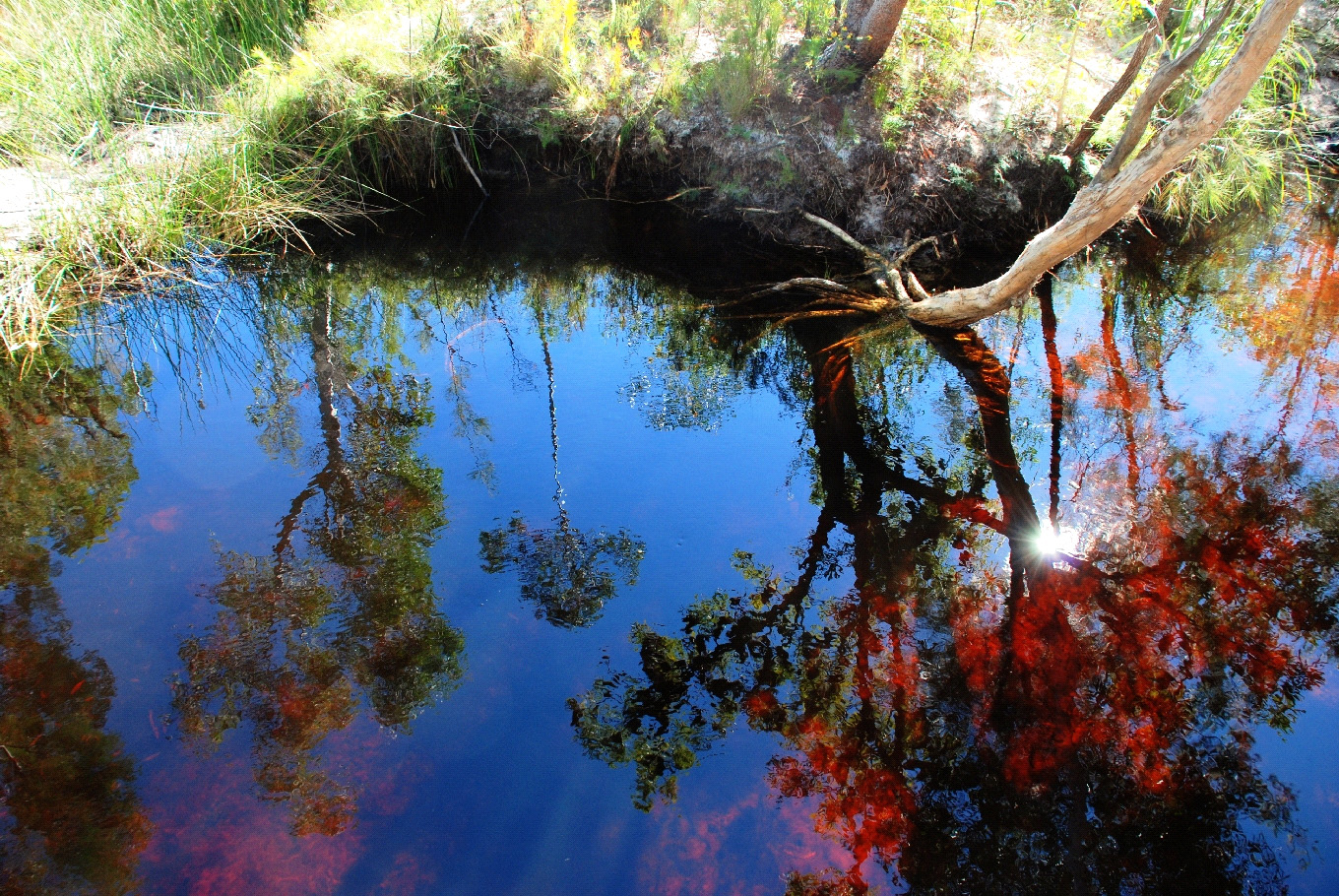
The exposures of rainbowfishes to these humic substances may be mild, or even beneficial, rather than being lethal. In very soft, low pH (3.5–4.0) freshwaters, such as that found in Amazonian backwaters, humic substances have been reported to protect fish against ionoregulatory effects induced by low pH, thereby enabling the fish to survive in these environments.
Humic substances are a group of natural organic compounds of decomposition of dead organic matter found abundantly in soil, natural water and various terrestrial and aquatic environments. They can be divided into three components based on their solubility: fulvic acids, humic acids, and humin. In aquatic ecosystems, they are the main components of dissolved organic matter (50–70%) that is found in most natural freshwaters in concentrations of 0.5 to 50 mg/L, but can also reach more than 100 mg/L. In freshwater systems, the majority of humic substances are derived from terrestrial plant debris. Despite their abundance in freshwaters however, the role of dissolved humic substances is still inadequately understood.
Intermittent streams that are subjected to seasonal or frequent drying are also a common feature in Australian inland waters. As drying proceeds, decreases in water volume concentrate the aquatic life into a reduced area. These isolated pools tend to experience physicochemical extremes in the form of elevated temperatures, fluctuating pH levels and low dissolved oxygen. When combined with leached organic material, this can produce high concentrations of toxic humic substances, such as polyphenols and tannins, which turn the water a deep brown colour, leading ultimately to ‘blackwater events’.
Documented fish kills from blackwater events are common throughout Australian inland rivers and streams, particularly during extended periods of inundation and prolonged periods of low flow.
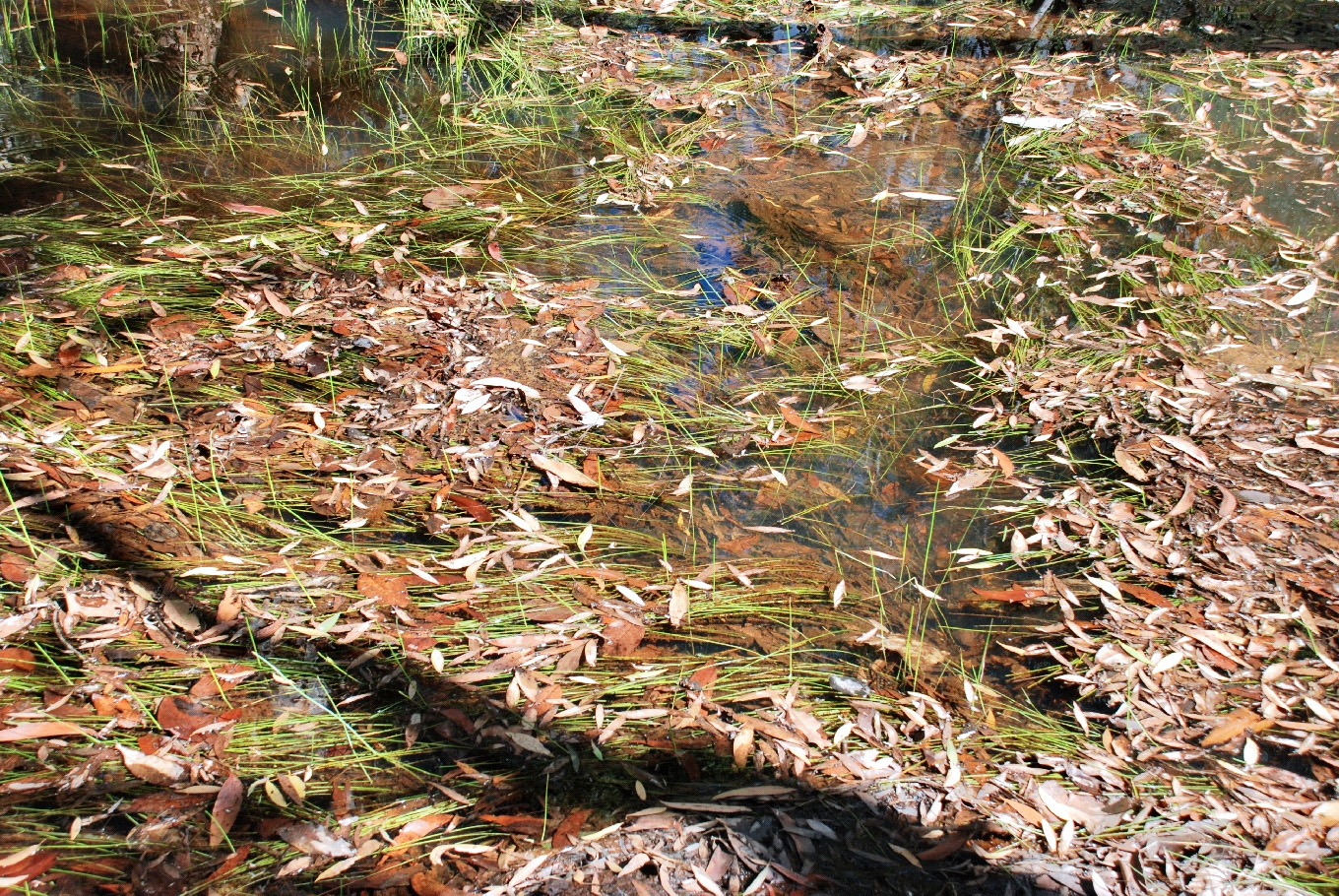
In many streams of Australia, dissolved humic substances are leached from fallen gum (Eucalyptus) leaves. The drier months are the major period of litter-fall from gum trees, and thus coincide with low water levels and the formation of isolated pools, which results in high local accumulation of particulate and dissolved humic substances. Leachates from eucalyptus leaves contains a wide diversity of chemical compounds (over 90 identified) that fall into the broad classes of polyphenols, volatile oils, waxes and tannins. Polyphenolic compounds are thought to act as deterrents to insect attack whilst leaves remain on trees and these are slowly leached into the water. These compounds can delay microbial colonisation for up to four months. Several factors influence the concentration of dissolved polyphenols, including, but not limited to, the age of the leaves and abiotic processes such as photodegradation and decomposition.
From an ecological point of view, this means that a given terrestrial plant cover results in natural organic matter with particular chemical properties, which can, under certain conditions, produce specific concentrations of humic substances that are toxic to aquatic life. Humic substances are natural environmental chemicals in the aquatic environment. With their functional groups, they have the potential to affect almost any biochemical and biogeochemical pathway in both freshwater organisms and ecosystems.