

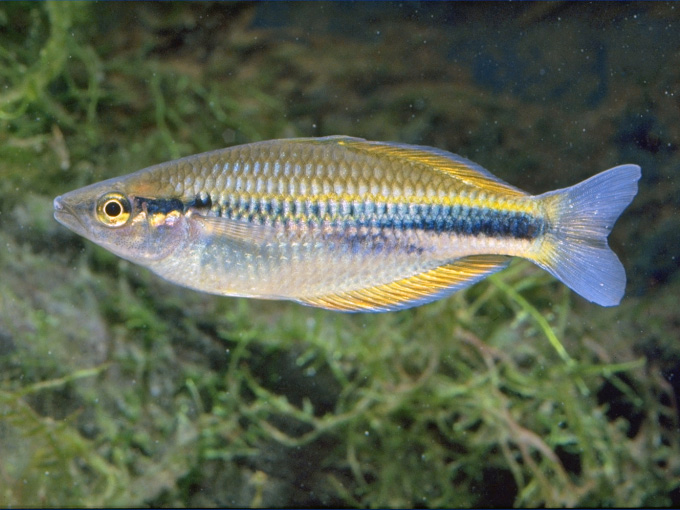
Melanotaenia affinis
New Guinea Rainbowfish
Synonymy
- Rhombatractus affinis Weber, 1908
- Rhombosoma sepikensis Herre, 1935
- Rhombosoma affinis Whitley, 1938
- Melanotaenia affinis Allen, 1980
Species Summary
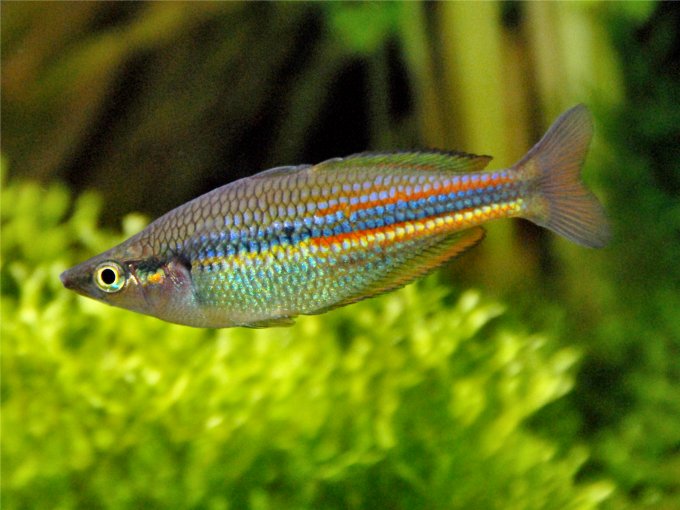
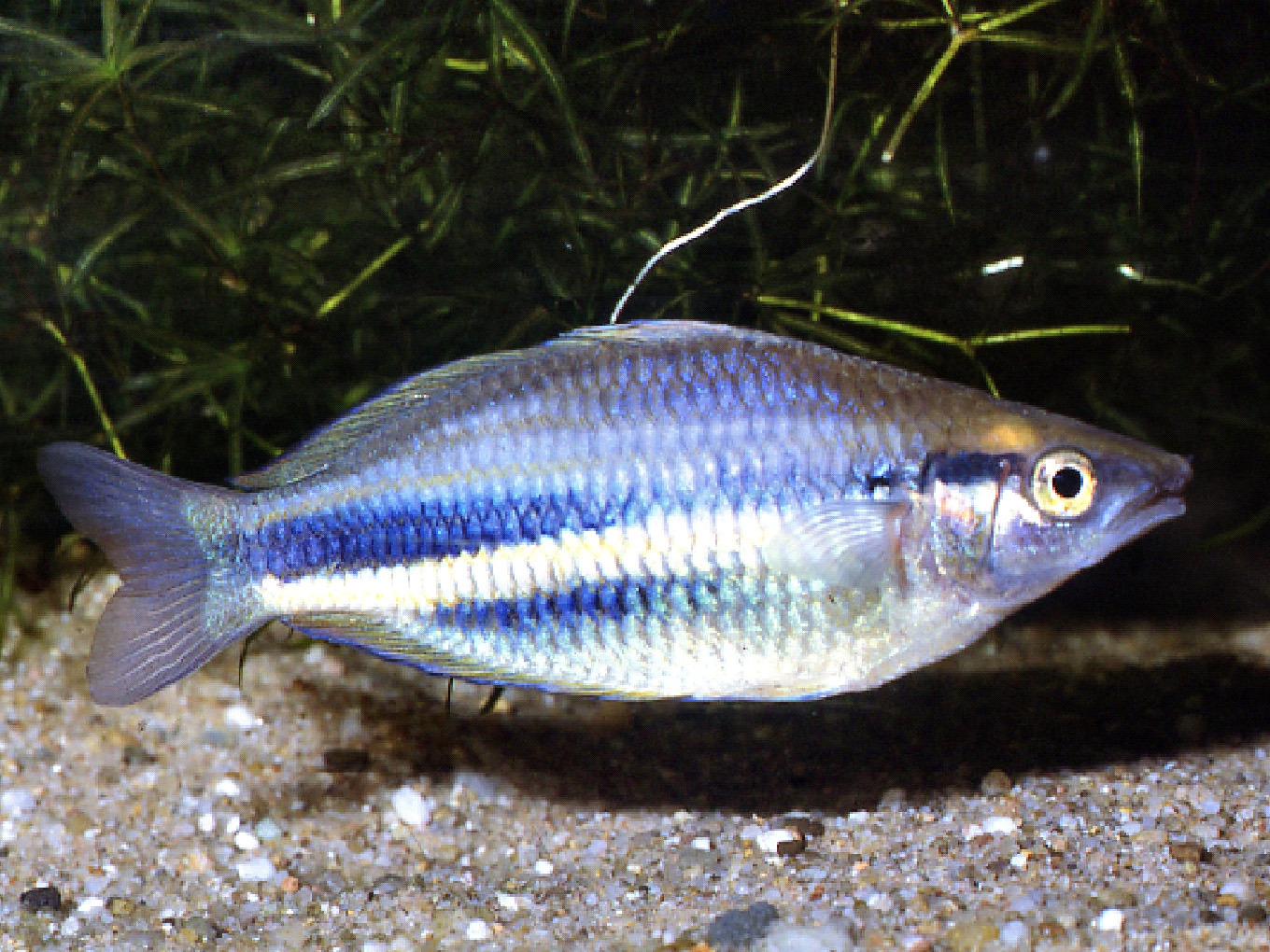
Melanotaenia affinis are an attractive species that are found only in the northern regions of New Guinea. As with many rainbowfishes, their colouration is variable depending on location and water conditions. They generally have a body colouration of olive to bronzy-yellow dorsally grading to white ventrally; a blue to blackish stripe from the snout to caudal fin base, often faint or absent in the pectoral fin region and becoming more intense and broader on the caudal peduncle where it is bordered by orange or reddish stripes (at least in males). The sides often have a series of narrow orange stripes between each scale row; fins whitish-translucent to yellowish; anal fin and frequently soft dorsal fin of mature males bright yellow-orange. Maximum size about 12–15 cm with a body depth of around 3–4 cm. Males are deeper bodied than females and have pointed posterior tips of the dorsal and anal fins. These features become more obvious with increased growth.
The overall colour pattern of males is more intense, particularly the orange stripes and dark mid-lateral stripe. The vertical fins of females are either translucent or only faintly yellow compared to the bright yellow-orange of males.
This species often exhibits geographic colour pattern variation. Generally this is related to the amount or intensity of orange or reddish striping on the sides, width and intensity of the dark mid-lateral stripe and intensity of yellow or orange colouration in the vertical fins. There may also be morphological variations, for example in relation to body depth and shape of the snout. Two populations in particular are noteworthy because of these features; one from the highland tributaries in the vicinity of Baiyer River and the other from lowland tributaries near Pagwi. The Baiyer River population is characterised by a relatively slender body and tends to have a higher soft dorsal ray count than specimens from other localities (17–20 vs. 13–16). The fish from streams near Pagwi differs by having a more pointed snout and a mid-lateral stripe that is more uniform in width (i.e., not broadly expanded posteriorly) and bordered by brilliant reddish stripes.
Males and females generally mature before the end of their first year or at a standard length of 5–6 cm. Melanotaenia affinis are carnivorous, feeding on a variety of small invertebrates taken from mid-water or from the surface. Gut content included crustaceans, insect larvae, and terrestrial insects such as ants and small beetles.
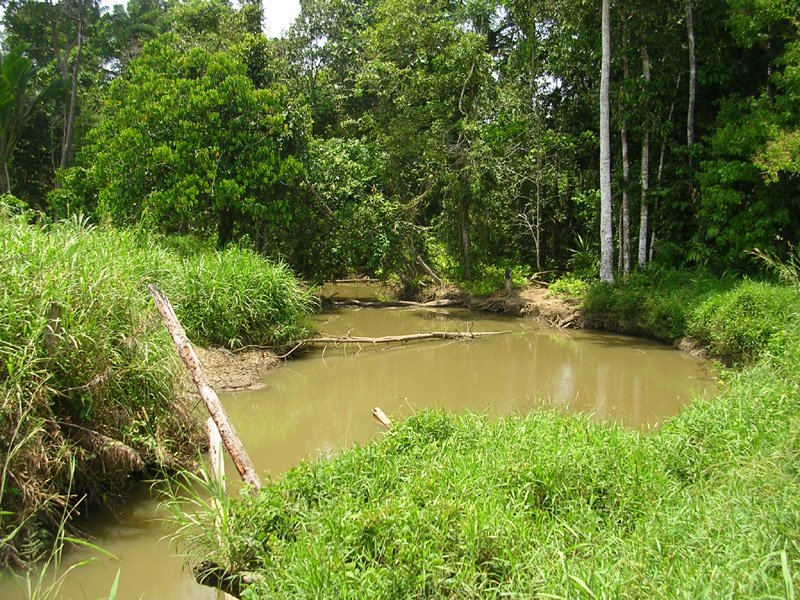
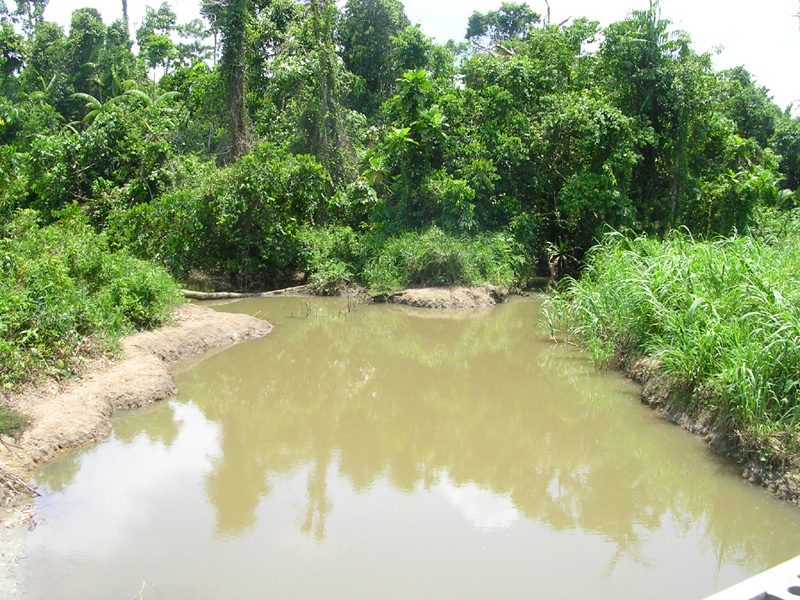
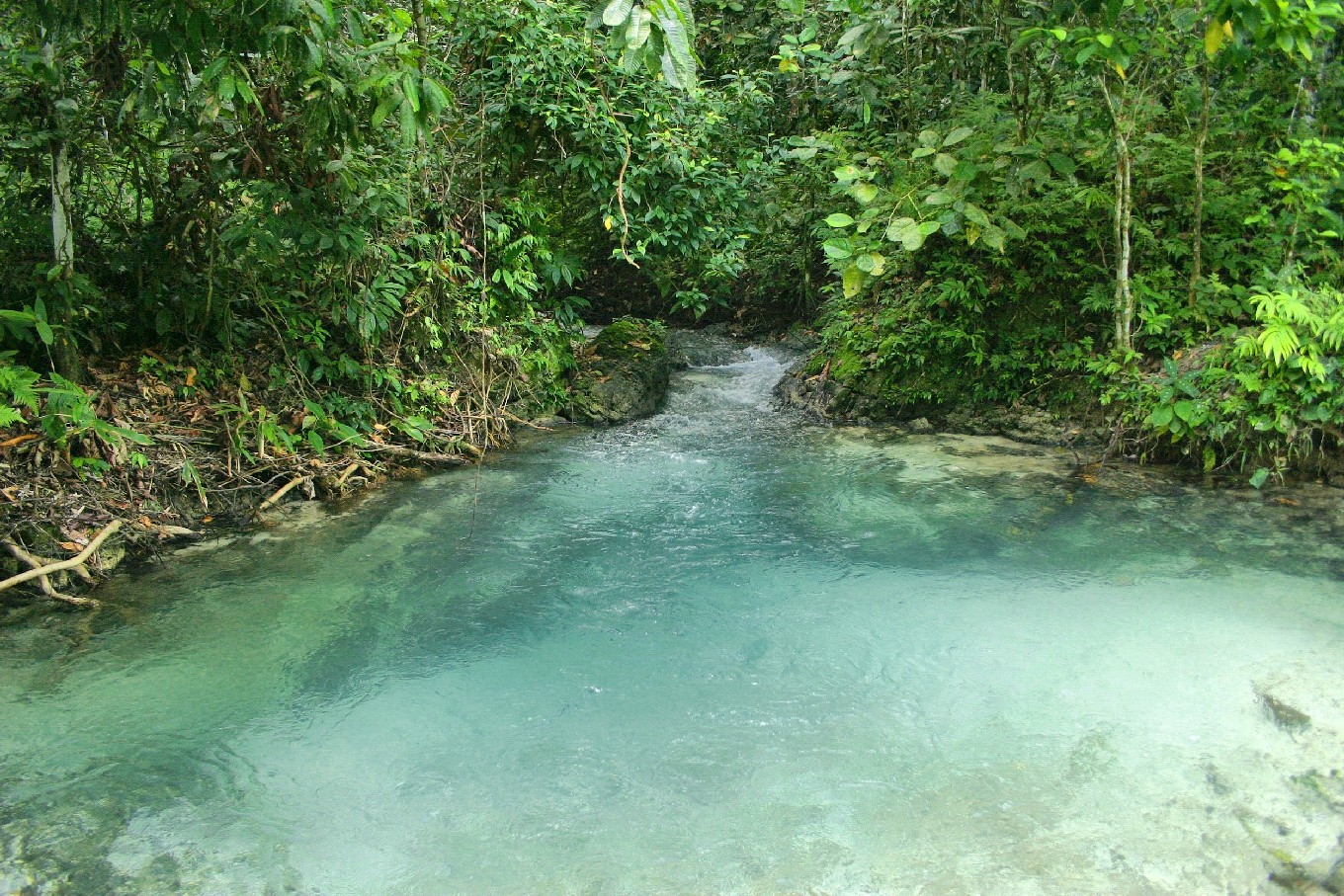
Sepik River habitat where M. affinis (Pagwi), Chilatheina fasciata and an undescribed Chilatherina sp. were collected
Etymology
The genus name Melanotaenia combines the Greek melanos, black, and taenia, band, referring to the black lateral band of M. nigrans, which Gill believed was one of two characters separating it from Atherina, the genus in which it had originally been described. The species name affinis is Latin for related; the allusion was not explained by Weber, but perhaps refers to its affinity with — or Weber’s having nearly identified it as — Nematocentris novaeguineae (now a synonym of M. goldiei).
Etymology compiled from C. Scharpf (2023), “Fishes of Sahul: An Etymological Survey (Part 6), the rainbowfishes (continued)”, Fishes of Sahul 37(1): 2006–2022, and etyfish.org.
Distribution & Habitat
Melanotaenia affinis are widely distributed in northern New Guinea (north of the central dividing range). The range extends from the Oomsis River near Lae, Papua New Guinea westward into West Papua to at least the vicinity of Nabira. It is the most common rainbowfish in tributary streams of the Markham, Ramu and Sepik Rivers of Papua New Guinea. Found in some mountainous headwater streams of the Sepik in the Western Highlands, such as in the Baiyer River, and also recorded from the Taritatu River (Mamberamo system) in West Papua.
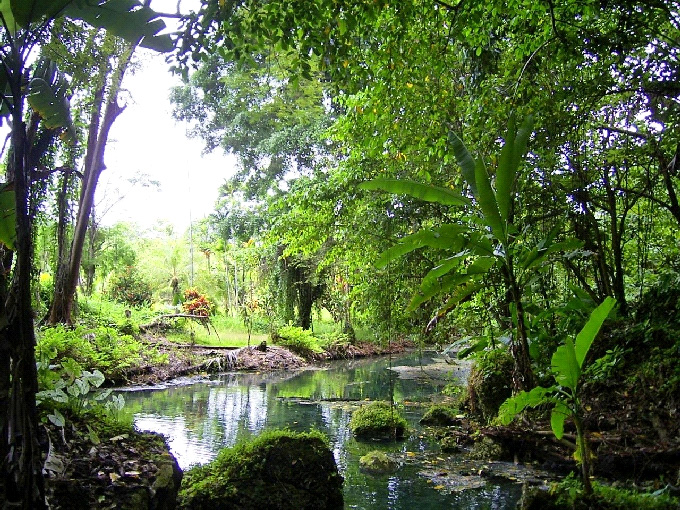
They are found most frequently in rainforest streams, in water temperatures between 18–28° Celsius. They are mainly found around sub-surface vegetation, submerged logs, or branches in small tributary streams but can also occur in lakes, swamps, and lagoons often together with Chilatherina and Glossolepis species. Their natural environment is subjected to seasonal variations with water temperature, pH, and hardness levels varying considerably. They are usually found in clear water, but sometimes in turbid conditions.
Remarks
Melanotaenia affinis were one of the earlier New Guinea rainbowfishes to be introduced to the aquarium hobby. They first appeared in the Australian hobby around 1959. Further live specimens were collected near Lae by Barry Crockford and Gerald Allen in the late 1970’s and subsequently reintroduced to the hobby in Australia. Three main varieties have been maintained in the hobby. The ‘standard’ coloured variety is widespread in a number of locations and is indistinguishable in colour pattern. Live specimens of this variety were collected and transported back to Australia by Barry Crockford in the late 1970’s.
The ‘Pagwi’ variety is the brightest and best known variety. It is primarily known from Kuins Creek, a tributary of the Sepik River near Pagwi Village, but are undoubtedly present in many creeks in that area. The mid-lateral line is blue, prominent and has bright red-orange upper and lower margins on the rear half of the body. There is also a broad pale yellow anterior scale row just below the mid-lateral band. Live specimens of this variety were collected and transported back to Australia by David Coates and Gerry Allen in 1982.
This population was collected by Gary Lange in 2006 from a small stream near the village of “Bonggo” located near Jayapura in West Papua. The small stream flowed under the gravel road and the fish were collected where the water was shallow and a lot easier to catch. This variety is currently available in the hobby.
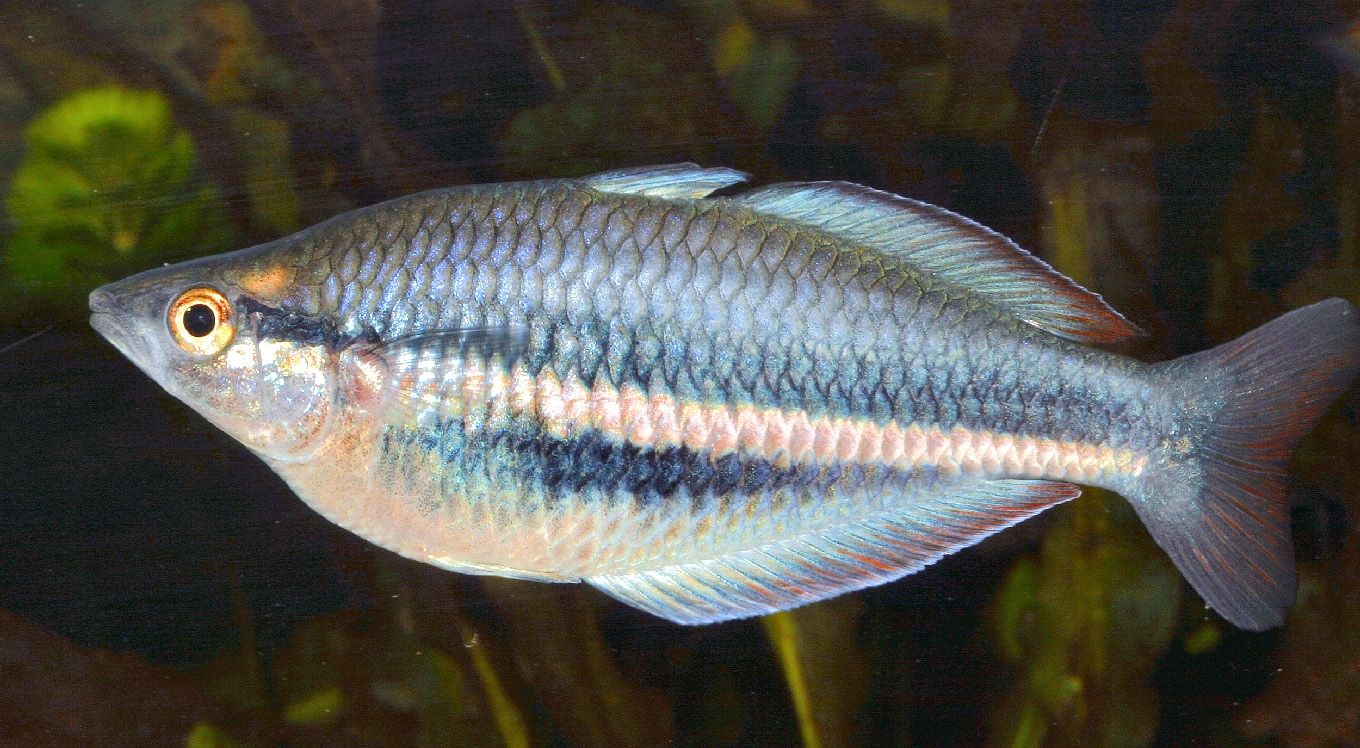
Another, the ‘Bluewater Creek’ variety was collected from a stream near Madang, Papua New Guinea by Gerald Allen in 1978. The upper body is greenish-blue with silvery reflections and the lower body white. The mid-lateral band is blue-black having a broad white margin on the lower edge, which is separated from the lower side by a diffused bluish-black stripe. Live specimens of this variety were collected by Heiko Bleher in 1988 and taken back to Europe.
References
- Allen G.R. & D. Coates (1990) An ichthyological survey of the Sepik River, Papua New Guinea. Records of the Western Australia Museum Supplement 34: 31-116.
- Anon. (2001) Fish collection database of the National Museum of Natural History (Smithsonian Institution).
- Allen G.R. (1991) Field Guide to the Freshwater Fishes of New Guinea. Christensen Research Institute, Madang, Papua New Guinea.
- Herre A.W. (1936) Fishes of the Crane Pacific Expedition. Field Museum of Natural History. Zoological Series, 21: 1-472.
- Weber M. (1908) Süsswasserfische von Neu-Guinea... 5(2): 201-267.
- Whitley G.P. (1956) Fishes from inland New Guinea. Records of the Australian Museum 24(3): 23-30.