

Melanotaenia splendida
Eastern Rainbowfish
Species Summary
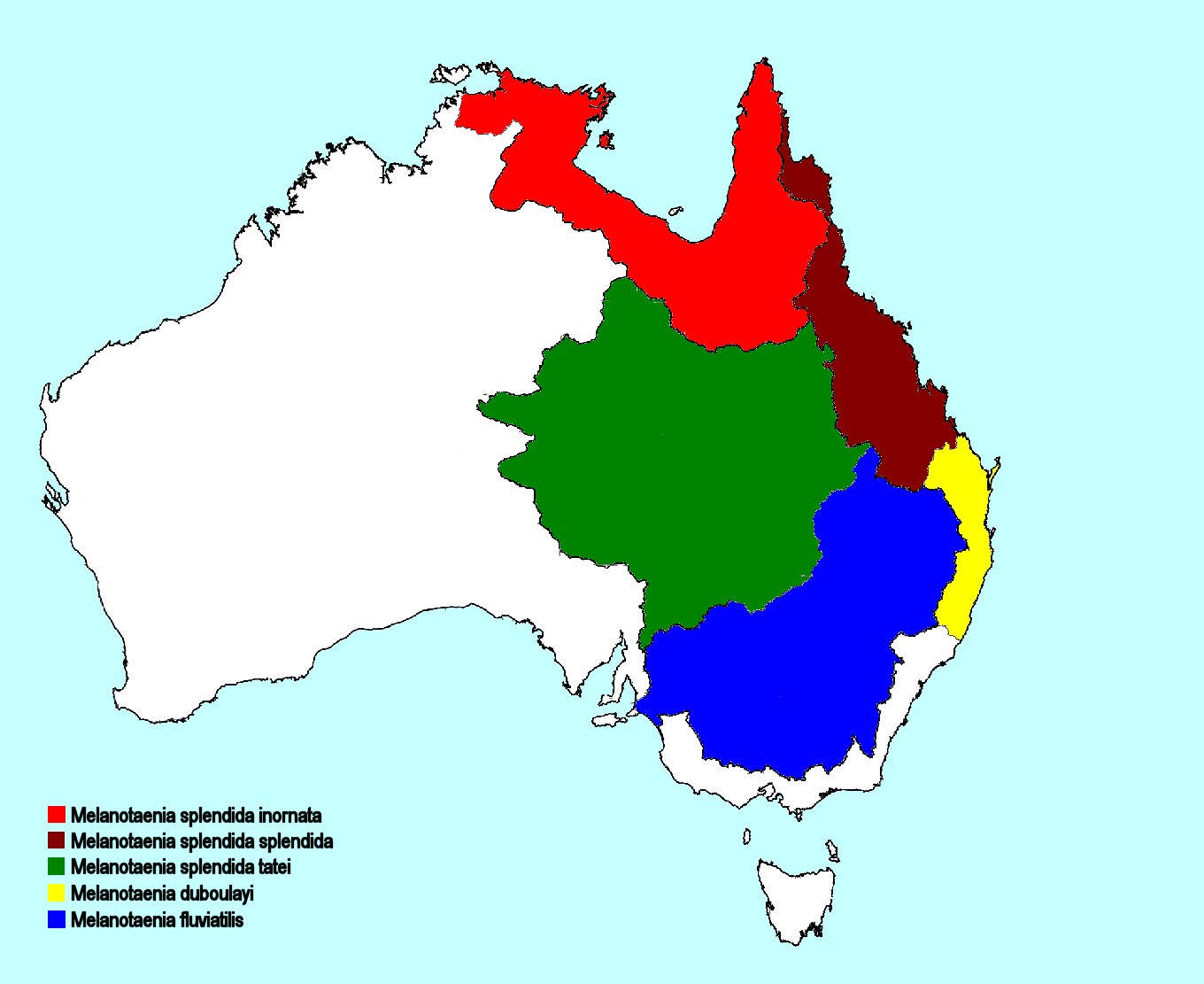
Melanotaenia splendida is by far the most widespread of any rainbowfish species, occurring across western and central southern New Guinea and northern Australia from the Adelaide River in the Northern Territory to Deepwater Creek a small coastal stream located between the cities of Bundaberg and Gladstone on the east coast of Queensland. They also occur throughout most rivers in central Australia as well as the Paroo and Warrego Rivers in Murray-Darling system. The “splendida” rainbowfishes are currently a widely distributed group comprising four subspecies:
Melanotaenia splendida were originally collected from the Fitzroy River in central Queensland and scientifically described as Nemacentrus splendida in 1866. Gerald Allen’s revision of the family Melanotaeniidae in 1980 places them under their current name. The different subspecies of M. splendida are not easily identified in relation to each other as they display a great variation of colours and markings. Principal visual differences are body depth and colour pattern, which is variable depending on location and natural environment. At the same time, body form within each subspecies is variably and appears to be related to habitat conditions, which can sometimes make correct identification difficult.
Populations of almost every river system they occupy have their own distinctive body colour and pattern. Colour variability in rainbowfishes has been a source of confusion to both aquarists and taxonomists studying their life history. Colour appears to vary from population to population as well as within a population, particularly during different stages of the fishes’ lifespan. This colour variability is related to age, sex, stress, habitat conditions and spawning. Geographic distribution is very helpful; if you know where they were collected you can generally make a confident identification. Consequently, specific names usually based on the locality where each is found are used by rainbowfish enthusiasts to identify each variety. Where populations need to be identified, they are often done by inclusion of a form or population identifier in brackets following the species name e.g., Melanotaenia splendida (Burdekin River).
Whether or not Melanotaenia splendida is truly a distinct species or subspecies complex is a matter of on-going debate. Ever since Carolus Linnaeus founded the modern system of classifying species in the mid-l8th century, taxonomists have argued over just what exactly species and subspecies are. In general, fishes evolve into different species and subspecies after becoming geographically isolated from others, adapting to their different environments, and changing over time through the process of natural selection.
Geographic populations of M. splendida have been isolated from each other for perhaps thousands of years. They have gradually evolved physical adaptations that reflect their habitat. Some biologists classify M. splendida as separate subspecies because they are visibly different. Others say they are genetically the same as other M. splendida subspecies and differ only because of environmental circumstances. The traditional view of subspecies is morphological variants distinguishable at the level of the population where 75% or more of the individuals of the populations of one subspecies can be distinguished from those of other subspecies.
Biology & Ecology
Not a lot is known about the biology or ecology of M. splendida in their natural environments. Most information is mainly based on aquarium observations. In captivity they can reach a maximum size of 12–15 cm, but are usually less than 8 cm. Males are more brightly coloured, larger, and much deeper bodied than females. Generally, the larger males can usually be identified from the elongation of posterior rays in the second dorsal and anal fins. Females and juveniles have plain silvery bodies and fins that are either translucent or only faintly coloured compared to the brighter colours of males. Sexual maturity occurs at about 3–4 cm for both sexes.
The main components of their natural diet are algae, aquatic insects, terrestrial insects and microcrustaceans. The algal component consists mainly of green filamentous species. A variety of aquatic insects are eaten; the main identifiable species being chironomid larvae and pupae, and coleopterans. The main terrestrial insects were formicids (ants) and the main microcrustaceans were cladocerans. Traces of hydrophytes, oligochaetes, gastropods, arachnids, macrocrustaceans, teleosts, terrestrial plants, detritus and inorganic material were also found in the stomachs. In the pools and riffles that enter the floodplain in the wet season they feed mainly on non-aquatic insect forms such as winged diptera and ants.
In their natural environment M. splendida has a prolonged spawning period with a peak of spawning activity in pre-flood and flood periods, although individuals in spawning condition and juveniles may be found throughout the year. Spawning during the wet season (November to April), when the inundation of streams and floodplains ensures an expanded habitat (in area and diversity) and a greater array and abundance of food. In contrast, spawning peaks during the dry season (May to October) ensures that larvae are produced during a period of relatively stable environmental conditions. This strategy increases the chances of some eggs surviving. Increased stream flow may result in conditions unfavourable for reproduction (i.e., physical removal of eggs, larvae and spawning substrate).
In the main, M. splendida will breed when environmental conditions ensure maximum fertilisation and larval survival. They usually spawn small numbers of eggs over a large area in slow-flowing waters and the backwaters of flooded areas. The presence of extensive spawning substrate enables them to ‘spread the risk’ from predators. The eggs are attached by adhesive threads to aquatic plants and other objects in the water, which hide them from predators.
The eggs, however, are subject to desiccation if the water level drops or to dispersal if there is a flood.
Melanotaenia splendida subsp. inornata are reported to migrate upstream at the onset of the breeding season, which corresponds to the start of water flow after the dry season. They spawn for an extended period during the early-wet season, and their gonads are developing for the next year’s spawning by the late-wet-early-dry season. In a number of gonads examined, the number of eggs ranged from 70 to 370.
Under aquarium conditions, pre-spawning behaviour usually occurs in the morning and may continue for up to an hour before spawning takes place. During this period the colours in both sexes become more intense, but to a lesser extent in the female. In males, the edges of the fins and the chequering of the caudal and second dorsal fins become black. The nape may darken to black in some but not all fish. The midlateral stripe is prominent, extending from the origin of the pectoral fin to the caudal peduncle. Near the tail, two shorter dark lines appear above and below the midlateral stripe. The normal orange-yellow longitudinal stripes become a more intense colour in both sexes. The males have an iridescent purple sheen in light. The operculum has a glowing red spot in both sexes. The pectorals do not become coloured in either males or females. In the females, the midlateral stripe darkens before spawning but the stripe is not as long as in males. The chequered appearance of the second dorsal fin becomes more noticeable and the colour of all the fins darkens except in the case of the pectorals.
Chasing follows immediately after the colour change. The males chase the females, swim below them and brush their vent area with erect dorsal fins or butt them in the vent region or in the area of the pectoral fins. The males frequently tremble as they swim below the females. They display erected fins as they swim beside or at right angles in front of the females. During the pre-spawning chasing and display, the males can become quite aggressive and nip the females if the latter do not show interest in the display. In the final phase of pre-spawning behaviour, the pair swim with their bodies parallel, sinking and rising and then remain in one place with heads touching and their bodies vibrating rapidly. Eggs and sperm are then expelled amongst the plants or spawning medium.
Large females (>50 mm TL) produce more than 100 eggs per day at the peak of their spawning. Smaller females (30-35 mm TL), which were only just sexually mature shed fewer eggs, 20-30 per day and do not spawn each day. Accurate counting of the eggs is difficult as the male disperses the eggs rapidly by the swishing of his tail. Two females were once observed to lay more than 1700 eggs within a single one-week spawning period. The number of eggs shed by a single female is directly related to the size of the female with large females spawning from 40-250 eggs. Females usually only spawn once each day; however, males will often spawn with more than one female in one day. In captivity, with limited area and artificial substrate, females may spawn all their eggs at the same time.
The eggs of M. splendida at fertilisation are similar in appearance to those of other rainbowfishes. All are spherical, with a number of adhesive filaments, 3-8 mm in length, arising from a small area of the chorion at the animal pole. Spawned eggs, which range in size from 0.93 to 1.24 mm in diameter, are adhesive, negatively buoyant in freshwater and are usually clear to light amber in colour. The eggs hatch after an incubation period of four to nine days depending on temperature. Temperature is one of the major factors that influences the embryonic period for rainbowfishes. Average embryonic period is about 5 days at 28°C.
The average larval length of M. splendida at hatching ranges from 2 to 4 mm, which is similar to other rainbowfish species. Hatched larvae are well developed and competent swimmers. Growth rates of the larvae are initially slow, with little variation until around 7 to 14 days. Growth is directly related to the initial absorption of the yolk sac and the provided larval diet. After that period growth rates increased. As the larvae increased in age, the variation in length between individuals also increased.
The continued growth and development of the fry will vary from one hobbyist to another and is largely conditional upon captive conditions such as temperature, water quality, and feeding regime. Under aquarium conditions increased temperature generally results in higher growth rates. 28 ± 1°C is considered the most effective and safe temperature for optimum growth rate. At this temperature range, M. splendida are relatively fast growing with sexual differences beginning to appear between 9 and 12 weeks after hatching.
Food is an important factor affecting growth, especially in the early larval stages. Research has found that diet strongly affects not only fecundity but also the biochemical make-up of eggs and sperm as well as the growth rate and survival of larvae. The preferred size of food for larval fishes increases as mouth size and feeding competency increase. Providing natural ‘green-water’ (phytoplankton) with resident zooplankton as food for the newly hatched fish has several advantages. The larvae are easily able to switch to different sized food, a feature not present when feeding foods such as rotifers or brineshrimp. Green water also enables the zooplankton to feed on resident algae and microbes, thus retaining their nutritional value for greater periods of time. In addition, a varied diet may affect the growth of rainbowfishes positively.
Remarks
Because of the great variation in colours and body forms, Melanotaenia splendida should be bred within their own localised populations. Regardless of their various colour patterns, at this point of time, they are all believed to belong to the same species and are capable and willing to breed together if permitted to do so. The serious hobbyist intent on maintaining pure lines must keep each population in separate aquariums. Unless this is done, members of the different subspecies or populations will interbreed and complicate future breeding programs and identification.
Melanotaenia splendida subsp. inornata inhabit the river systems of the Northern Territory and Queensland, which flow into the Arafura Sea and Gulf of Carpentaria – from the Adelaide River to Cape York Peninsula, extending down the east coast to around the Lockhart and Stewart Rivers.
Melanotaenia splendida subsp. splendida are found in streams east of the Great Dividing Range along the coast of Queensland from Deepwater Creek north to Scrubby Creek, just south of the Lockhart River.
Melanotaenia splendida subsp. tatei is widespread and abundant in the larger rivers of the Lake Eyre Basin and the Western Plateau of the Northern Territory. This species has only recently been identified from the Murray-Darling Basin, where it is recorded from the arid rivers in the north-western basin. It is found only in the Paroo and Warrego rivers, and hybrids with Murray-Darling rainbowfish have been identified in the lowermost Warrego River and the Darling River from around the Bogan River down to at least Menindee.
Other species formerly considered subspecies of M. splendida
Melanotaenia duboulayi inhabits the coastal drainages east of the Great Dividing Range from the Hastings River on the mid northern coast of New South Wales to Baffle Creek in southern Queensland.
Melanotaenia fluviatilis is the most southerly ranging rainbowfish in Australia. Their distribution covers the MurrayDarling River system in Queensland, New South Wales, Victoria, and South Australia.
Melanotaenia rubrostriata is widely distributed in southern New Guinea between Etna Bay in West Papua and the Central Province of Papua New Guinea. The Kikori River was the previous eastern limit of distribution, but recent surveys indicate that they are more widespread; having been collected in the Sapoi River in the Lakekamu Basin. The Sapoi River drainage is located approximately 150 km northwest of Port Moresby.