

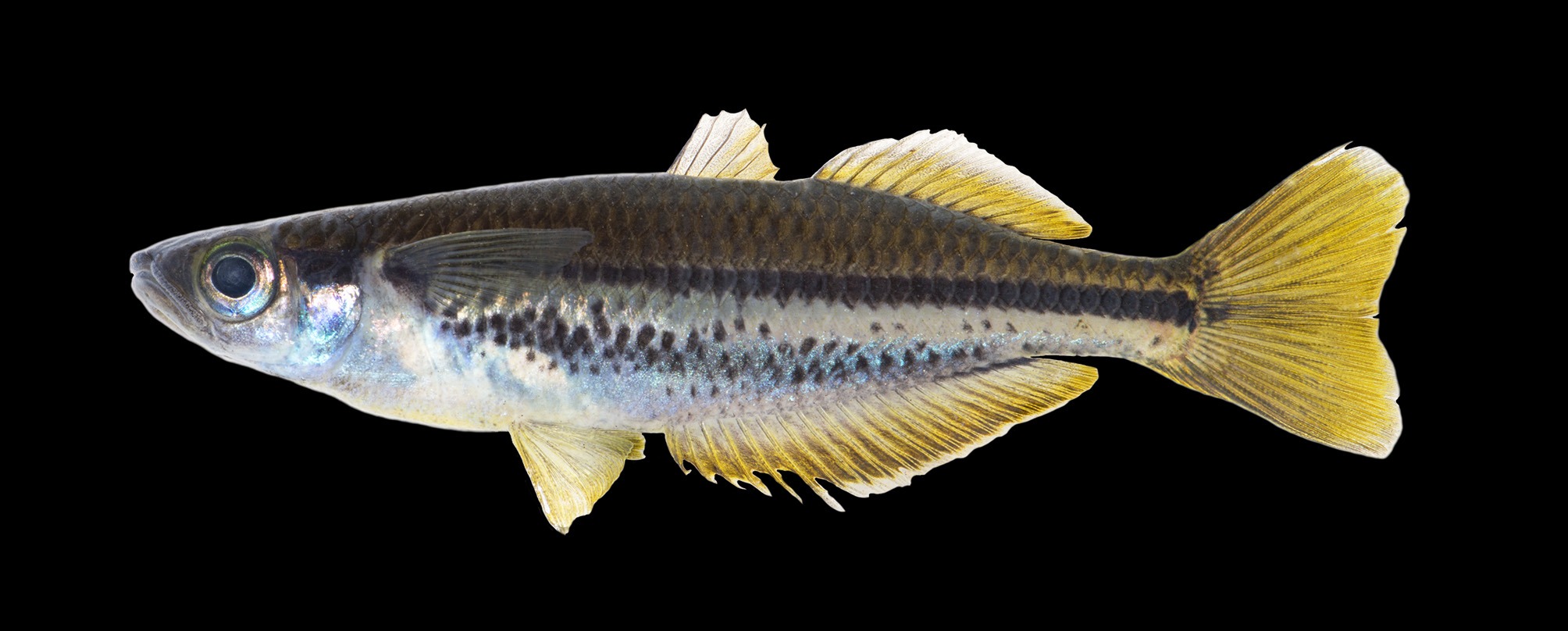
Cairnsichthys bitaeniatus
Daintree Rainbowfish
Species Summary
Cairnsichthys bitaeniatus is a small, slender rainbowfish described in 2018 as the second species in the genus Cairnsichthys, which until then was considered to contain only the Cairns Rainbowfish, C. rhombosomoides. A combined genetic and morphological study of an isolated population discovered north of the Daintree River, about 120 km from the previously known range of the genus, confirmed it as a distinct species rather than an outlying population.
Etymology
The genus name Cairnsichthys combines Cairns, Queensland, Australia, where C. rhombosomoides is confined to relatively few streams in the vicinity of that city, with the Greek ichthys, fish. The species name bitaeniatus combines the Latin bi-, two, and taeniatus, banded, referring to the two dark stripes on its sides, compared with the inconspicuous or absent ventral stripe of C. rhombosomoides.
Etymology compiled from C. Scharpf (2021), “Fishes of Sahul: An Etymological Survey (Part 4), the Rainbowfishes”, Fishes of Sahul 35(1): 1706–1714, and etyfish.org.
Distribution & Habitat
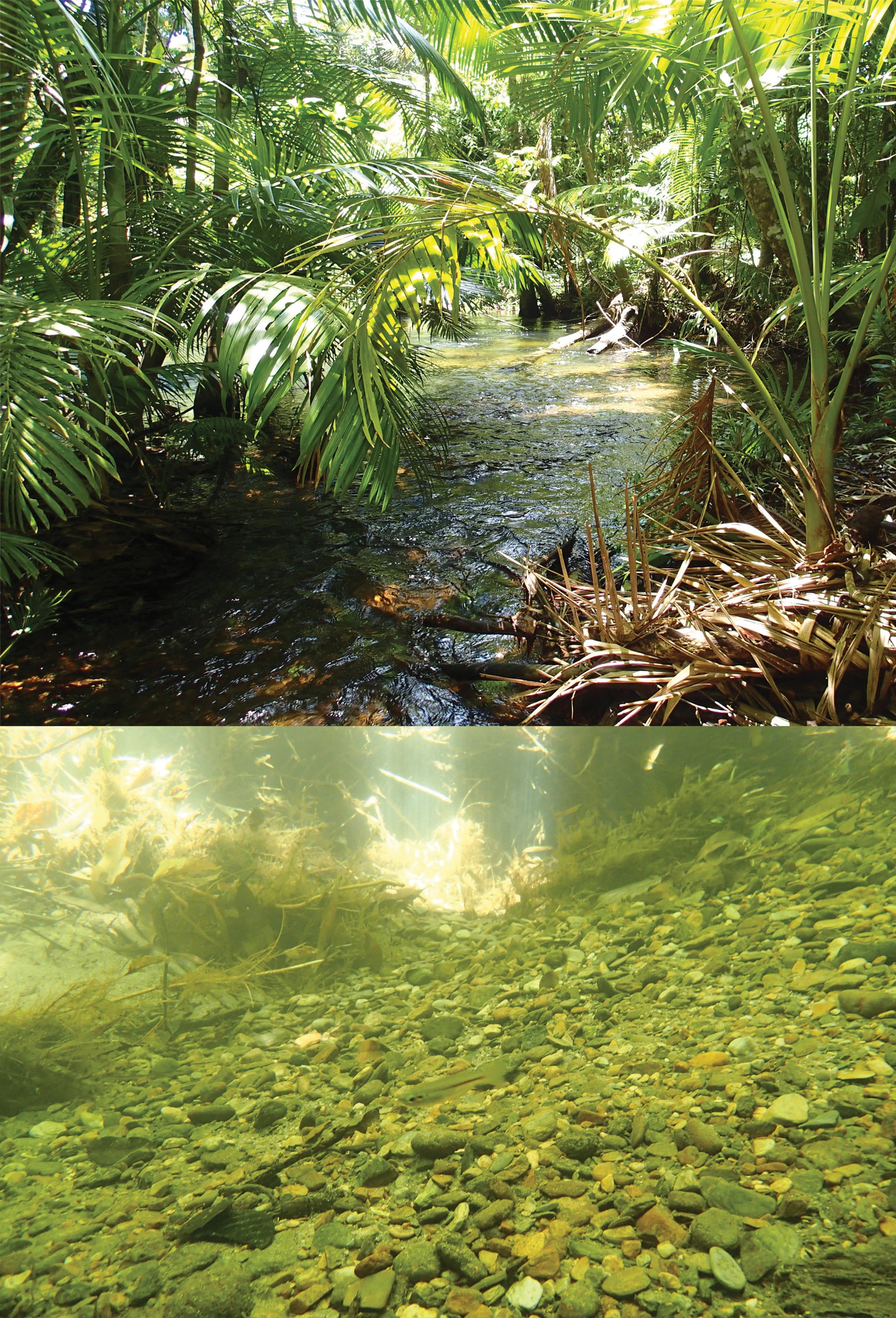
Cairnsichthys bitaeniatus is known only from the Cooper Creek and neighbouring Hutchinson Creek systems in far north Queensland, a combined range of roughly 16 km², making it a narrow-range endemic of significant conservation concern. Most records come from Little Cooper Creek, a small, clear, fast-flowing tributary shaded by rainforest, with a mixed substrate of rock, sand and log debris. The species has also been found in South Cooper Creek and an upper reach of Hutchinson Creek. It is generally uncommon wherever it occurs, usually seen singly or in small groups of two or three, and favours the deeper pools immediately upstream of riffles, swimming steadily into the current. It is often found schooling with Melanotaenia splendida splendida, Melanotaenia trifasciata and Pseudomugil signifer.
Description
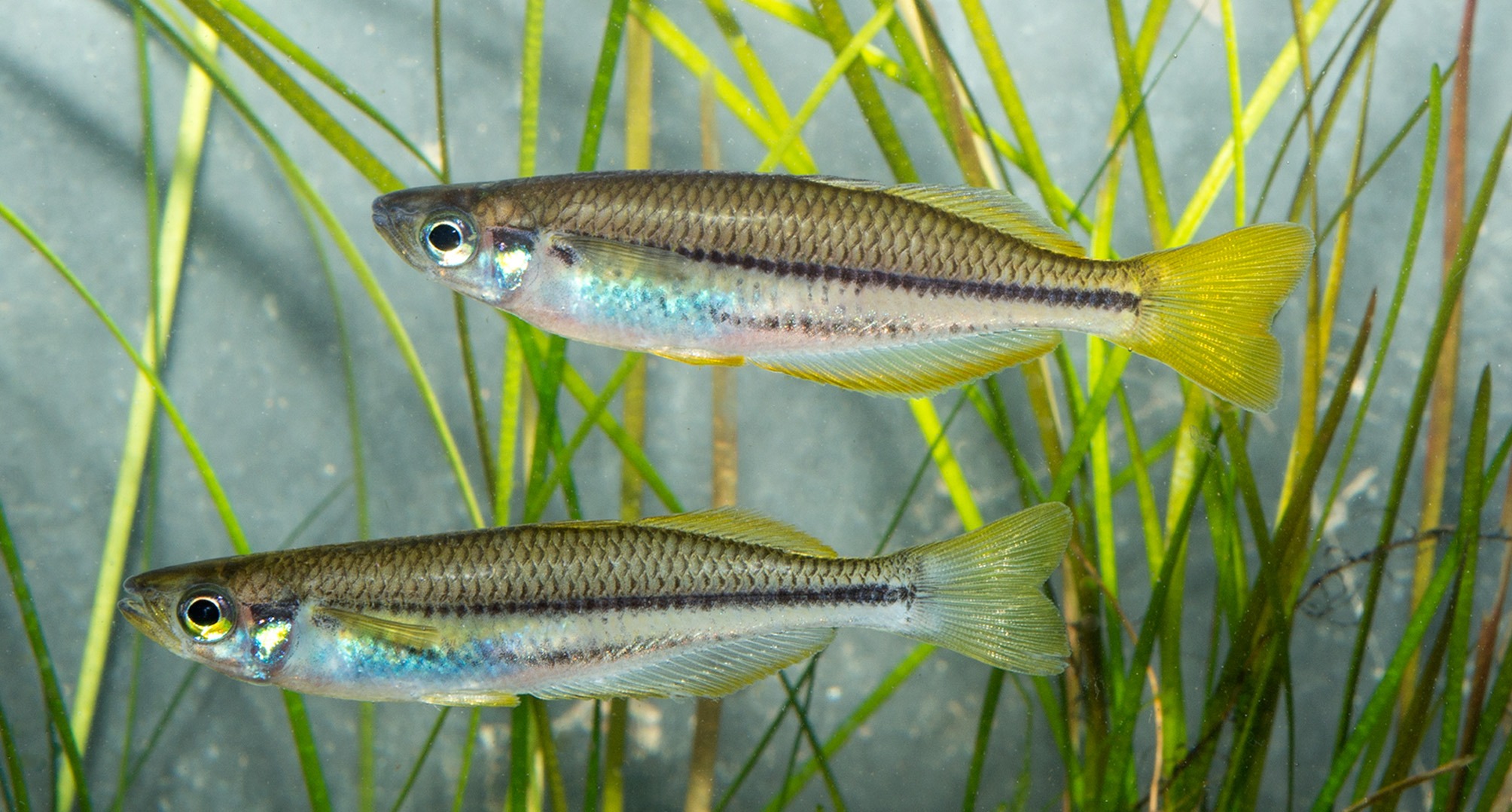
A slender rainbowfish to about 66 mm SL, generally more elongate than C. rhombosomoides, especially in fish under about 45 mm SL, with a flatter, straighter predorsal profile rather than a rounded one. Body brownish above with a fine darker scale outline, often with a yellowish hue, and bluish white below with an extensive pale yellow patch just behind the pectoral fin base. A narrow blackish mid-lateral stripe runs from the pectoral fin base to the tail, and a second, usually more conspicuous, dark stripe is typically present lower on the body — the feature giving the species its name. A short, robust black bar crosses the upper operculum, and a dark spot marks the pectoral fin base. Nuptial males develop yellowish (rather than orange-red) submarginal markings on the second dorsal and anal fins.
Comparison with the Cairns Rainbowfish
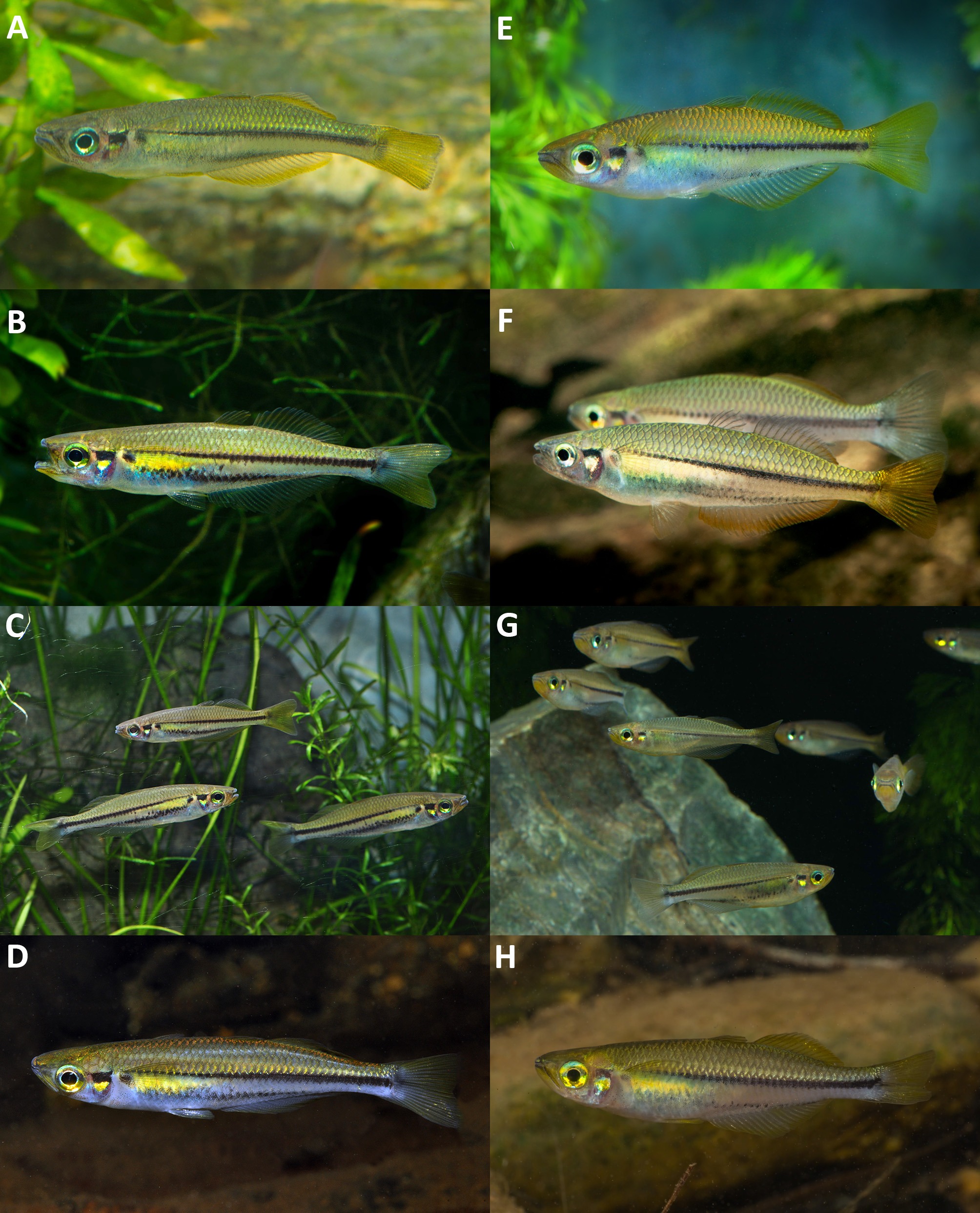
Cairnsichthys bitaeniatus is most reliably separated from its only congener, C. rhombosomoides, by a combination of features: a more robust black stripe across the upper operculum, a more intense dark spot at the pectoral fin base, a pronounced yellow patch on the lower body, and usually a distinct second dark stripe low on the side (generally faint or absent in C. rhombosomoides). It also has slightly smaller scales, reflected in higher lateral and predorsal scale counts, typically more vertebrae, and yellowish rather than orange-red fin markings in nuptial males. The two species are otherwise similar in general appearance and are not known to occur together, being separated by roughly 120 km of coastline.
Remarks
Cairnsichthys bitaeniatus inhabits the country of the Eastern Kuku Yalanji people. Its tiny range, small population and specialised habitat requirements suggest a conservation status of Critically Endangered, considerably more precarious than the ‘Vulnerable’ listing already held by C. rhombosomoides. All known populations occur on private land, including hobby farms and small-scale horticulture, though the headwaters rise within the Daintree National Park World Heritage Area. Water extraction, chemical runoff and the introduction of alien fish are identified as potential threats. The species has a distinctive, sinuous swimming style that an experienced observer can use to tell it apart from other rainbowfishes in the same streams even without a close view.
Account compiled for Home of the Rainbowfish from M. P. Hammer, G. R. Allen, K. C. Martin, M. Adams, B. C. Ebner, T. A. Raadik & P. J. Unmack (2018), “Revision of the Australian Wet Tropics endemic rainbowfish genus Cairnsichthys (Atheriniformes: Melanotaeniidae), with description of a new species”, Zootaxa 4413(2): 271–294.
References
- Burrows D.W. (1998) FNQ 2010 Regional Environment Strategy - Key Waterways Report. ACTFR, Townsville, Qld.
- Hammer M.P., G.R. Allen, K.C. Martin, M. Adams, B.C. Ebner, T.A. Raadik and P.J. Unmack (2018) Revision of the Australian Wet Tropics endemic rainbowfish genus Cairnsichthys (Atheriniformes: Melanotaeniidae), with description of a new species. Zootaxa 4413 (2): 271-294.
- Martin K.C. and S. Barclay (2013) New Distribution Records for the Cairns Rainbowfish Cairnsichthys rhombosomoides (Melanotaeniidae): implications for conservation of a restricted northern population. aqua, International Journal of Ichthyology, 19(3): 155-164.
- Nichols J.T. and H.C. Raven (1928) A New Melanotaeniin fish from Queensland. American Museum Novitates Nr. 296, American Museum of Natural History.
- Pusey B.J., M.J. Kennard and A.H. Arthington (2004) Freshwater Fishes of North-Eastern Australia. CSIRO Publishing, Victoria.
- Thuesen P.A., B.J. Pusey, D.R. Peck, R. Pearson and B.C. Congdon (2008) Genetic differentiation over small spatial scales in the absence of physical barriers in an Australian rainforest stream fish. Journal of Fish Biology 72(5): 1174-1187.