

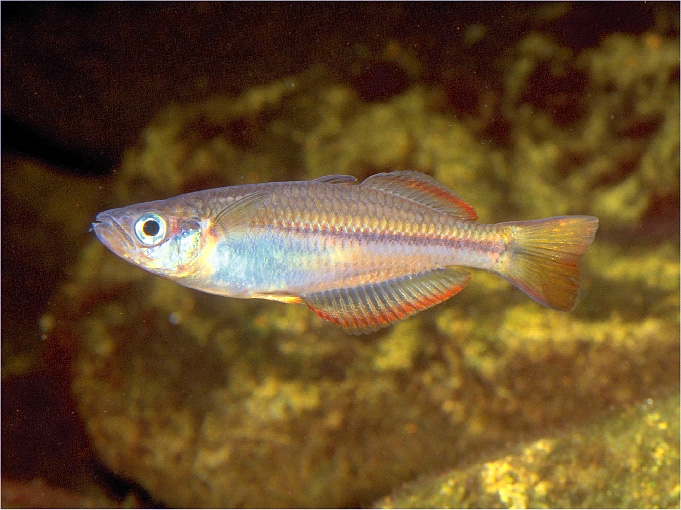
Cairnsichthys rhombosomoides
Cairns Rainbowfish
Species Summary
Cairnsichthys rhombosomoides were originally collected by Henry Raven in October, 1921 from Babinda Creek, a tributary of the Russell River in north Queensland. They were scientifically described in the American Museum Novitates Nr. 296, in 1928 by John T. Nichols and Henry C. Raven and placed in the genus Rhadinocentrus. Gerald Allen’s revision of the family Melanotaeniidae in 1980 placed them in the monotypic genus Cairnsichthys in recognition of its distinctiveness.
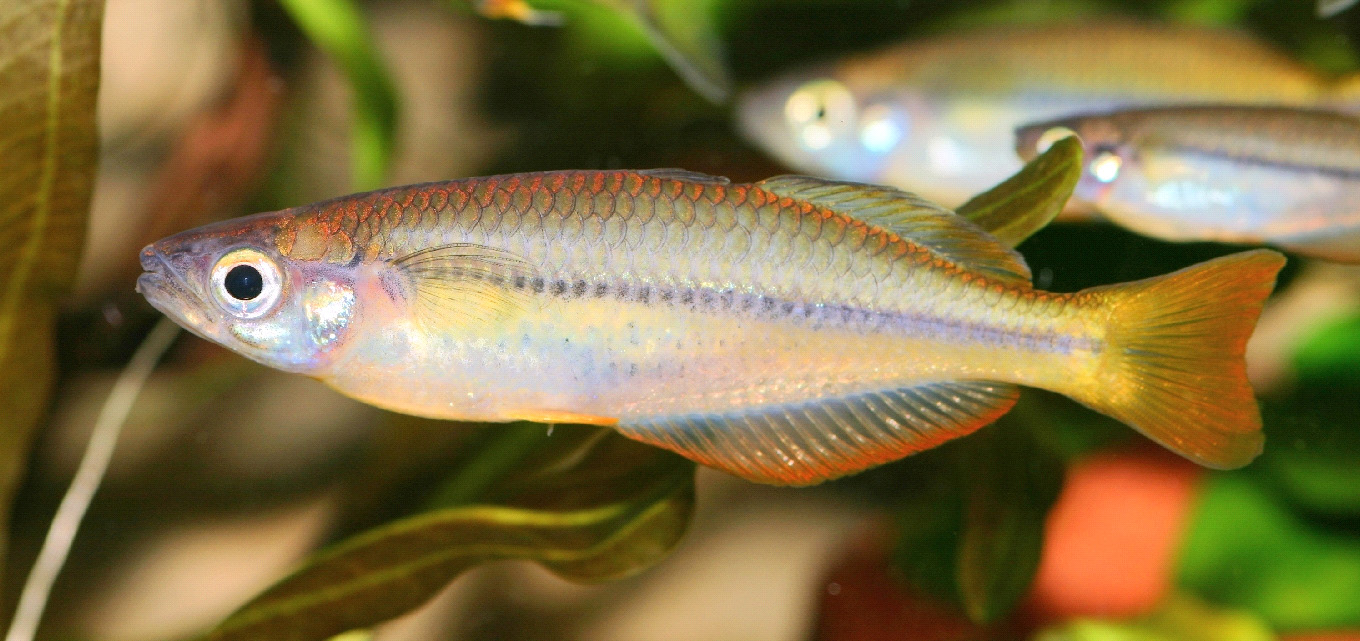
Body colouration is yellow-brown on the dorsal half of body and silvery-white below with a continuous thin dark mid-lateral band. A large silvery or yellowish spot can be seen on the operculum. Males have a yellow-orange coloured outer margin on the dorsal and anal fins. The caudal fin has a similarly coloured fan. They may reach a maximum body size of 10 cm, but are usually around 7 cm. Males can be distinguished from females by their elongated dorsal and anal fins and brighter colours - females have shorter and more rounded fins. Males are also larger and deeper bodied than females.
Cairnsichthys rhombosomoides is believed to be a very old isolated species, whose current distribution is the remnant of a previously larger distribution range that has been reduced due to environmental changes. It is possible that they were the original rainbowfishes in rivers of northern Queensland.
Etymology
The species name rhombosomoides means having the form of Rhombosoma, referring to its resemblance to the young of Rhombosoma novaeguineae (now a synonym of M. goldiei), “but none of the fine rays are pungent.”
Etymology compiled from C. Scharpf (2021), “Fishes of Sahul: An Etymological Survey (Part 4), the Rainbowfishes”, Fishes of Sahul 35(1): 1706–1714, and etyfish.org.
Distribution & Habitat
Cairnsichthys rhombosomoides is a tropical species inhabiting mainly the river systems that arise in the Francis and Bellenden Ker ranges about 45 km south of Cairns in northern Queensland. They have been collected from a number of river systems draining eastward, such as the Hull, Johnstone, Moresby, Mulgrave, Russell, and Tully Rivers; Liverpool and Maria Creeks. They also occur in some small isolated coastal streams around the Innisfail region. They have a very limited distribution range and as such, have a “restricted” conservation status listing which means “a species which is not presently in danger but which occurs in restricted areas and/or are uncommon”.
Cairnsichthys rhombosomoides can be found in both lowland and headwater tributary streams in water depth ranging from a few centimetres to about three metres. They are however, more commonly found in water between 30 and 50 cm deep.
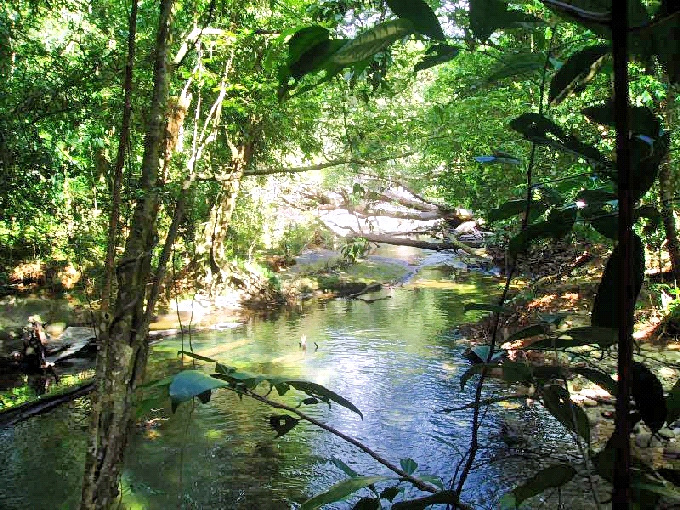
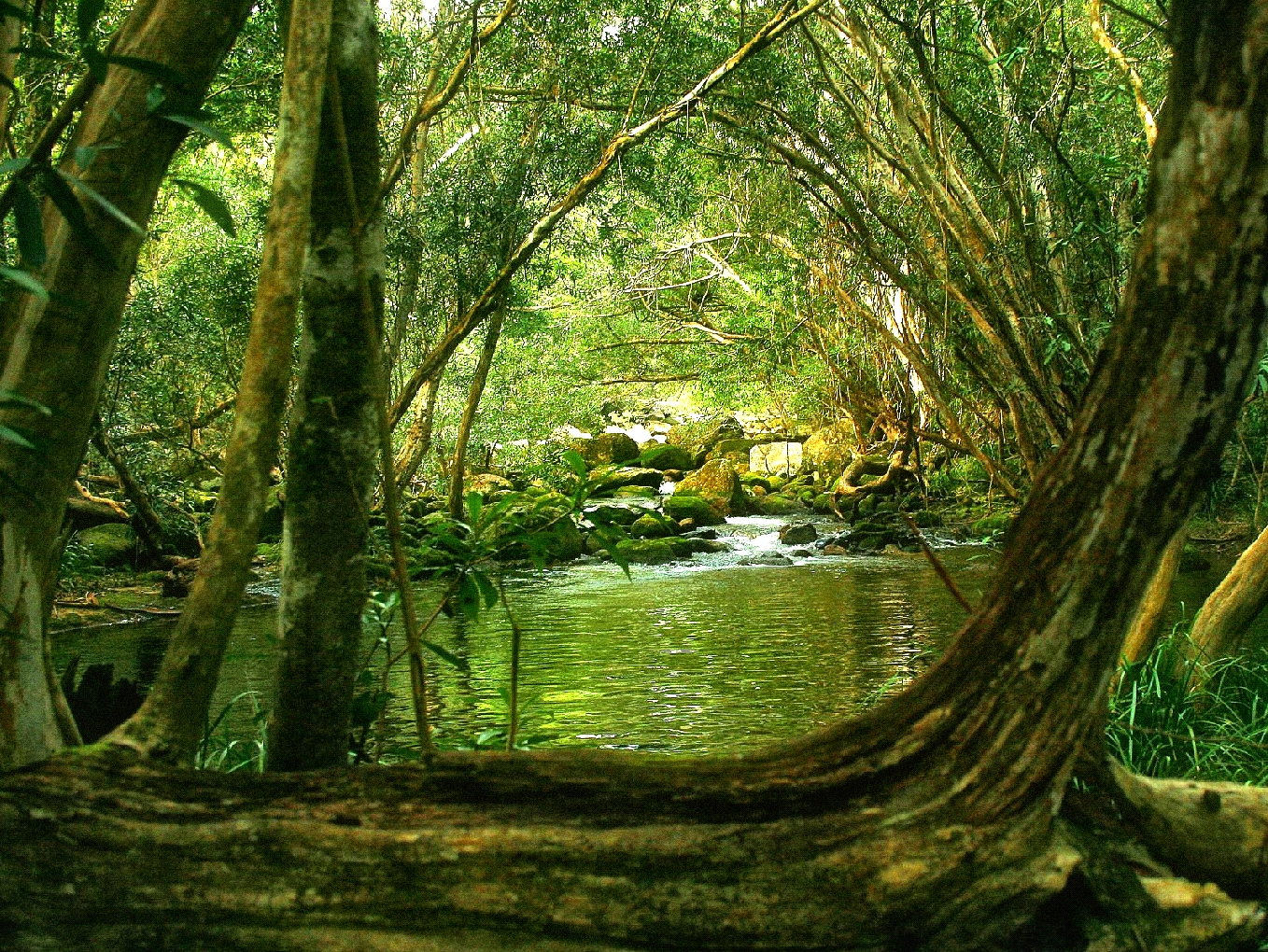
Upland streams generally have higher water flow over a substrate composed mainly of large rocks and bedrock with sand and fine gravel with good riparian cover (remnant rainforest) and minimal aquatic plants. Small lowland streams usually have mud, sand and fine gravel substrates with abundant leaf litter. They are generally found in small schools swimming above or among aquatic plants, woody debris and leaf litter. They are often found in company with Melanotaenia splendida, M. maccullochi and M. utcheensis.
The temperature range recorded in their natural habitat is 15 –29° Celsius. The pH in their natural habitat has been reported from 4.5–8.5 (lowland 4.5–6.8, upland 7.5–8.5). Conductivity from almost zero to 91 mS. Their diet is not well documented but appears to be dominated by small terrestrial insects and spiders.
Remarks
Breeding
Very little is known about the natural life history and ecology of Cairnsichthys rhombosomoides in their natural environment. In their natural environment spawning fish have been observed from April through to December with a peak in August to October. Like all members of the rainbowfish family, Cairnsichthys rhombosomoides are egg -scatterers and generally spawn amongst aquatic plants and leaf litter, with a small number of eggs being deposited at a time. In captivity, I have on a regular basis observed this species spawning in the gravel substrate. Sexual maturity occurs at about 3-4 cm for both sexes.
Fish commence spawning in their first year and mature females produce between 40 and 200 eggs. The number of eggs shed by a single female is directly related to the size of the female. Eggs adhere to water plants and hatching occurs after 5–9 days depending on temperature. Egg size is around 1.139 ± 0.021 mm with larvae hatching at about 3.46–5.46
References
- Burrows D.W. (1998) FNQ 2010 Regional Environment Strategy - Key Waterways Report. ACTFR, Townsville, Qld.
- Hammer M.P., G.R. Allen, K.C. Martin, M. Adams, B.C. Ebner, T.A. Raadik and P.J. Unmack (2018) Revision of the Australian Wet Tropics endemic rainbowfish genus Cairnsichthys (Atheriniformes: Melanotaeniidae), with description of a new species. Zootaxa 4413 (2): 271-294.
- Martin K.C. and S. Barclay (2013) New Distribution Records for the Cairns Rainbowfish Cairnsichthys rhombosomoides (Melanotaeniidae): implications for conservation of a restricted northern population. aqua, International Journal of Ichthyology, 19(3): 155-164.
- Nichols J.T. and H.C. Raven (1928) A New Melanotaeniin fish from Queensland. American Museum Novitates Nr. 296, American Museum of Natural History.
- Pusey B.J., M.J. Kennard and A.H. Arthington (2004) Freshwater Fishes of North-Eastern Australia. CSIRO Publishing, Victoria.
- Thuesen P.A., B.J. Pusey, D.R. Peck, R. Pearson and B.C. Congdon (2008) Genetic differentiation over small spatial scales in the absence of physical barriers in an Australian rainforest stream fish. Journal of Fish Biology 72(5): 1174-1187.