

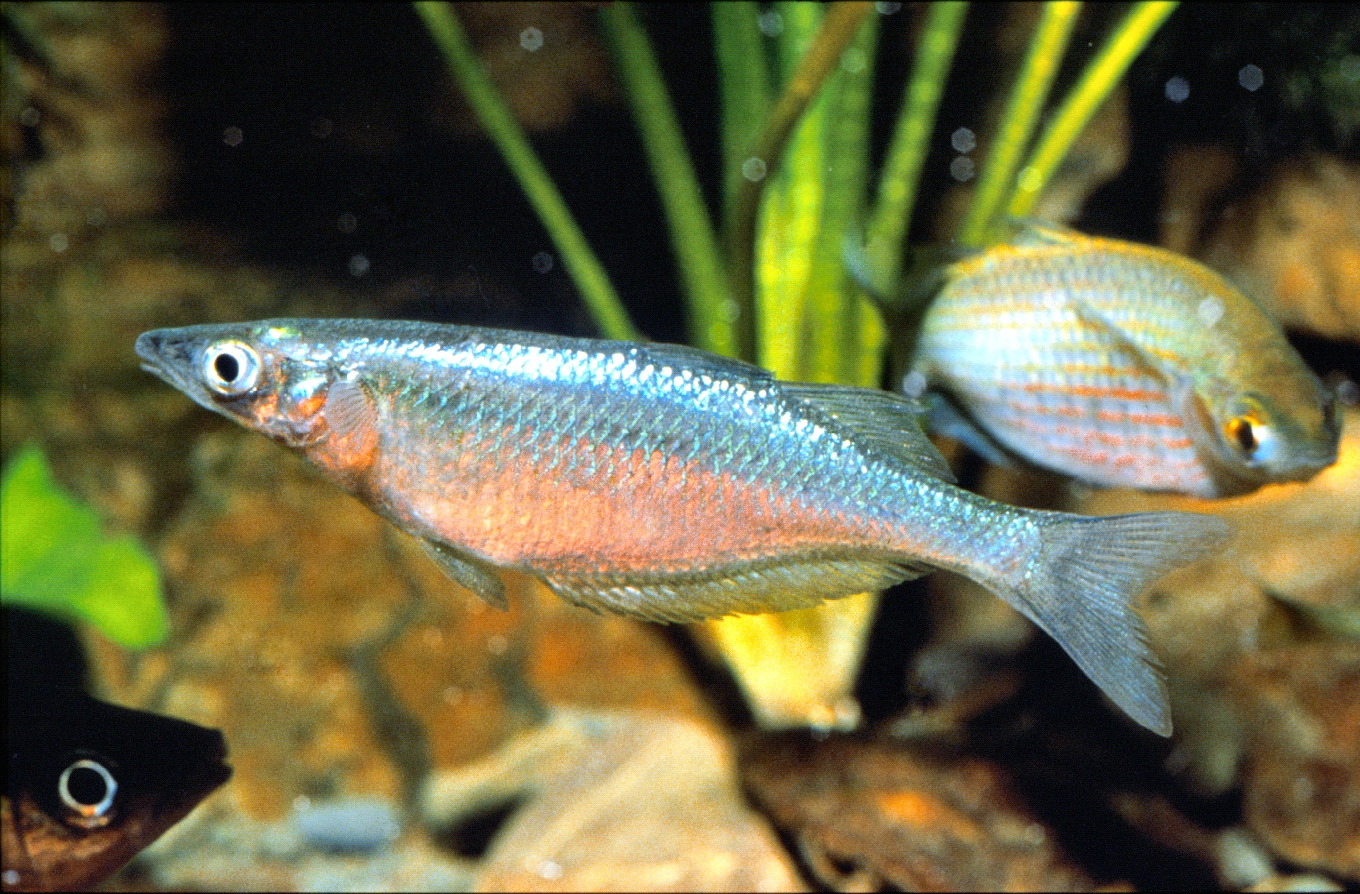
Chilatherina crassispinosa
Silver Rainbowfish
Synonymy
- Rhombatractus crassispinosus Weber, 1913
- Centratherina crassispinosa Regan, 1914
- Chilatherina crassispinosa Regan, 1914
Species Summary
Chilatherina crassispinosa has an overall silvery body, shading to bluish dorsally and white ventrally. Fins translucent, except anal and pelvis fins and base of second dorsal fin often yellowish in males; dorsal and ventral edges of caudal fin with narrow black margin. Males have narrow orange stripes on the sides; one between each scale row and are generally deeper bodied than females. Males have more intense colouration, particularly with regards to the orange stripes and the yellow colour of the vertical fins. Chilatherina crassispinosa are similar to Chilatherina bulolo, but have a more pointed head, taller first dorsal fin, and a narrower space on top of the head between the eyes. Maximum size of males to about 10 cm SL, females to about 8 cm.
Etymology
The species name crassispinosa combines the Latin crassus, fat or stout, and spinosus, spiny, presumably referring to the curved first spine of the second dorsal fin, thicker than the first spine of the first dorsal fin.
Etymology compiled from C. Scharpf (2021), “Fishes of Sahul: An Etymological Survey (Part 4), the Rainbowfishes”, Fishes of Sahul 35(1): 1706–1714, and etyfish.org.
Distribution & Habitat
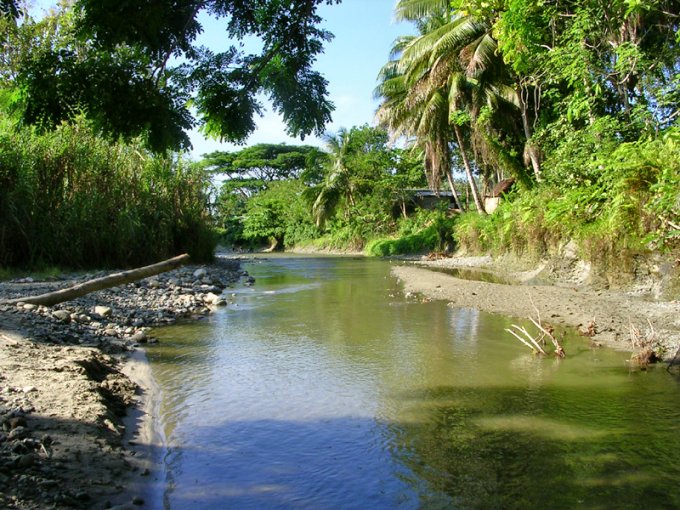
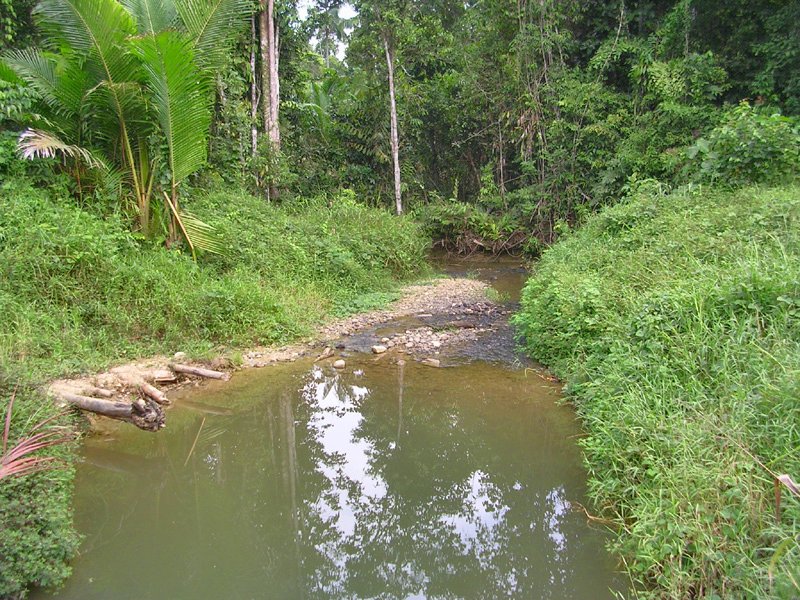
Known from foothill tributaries of the Torricelli Range on the northern side of the Sepik River Basin. They also occur in the upper Ramu system and streams in the Bewani Mountains flowing into the Neumayer River, both in Papua New Guinea, north of the Sepik.
The range extends into northern West Papua where it is known from several coastal streams just to the west of Jayapura and from a few scattered locations in the Mamberamo system. This species was initially collected from the Tawarin River, West Papua during 1903. It is widely distributed in northern New Guinea. It is found in the following rivers system: Begowre, Buarin, Gogol, Mamberamo, Pual, Ramu, Sepik and Sermowai. It also occurs in a number of smaller independent drainages along the northern coast.
Chilatherina crassispinosa are found in slow flowing, clear water, streams and quiet pools, in water temperatures between 24-28° Celsius and pH 7.5-8.5. These streams are usually situated in hilly (rainforest) terrain. The fish congregate in exposed sections, which receive full sunlit for most of the day. Other rainbowfishes sometimes found together with this species include Chilatherina lorentzii, Chilatherina fasciata, and Melanotaenia affinis.
Remarks
This species was previously recorded from the Markham system of Papua New Guinea by Allen and Cross (1982), but in a subsequent paper by Allen (1983) the Markham population was shown to be a distinct species, Chilatherina bulolo. Live specimens were collected in 1980 and 1983, and transported to Australia. However, they were never popular or widely available and their status in the hobby today is uncertain.
References
- Allen G.R. (1983) Chilatherina bulolo a valid species of rainbowfish (Melanotaeniidae) from northern New Guinea. Fishes of Sahul 1(2): 13-17.
- Allen G.R. & N.J. Cross (1982) Rainbowfishes of Australia and Papua New Guinea. T.F.H. Publications (New Jersey, U.S.A.).