
Glossolepis dorityi
Grime Rainbowfish
Species Summary
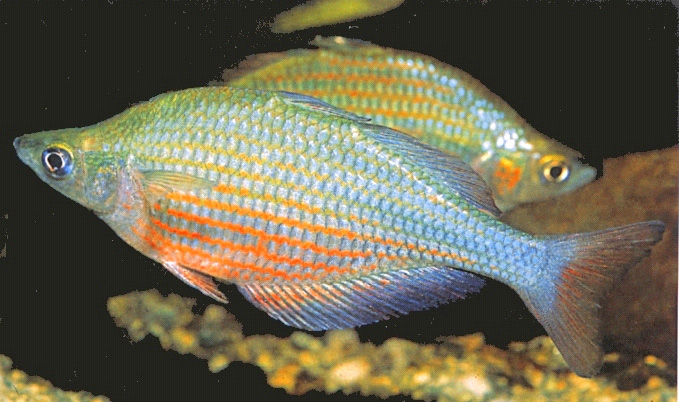
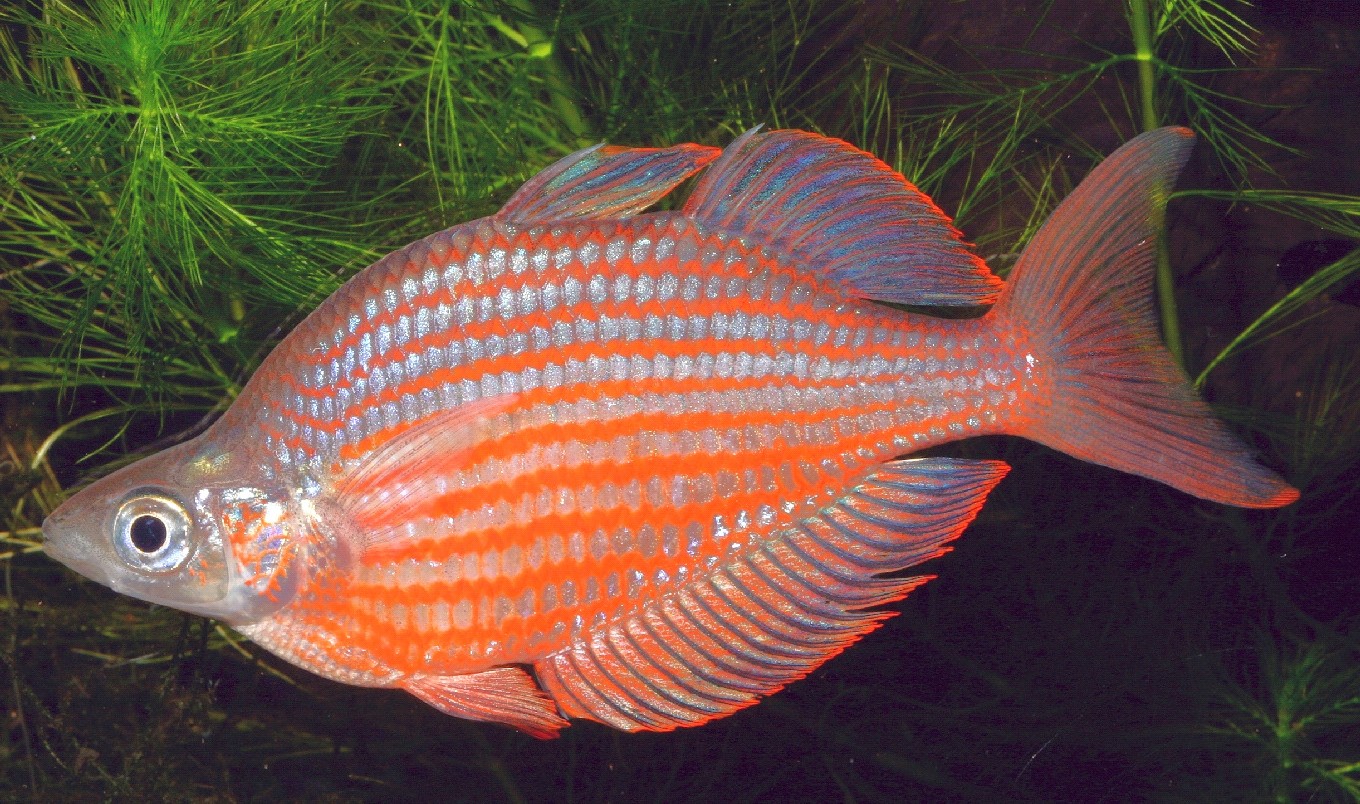
Glossolepis dorityi males have a body colour that is generally greenish with silvery reflections on the back, nape, and side of head. They have a dull orange or bronze stripe between each scale row of upper half of body; red-orange stripe between each scale row of lower half of body, especially prominent during courtship activities. Fins greenish to translucent, but with pinkish or red-orange hue on ventrals and basal half of anal and second dorsal. Female generally greenish with silvery reflections and lacking orange or red-orange stripes between scale rows. Males generally possess a deeper body and have elongated posterior rays on the dorsal and anal fins. Males may reach a maximum size of 10 cm, but females are usually less than 8 cm SL. This species is named “dorityi” in honour of Dan Dority for his efforts in collecting the type specimens.
Etymology
The genus name Glossolepis combines the Greek glossum, tongue, and lepis, scale, referring to the tongue-shaped incisions (crenulated margins) on the scales of G. incisa. The species is named in honour of American missionary and rainbowfish enthusiast Dan Dority, who helped collect the holotype.
Etymology compiled from C. Scharpf (2021), “Fishes of Sahul: An Etymological Survey (Part 4), the Rainbowfishes”, Fishes of Sahul 35(1): 1706–1714, and etyfish.org.
Distribution & Habitat
Glossolepis dorityi is currently known only from the Grimé River region of northern West Papua. The area was formerly known by the Dutch administrators as the Nimboran (Grimé) Plain. It is located roughly 50 kilometres west of Lake Sentani.
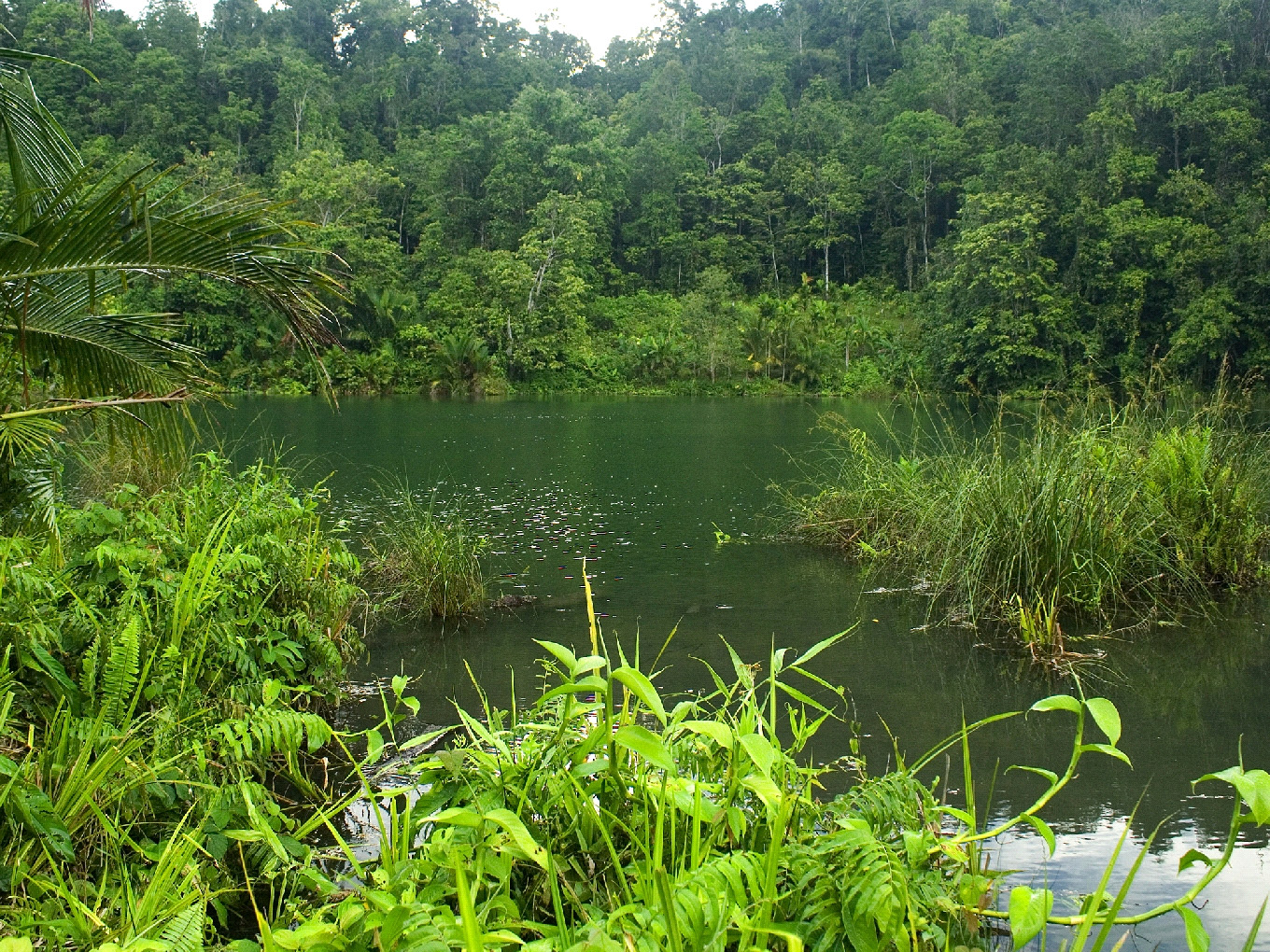
The type locality consists of a small round lake (Lake Nenggwambu or Lake Kali Biru). There is a vigorously flowing outlet stream, but no apparent inlet, indicative of a subterranean connection with neighbouring lakes via the limestone substratum. Water was relatively clear and maximum depth was estimated to be at least 10–15 m. The lake is surrounded by secondary forest and aquatic plants were abundant, but relatively few species were evident. Fishes were most strongly congregated around the outlet, where vegetation was very dense. Glossolepis dorityi was the most abundant fish species and a second rainbowfish, C. fasciata was also common. The body colouration of this C. fasciata variety is mostly an orange to mauve and shows a golden luminescent nuptial stripe on their forehead which is switched on and off during spawning.
Remarks
Dan Dority and David Price collected Glossolepis dorityi in April 2000. Heiko Bleher found this species in May 1999 in Lake Nenggwambu, but was unable to collect any specimens. However, in a nearby lake (Lake Jaigum) he collected specimens of the same species. Unfortunately only two males survived the journey back to Europe. He returned in November of the same year - but once again was unsuccessful in collecting specimens. However, during his third journey, at the end of 2000, he succeeded in catching six adult specimens. He also collected more specimens from Lake Jaigum. He eventually returned to Europe with four males and one female. Further live specimens were collected in 2008 by Dan Dority, Gary Lange and Johannes Graf. Specimens from both lakes are currently available in the hobby.
The rainbowfishes in Lake Nenggwambu are in serious danger of extinction due to the introduction of predatory fishes such as Channa striata and Cyprinus carpio. The formerly crystal-clear water is now muddy and dark brown. Water plants (Ottelia sp.) are completely gone. Glossolepis dorityi and C. fasciata are also heavily infested with Lernaea sp. (anchor worms) due to the introduction of the exotic fish species. The population of G. dorityi in Lake Jaigum is now thought to no longer exist in the lake (J. Graf 2009, pers. comm.).
References
- Allen G.R. (2001) A new species of rainbowfish (Glossolepis: Melanotaeniidae) from Irian Jaya, Indonesia. Fishes of Sahul - Journal of the Australia New Guinea Fishes Association 15(3): 766-775.