

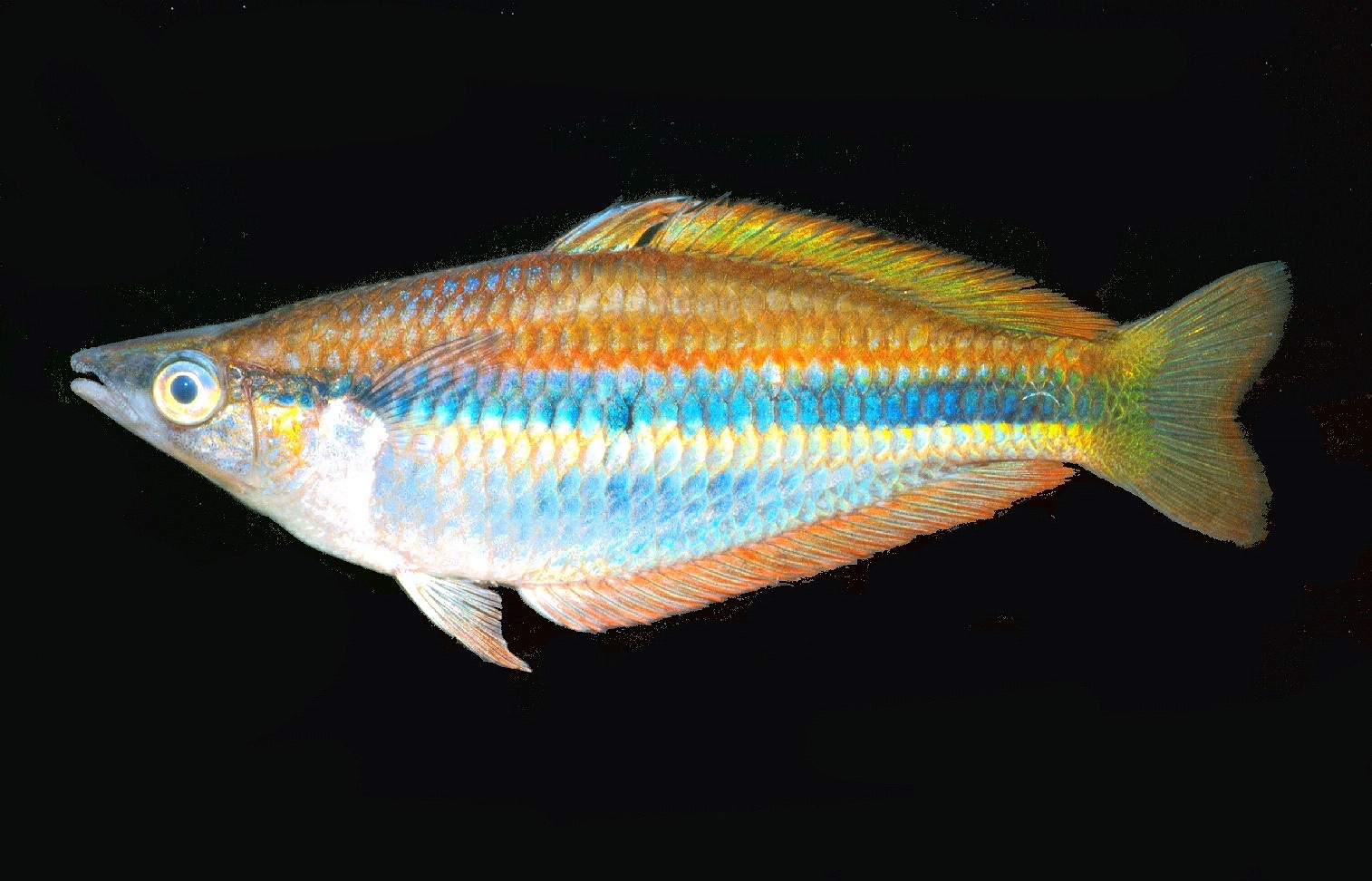
Melanotaenia rubripinnis
Red-finned Rainbowfish
Species Summary
Melanotaenia rubripinnis have a body colouration that is red on the back, mainly white on lower half of body except for blue smudge above anterior part of anal fin. A black stripe runs from the rear edge of the eye to the pectoral fin base, continuing as a blue-black mid-lateral stripe to the base of caudal fin. The mid-lateral stripe is more or less uniform in width, bordered by a narrow blue stripe above and broader yellow stripe below. The dorsal, anal and caudal fins are redorange. The pectoral and pelvic fins are translucent. Specimens from more open habitats are brown above and white below with a black mid-lateral stripe that is narrowly bordered above and below by a light blue stripe.
Occasional specimens from mountain streams are uniformly bluish except for a white breast region and black stripe between the eye and pectoral-fin base. Males have a more intense colour pattern, especially specimens from dense lowland rainforest streams. May reach a maximum size of 12 cm, but usually less than 10 cm SL.
Melanotaenia rubripinnis is most closely related to M. vanheurni from the Mamberamo River system. However, it differs in colour and modal number of soft dorsal rays (usually less than 18 in M. rubripinnis and more than 18 in M. vanheurni). In addition, M. rubripinnis has fewer cheek scales (range 17-26, average 19.9 vs. range 19-36, average 29.2).
Etymology
The species name rubripinnis combines the Latin ruber, red, and pinnis, fin, referring to its red-orange dorsal, anal and caudal fins.
Etymology compiled from C. Scharpf (2023), “Fishes of Sahul: An Etymological Survey (Part 6), the rainbowfishes (continued)”, Fishes of Sahul 37(1): 2006–2022, and etyfish.org.
Distribution & Habitat
Melanotaenia rubripinnis is currently known only from tributary streams of the Tirawiwa and Logari river systems in north-western New Guinea. They were relatively common in a variety of habitats including tannin-stained creeks in lowland rainforest, larger streams in more open situations, and mountain tributaries to an elevation of about 400 metres above sea level. They have been found in quiet shaded pools, as well as sunlit sections of larger streams and relatively fast-flowing mountain streams. They were found together with Chilatherina alleni and Glossolepis leggetti. Melanotaenia rubripinnis and Chilatherina alleni generally co-occur in the same streams and are also sometimes found with Glossolepis leggetti in lowland streams immediately adjacent to foothills.
Stream habitat consists of gravel, rock, and sandy bottoms with log snags and leaf debris; water clear, but darkly stained with slight to moderate flow in closed-canopy rainforest. Water temperature 24–31°C, pH 6.0–7.8
Remarks
Melanotaenia rubripinnis was collected during a Conservation International survey of the Wapoga River drainage in 1998 by Gerald Allen and Samuel Renyaan. It was named “rubripinnis” (Latin: with red fins), with reference to the characteristic fin colouration. Currently, no live specimens have been collected for the aquarium hobby.
References
- Allen G.R. & S.J. Renyaan (1998) Three new species of rainbowfishes (Melanotaeniidae) from Irian Jaya, Indonesia. Aqua, Journal of Ichthyology and Aquatic Biology 3(2): 69-80.
- Allen G.R. & S. Renyaan (2000) Fishes of the Wapoga River System. In: A.L. Mack and L.E. Alonso (eds.) A Biological Assessment of the Wapoga River Area of Northwestern West Papua, Indonesia. RAP Bulletin of Biological Assessment 14, Conservation International, Washington, DC. pp 47-53, 101-112.