
Melanotaenia kolaensis
Kola Rainbowfish
Species Summary
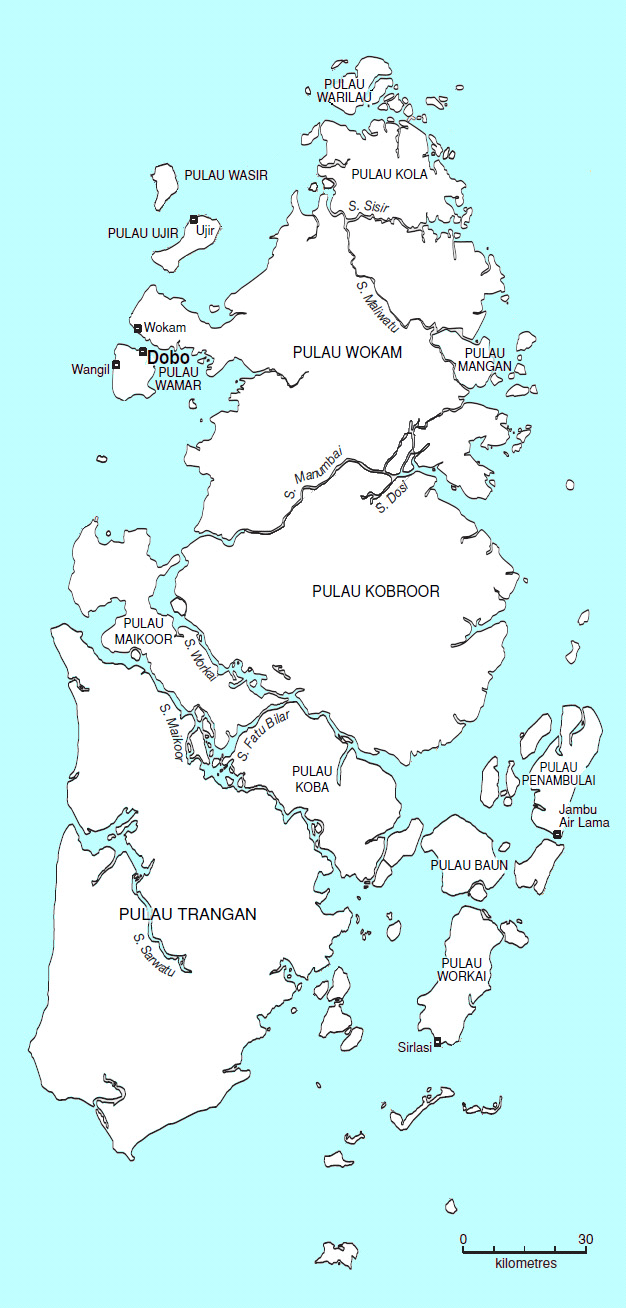
The Aru Archipelago, a cluster of islands on the shallow continental shelf between New Guinea and northern Australia, was largely overlooked by ichthyologists for a century after Dutch collectors first sampled its rivers in 1907–09. Aquarium enthusiast Heiko Bleher brought Aru rainbowfishes to hobbyist attention after visits in 2004 and 2007, and two expeditions in 2013 (organised by Gerald Allen, Mark Erdmann and colleagues, with genetic work by Peter Unmack) revealed the islands to be an unexpected hotspot of rainbowfish speciation: seven species in all, most found nowhere else. Melanotaenia kolaensis belongs to the Aru ‘Goldiei’ group, along with M. picta, M. wokamensis and M. senckenbergianus. It reaches the deepest body of any member of this group (the holotype’s body depth of 36.2% SL is the highest on record for the complex).
Etymology
The species name kolaensis is a suffix denoting place, referring to Kola Island, Aru Islands, Maluku Province, Indonesia, the type locality.
Etymology compiled from C. Scharpf (2022), “Fishes of Sahul: An Etymological Survey (Part 5), the rainbowfishes (continued)”, Fishes of Sahul 36(4): 1968–1992, and etyfish.org.
Distribution & Habitat
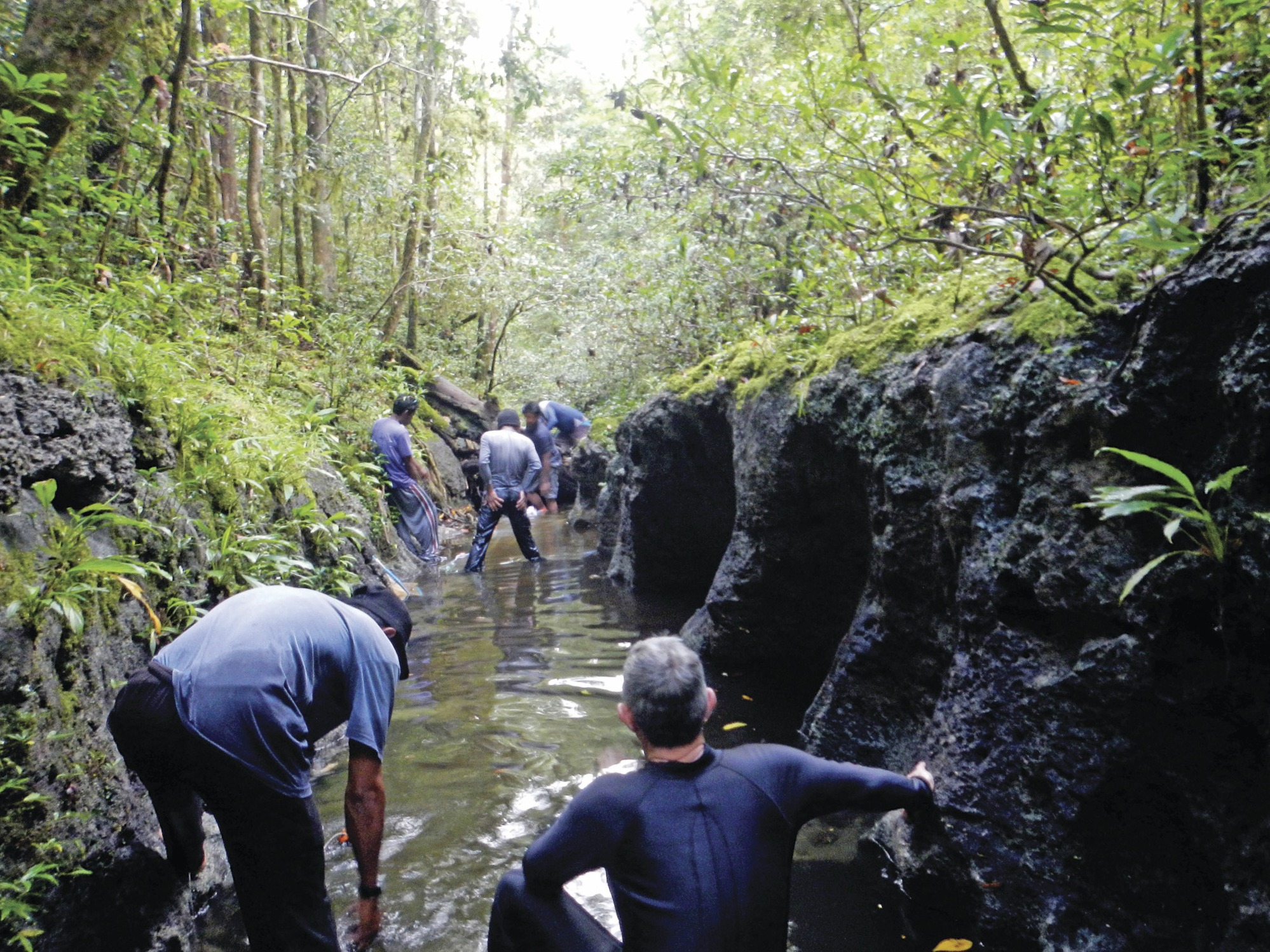
Melanotaenia kolaensis is known from two drainages about 7–8 km apart on Kola, the northernmost large island of the main Aru Group. The type locality lies some 11 km upstream, where a broad, mangrove-lined tidal reach narrows abruptly into a steep-walled limestone channel of pure fresh water; the fish was found just beyond the navigable limit of the stream.
Description & Comparison with Similar Species
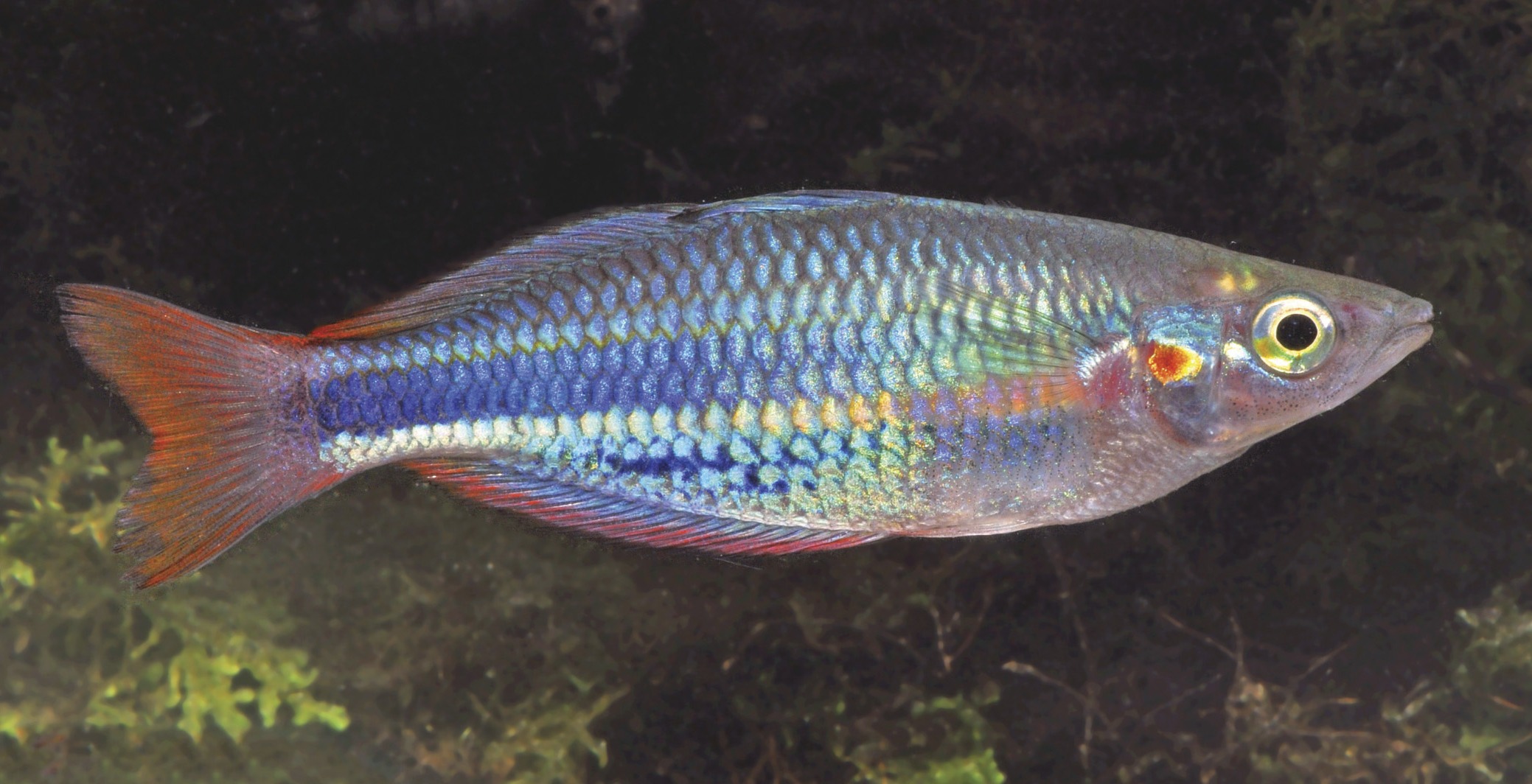
Live fish are light blue to blue-green above with a dark blue mid-lateral stripe, especially bold on the rear third of the body, edged below by a prominent white to pale blue stripe running forward along the lower caudal peduncle; a bright blue patch marks the flank behind the pectoral fin, and the second dorsal, anal and caudal fins carry a reddish suffusion. It is most similar to Melanotaenia kolaensis of neighbouring Wokam Island (separated by the wide Sungai Sisirwatu), the two sharing scale counts distinct from M. picta and M. senckenbergianus but differing in that Melanotaenia kolaensis lacks the bold red-orange stripes flanking the dark mid-line seen in M. wokamensis, and has more cheek scales.
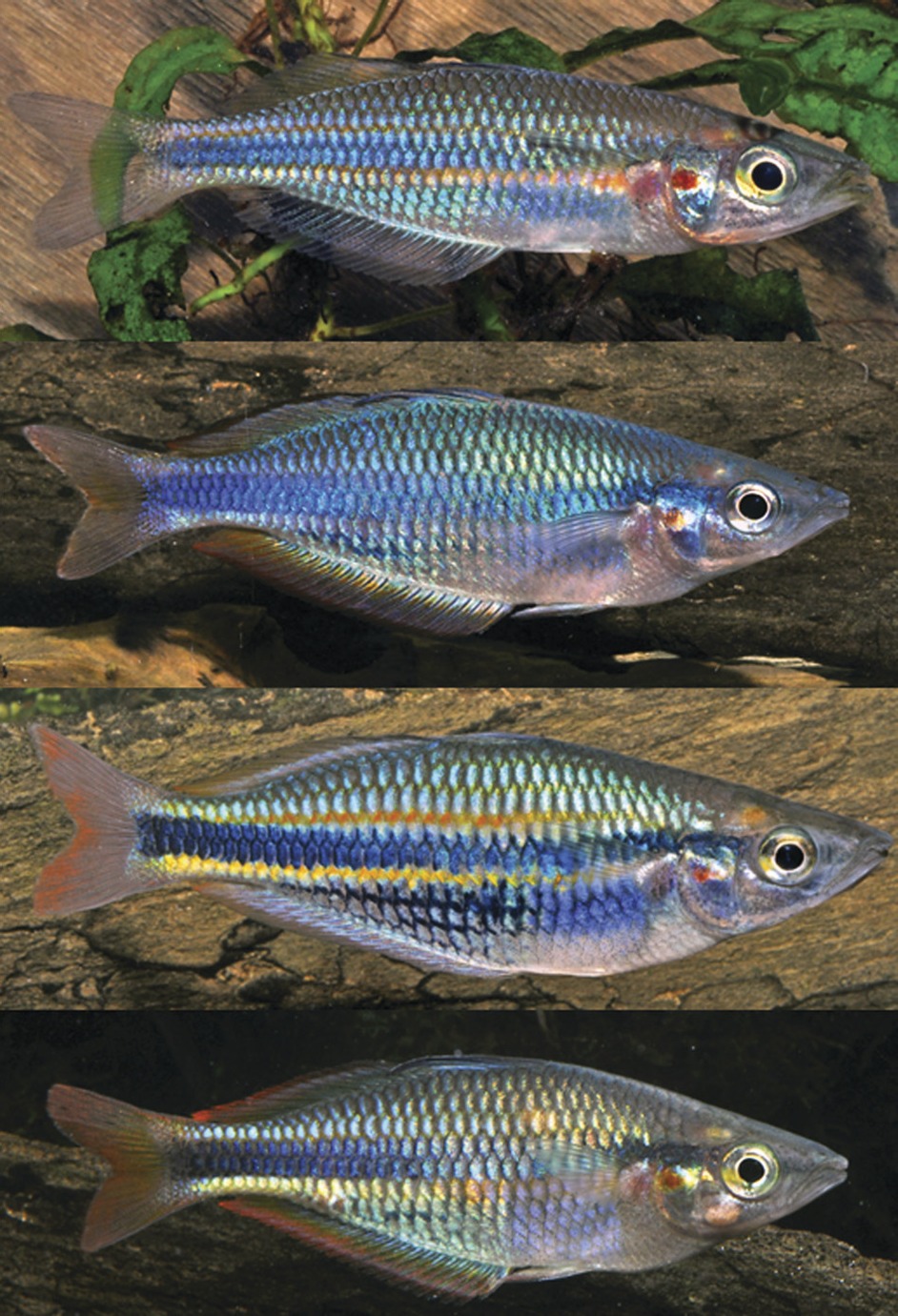
Account compiled for Home of the Rainbowfish from G. R. Allen, R. K. Hadiaty, P. J. Unmack & M. V. Erdmann (2015), “Rainbowfishes of the Aru Islands, Indonesia with descriptions of five new species and redescription of M. patoti Weber and M. senckenbergianus Weber”, aqua, International Journal of Ichthyology, 21(2): 71–106.
References
- Allen G.R., R.K. Hadiaty, P.J. Unmack and M.V. Erdmann (2015) Rainbowfishes (Melanotaenia: Melanotaeniidae) of the Aru Islands, Indonesia with descriptions of five new species and redescription of M. patoti Weber and M. senckenbergianus Weber. aqua, International Journal of Ichthyology 21(2): 66-108.