
Melanotaenia jakora
Jakora Rainbowfish
Species Summary
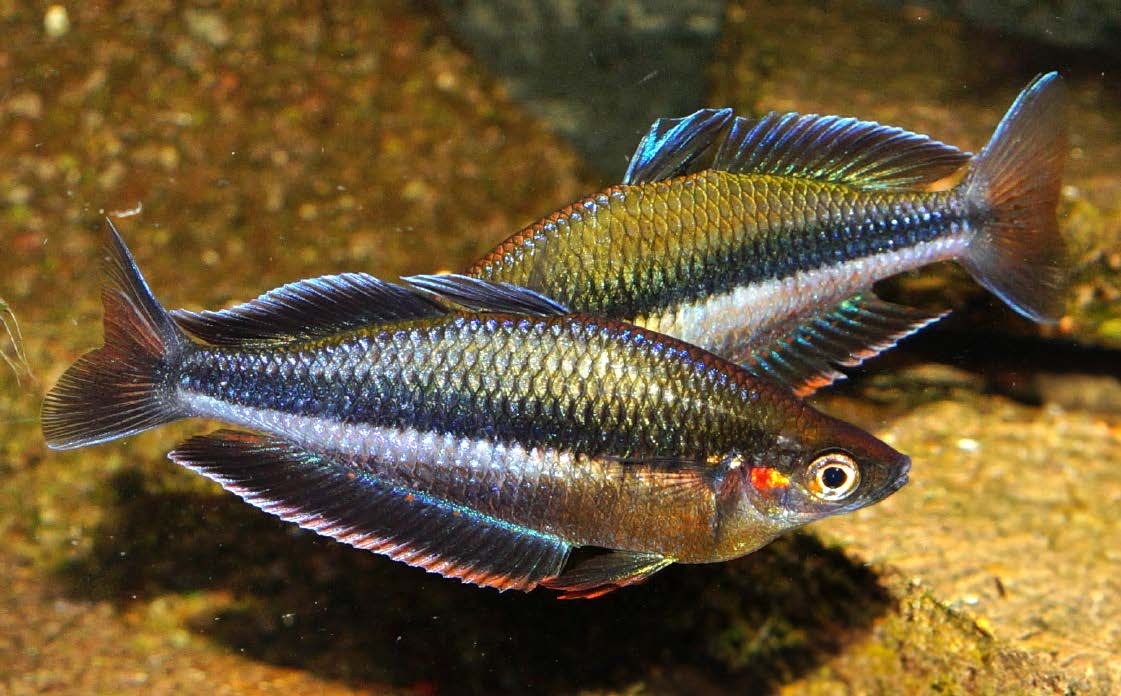
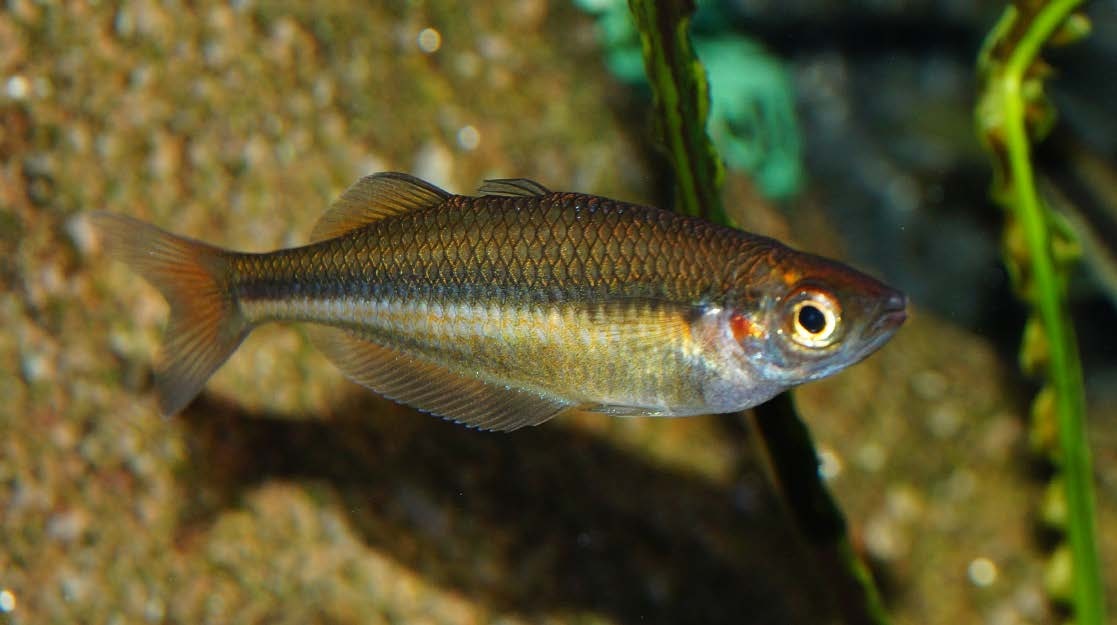
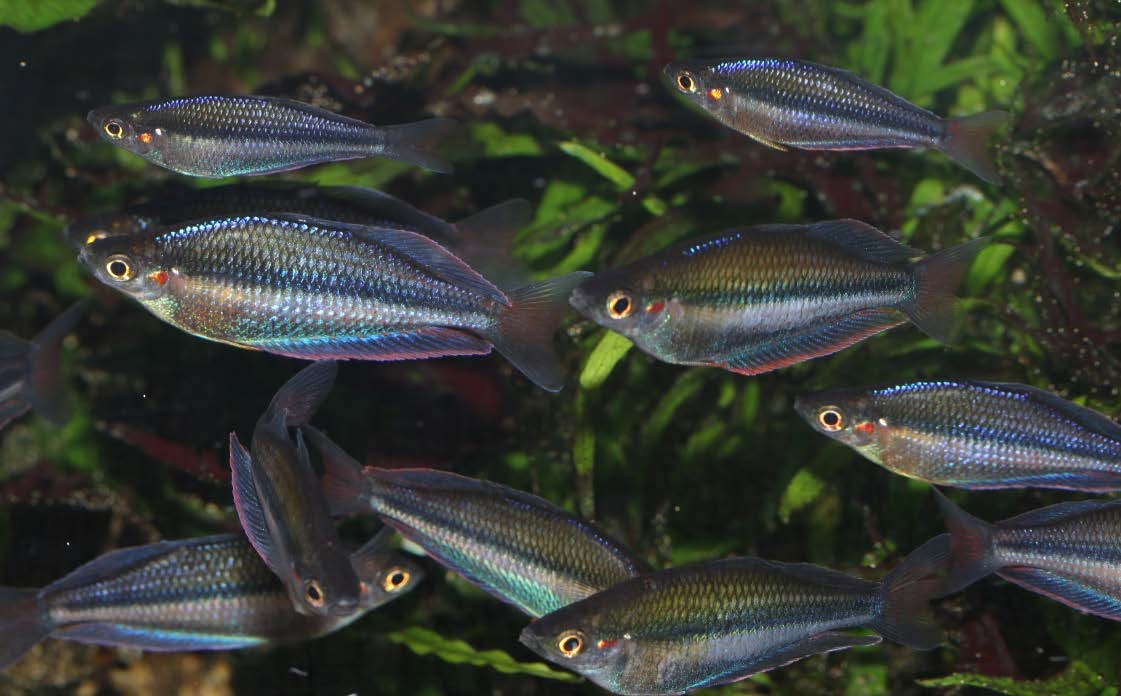
Melanotaenia jakora is a small, slender rainbowfish described in 2023 from the southern Vogelkop (Bird’s Head) Peninsula of Papua Barat Province, in western New Guinea (Indonesia). It is a modest fish, reaching only about 65 mm in standard length, but the males are strikingly coloured. The back is blackish-brown, grading to brown along the upper flanks, and is crossed by a bold dark midlateral stripe two scale-rows deep with a whitish-silver stripe beneath it. In direct light the whole body takes on an iridescent blue sheen; the lower part of the gill cover is red and the fins carry bluish-white margins. The unpaired fins of adult males are moderately elongated, their tips reaching back to the base of the tail. Females are plainer — brown with a dark midlateral stripe and faint orange stripes low on the body. Genetic analysis indicates that Melanotaenia jakora is a distinct lineage, not closely allied to the other rainbowfishes of the Vogelkop Peninsula and most closely related to the wider Bird’s Head lineage. It was known to aquarists before it was formally named, under the interim label Melanotaenia sp. “Kali Jakora”.
Etymology
The species is named for the village of Jakora, Papua Barat Province, Indonesia, the closest named locality to the type locality, an unnamed rainforest creek in the Sebjar River system.
Etymology compiled from The ETYFish Project (etyfish.org), accessed 2026, since this species postdates Christopher Scharpf’s published Fishes of Sahul etymology survey.
Distribution & Habitat
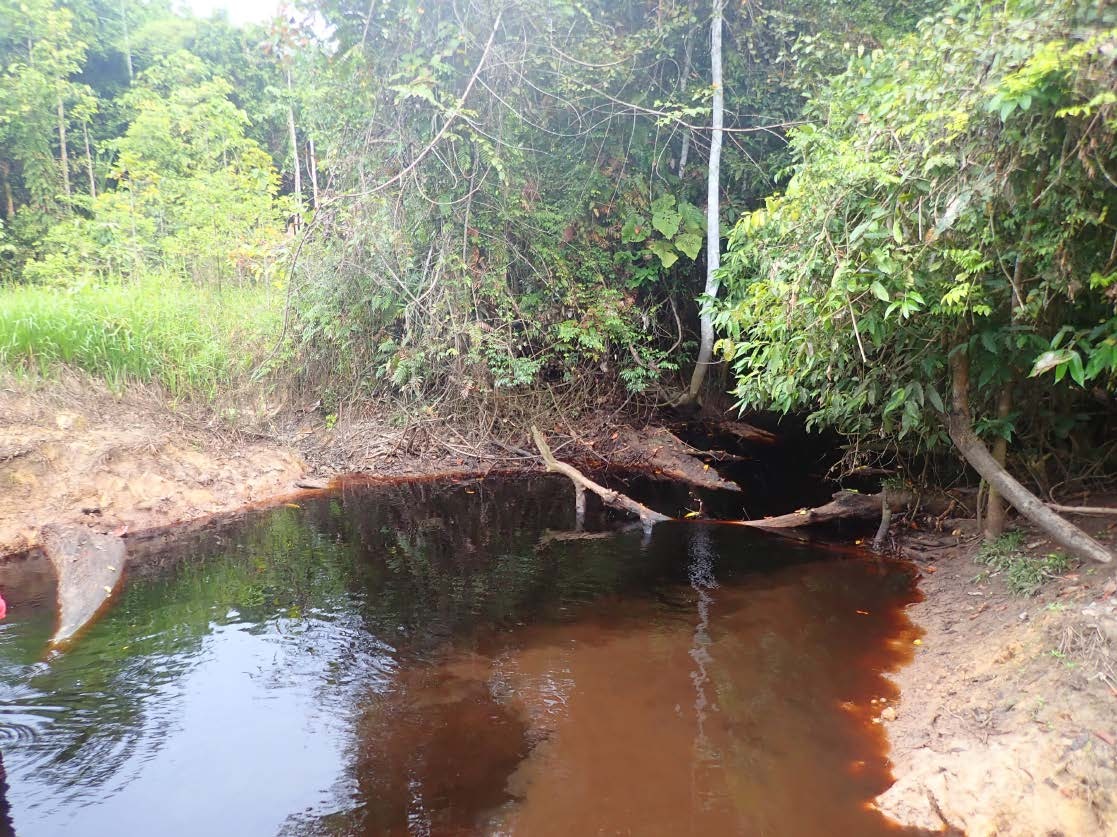
Melanotaenia jakora is known only from the vicinity of Meyado and Jakora village in the Sebjar (Sungai Sebjar) River system, in the southern part of the Vogelkop Peninsula, Papua Barat Province, Indonesia, and appears to be endemic to that small area. The type series was collected in August 2017 from a shaded rainforest creek crossing the road between Meyado and Jakora — a blackwater habitat stained dark with tannins, with a muddy substrate and no submerged aquatic plants. The water was soft and acidic: about 26 °C, conductivity around 30 µS, pH 6.4, and hardness below the limit of measurement. The only other fish recorded alongside it was an undescribed Melanotaenia of the local Vogelkop group.
Description
A small species, adults less than 65 mm SL, with a slender body (body depth about 3.4 times in standard length). The dorsal fin has IV (III–V) spines followed by I,10 (I,9–12) soft rays; the anal fin has I,20 (18–22) rays; pectoral rays 13; pelvic I,5; and the caudal fin has 15 branched rays. There are 37 (35–39) lateral scales, 21 (18–25) predorsal scales, and 14 (11–17) gill rakers on the first arch. In adult males the dorsal and anal fins are elongated, their tips reaching the base of the caudal fin. The species is distinguished from other Vogelkop rainbowfishes by this combination of counts together with the male colour — scales without dark margins, a reflective blue body sheen, and an unbroken midlateral stripe. In body shape it most resembles the Australian Melanotaenia gracilis, but it differs consistently in its fin-ray and scale counts.
Keeping & Caring
In the aquarium Melanotaenia jakora is a peaceful, rather retiring rainbowfish that does not compete well with more boisterous tankmates, so a single-species tank suits it best. Given soft, humic-rich water at around 25 °C, moderate lighting from the front, and a layout of driftwood and some plants, the males display their iridescent colours to full effect and their courtship is a highlight. Like most small rainbowfishes the species is short-lived — roughly two years — so it is worth keeping young fish coming on, for example by providing floating plants or dense Java moss in which fry can find refuge. Sexual maturity is reached at about six months of age.
Breeding
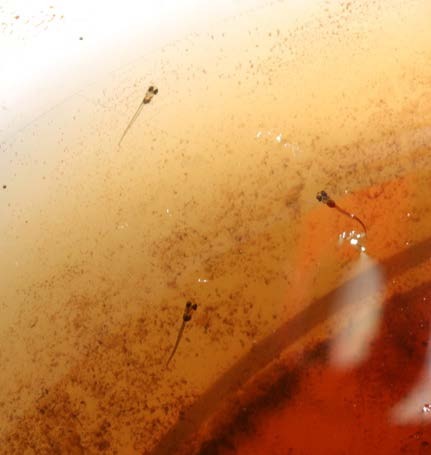
Melanotaenia jakora spawns readily on a mop of synthetic yarn in soft, slightly acidic water, but rearing the eggs proved unusually demanding. Early attempts failed because the eggs turned white and died in ordinary, moderately hard water; success came only after the blackwater conditions of the type locality were reproduced. The breeders eventually established that it was the low pH — not the humic substances themselves — that mattered, with eggs developing only at roughly pH 4 to pH 5. The eggs are clear when laid and darken to light brown as they develop, hatching in about 8–10 days depending on temperature. Newly hatched larvae take infusoria at first and then brine shrimp nauplii. After several captive generations the line appears to be domesticating, with recent broods hatching successfully in softer water up to about pH 6.5.
Remarks
The creek itself was known locally as “Kali Jakora”. The species reached hobbyists before it was formally described, under the interim name Melanotaenia sp. “Kali Jakora”, and because of its demanding blackwater breeding requirements it has so far remained uncommon in the hobby. As with many New Guinea rainbowfishes, its natural habitat is under pressure from deforestation, which adds conservation value to maintaining the species in aquaria.
Account compiled for Home of the Rainbowfish from J. A. Graf, H. L. Ohee, F. Herder & Haryono Haryono (2023), “A new species of rainbowfish (Melanotaeniidae), Melanotaenia jakora, from western New Guinea (Papua Barat Province, Indonesia)”, Fishes of Sahul 37(2): 2063–2068, and J. A. Graf (2023), “The discovery of Melanotaenia jakora and hints for keeping and breeding”, Fishes of Sahul 37(2): 2069–2072.