
Melanotaenia garylangei
Gary Lange’s Rainbowfish
Species Summary
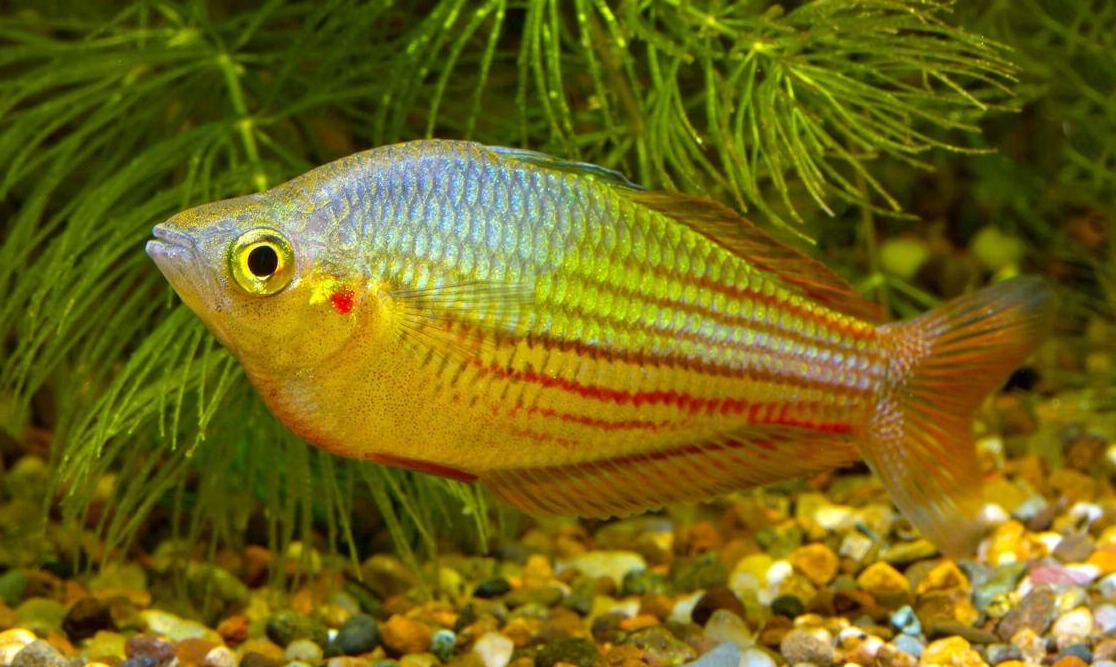
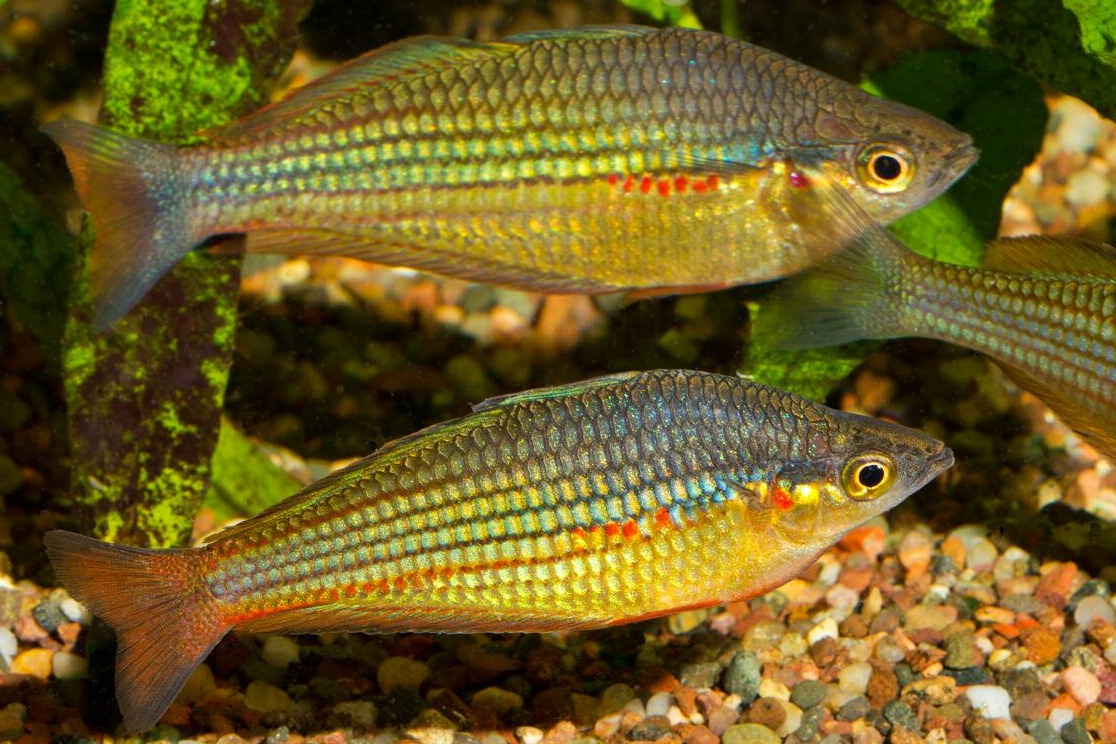
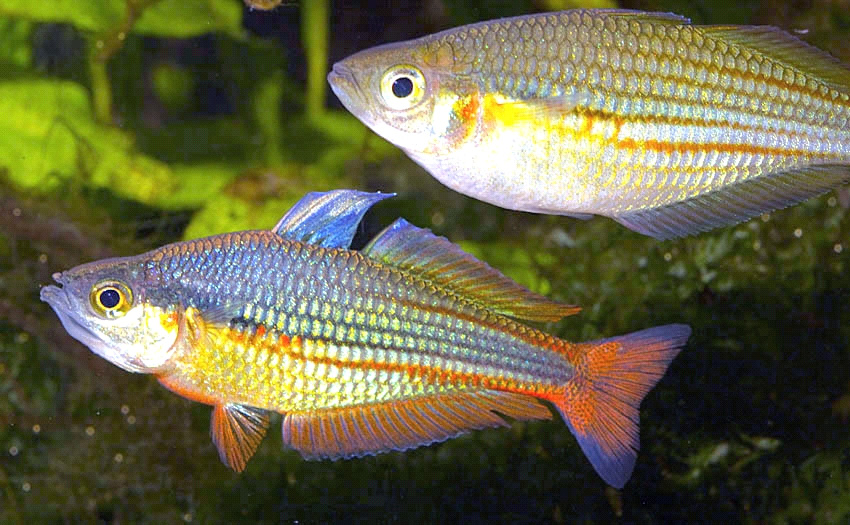
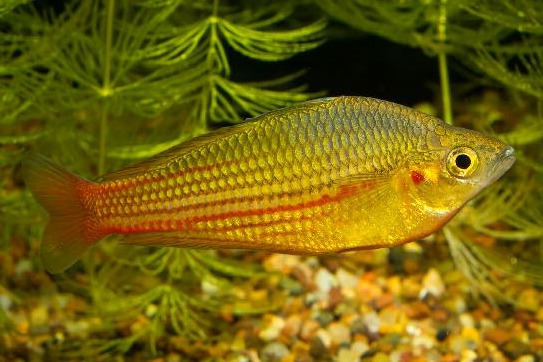
Melanotaenia garylangei is a medium-sized rainbowfish from the Dekai region in the central-southern part of Papua Province, in western New Guinea (Indonesia). It belongs to the “maccullochi” species group — a southern-New-Guinea and northern-Australian clade of small, similarly patterned rainbowfishes — and was the seventh member to be described. Adult males are handsomely coloured: the nape and upper fore-body are iridescent blue, grading to olive-green along the back and yellowish along the sides, with a red to orange belly and a golden-yellow eye. A blackish stripe runs along the midline, flanked above and below by fine red stripes, and the second dorsal, pectoral, anal and central caudal fins are red while the first dorsal is light blue. Females are plainer — light brown above and whitish below, without the blue nape or red fins. The species was collected in 2010 and established in the aquarium hobby well before it was formally described in 2015. In the hobby it is also known as the Golden Rainbowfish.
Etymology
The species is named in honour of Gary William Lange, a well-known rainbowfish enthusiast, who discovered this species.
Etymology compiled from C. Scharpf (2022), “Fishes of Sahul: An Etymological Survey (Part 5), the rainbowfishes (continued)”, Fishes of Sahul 36(4): 1968–1992, and etyfish.org.
Distribution & Habitat
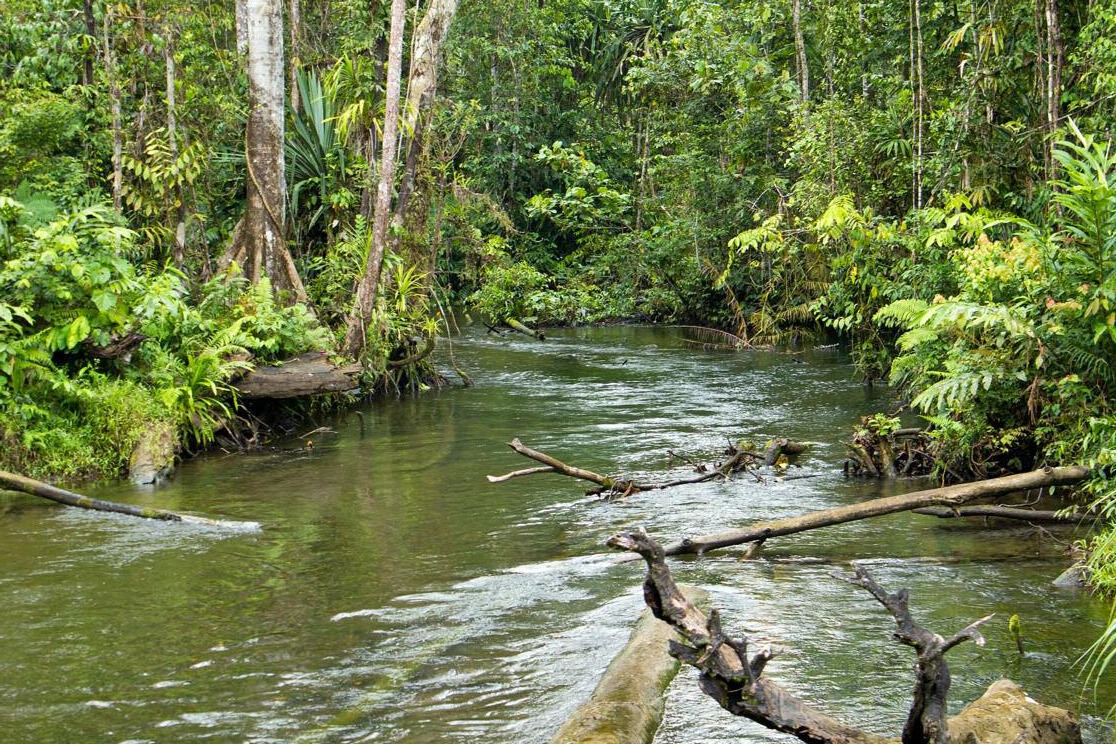
Melanotaenia garylangei is known only from the vicinity of Dekai, on the Brazza River in the Eilanden (Sungai Pulau) River system, in the central-southern part of Papua Province, Indonesia, and appears to be endemic to that area. Dekai lies roughly 190 km inland from the southern coast, at the foothills of the central mountains, in very wet country. The type series was collected in August 2010 from small rainforest creeks crossing newly built roads east and west of the village. The water was clear but tannin-stained, over a muddy substrate, sometimes shaded by forest canopy and sometimes open to the sun; submerged plants (Barclaya) were present at only one site. The species favours shallow water some 10–20 cm deep, often over floating grass. It occurs alongside Melanotaenia goldiei, Melanotaenia rubrostriata, an undescribed blue-eye (Pseudomugil sp.) and the glassfish Ambassis agrammus, the three rainbowfishes sometimes coming up in a single net haul — but each keeps largely to its own microhabitat, with M. goldiei in faster open water, M. rubrostriata along the stream edges, and the present species in the shallowest grassy margins.
Description
A medium-sized member of the maccullochi group, described from 15 specimens of 42–78 mm standard length. The dorsal fin carries IV–VI spines followed by I,12–15 soft rays; the anal fin has I,16–20 rays; pectoral rays 9–13; pelvic I,5–7; and the caudal fin 15–18 branched rays. There are 34–37 lateral scales, 10–12 transverse scales, 11–16 predorsal scales and 12–17 gill rakers on the first arch. The body is moderately deep, about 2.8 times in standard length. Adult males develop elongated, pointed dorsal and anal fins from around 25 mm SL, whereas those of females stay short and rounded. The species is told from its closest relative, Melanotaenia ogilbyi of the neighbouring Unir/Lorentz drainage, by the blue coloration on the fore-body of mature males, the red second dorsal and anal fins, and a consistently higher count of soft rays in the second dorsal fin (12–15, versus 9–11 in M. ogilbyi).
Keeping & Caring
Melanotaenia garylangei is an undemanding, peaceful rainbowfish well suited to a semi-planted community or species tank. In the aquarium it takes a good-quality flake, freeze-dried and frozen bloodworms, and frozen adult brine shrimp, with live blackworms, mosquito larvae or daphnia as excellent occasional foods; a weekly fast day does the fish no harm. Robust plants such as Anubias, Cryptocoryne and swordplants suit it — fine-leaved plants are best avoided if you intend to breed, so that the fish spawn on a yarn mop rather than in the foliage. Temperature is not critical, around 24 °C being comfortable, and a generous weekly water change of about 50% keeps the fish in good condition, especially when they are in breeding mode.
Breeding
Melanotaenia garylangei spawns readily onto a floating wool mop suspended just clear of the substrate. After about a week of laying, the mop is moved to a small bare hatching tank and the eggs incubated at around 27–28 °C with gentle aeration. Lightly tinting the hatching water with methylene blue helps: it stains and reveals infertile eggs, and picking and treating eggs this way can also break the mycobacteriosis (fish “TB”) cycle that otherwise passes from parents to fry. The newly hatched fry are tiny and stay in the top centimetre of water, so they need very fine first foods — graded dry fry foods of 5–50 microns, or vinegar eels — before moving on to newly hatched brine shrimp after about five days. Frequent small water changes keep the fry growing; the sexes can be told apart at around three months, and the fish begin producing viable eggs at just over 2.5 cm in length.
Remarks
Melanotaenia garylangei reached aquarists as a result of a 2010 collecting trip to Dekai and was established in breeding groups in Germany and the United States before its formal description in 2015; in the hobby it circulated under the interim name Melanotaenia sp. “Dekai Village”. The species honours Gary William Lange, a well-known rainbowfish enthusiast who first found it. Thanks to its ready availability from those captive lines, its moderate size and its bright colours, it has become a popular and well-established aquarium rainbowfish.
Account compiled for Home of the Rainbowfish from J. A. Graf, F. Herder & R. K. Hadiaty (2015), “A new species of rainbowfish (Melanotaeniidae), Melanotaenia garylangei, from western New Guinea (Papua Province, Indonesia)”, Fishes of Sahul 29(2): 870–881, and G. Lange & J. Graf (2017), “The discovery of Melanotaenia garylangei – the Golden Rainbowfish from Dekai” and “Keeping and raising Melanotaenia garylangei – the Golden Rainbowfish from Dekai”, Fishes of Sahul 31(1): 1073–1080.
References
- Graf J.A., F. Herder and R.K. Hadiaty (2015) A New Species of Rainbowfish (Melanotaeniidae), Melanotaenia garylangei, from Western New Guinea (Papua Province, Indonesia). Fishes of Sahul, 29 (2): 870-881.