
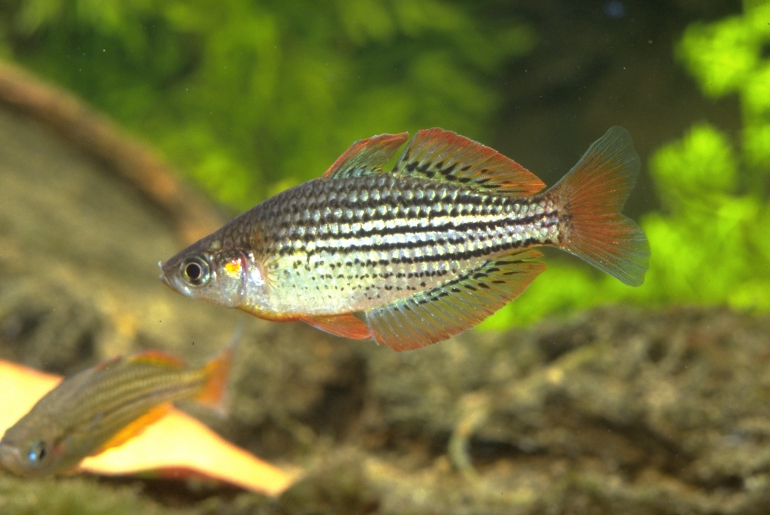
Melanotaenia maccullochi
McCulloch’s Rainbowfish
Species Summary
Melanotaenia maccullochi, McCulloch’s Rainbowfish, is a small dwarf rainbowfish now restricted to the coastal Wet Tropics of northeast Queensland. It was described by J. D. Ogilby in 1915 from the Barron River near Cairns and named for the ichthyologist Allan Riverston McCulloch. For most of the twentieth century the name was applied broadly to similar small striped rainbowfishes across northern Australia and southern New Guinea, but a combined genetic and morphological study published in 2019 showed this broad concept to comprise three separate species. The nominal species Melanotaenia maccullochi was redescribed and restricted to its original Queensland range, while the Cape York/Torres Strait/New Guinea populations became Melanotaenia sahulensis and the isolated Northern Territory population became Melanotaenia wilsoni. This account covers only the Queensland form retained under the original name — see M. sahulensis and M. wilsoni for the other two.
Etymology
The species is named in honour of Ogilby’s friend and colleague Allan Riverston McCulloch (1885–1925), Curator of Fishes at the Australian Museum, “whose excellent papers on our southern and deep-water fishes have become the leading feature in Australian ichthyology”; he also created the illustrations featured in Ogilby’s paper. (Note the latinization of “Mc” to “Mac.”)
Etymology compiled from C. Scharpf (2022), “Fishes of Sahul: An Etymological Survey (Part 5), the rainbowfishes (continued)”, Fishes of Sahul 36(4): 1968–1992, and etyfish.org.
Distribution & Habitat
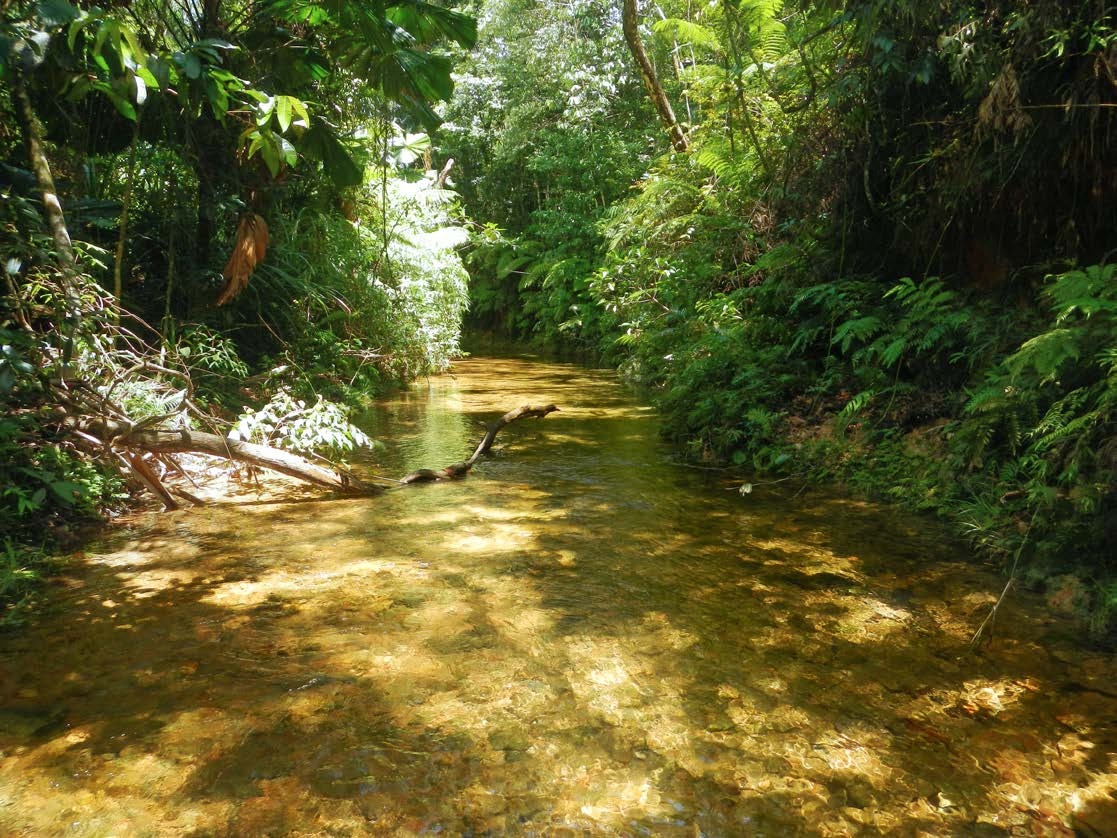
Melanotaenia maccullochi occurs only along the coast of northeast Queensland, from a cluster of records around Cape Flattery, Hope Vale and the McIvor River in the north, through an isolated population in the lower Daintree River area, then from around Cairns south to Camp Creek near Cardwell, its southernmost known locality. It lives in floodplain swamps, dune lakes and small tributary streams with dense cover and often soft, tannin-stained, acidic water. The type locality, a swamp associated with the lower Barron River at Cairns, has long since been cleared and developed, and the species is believed extirpated there; a small population persists nearby in Boggy Creek, about 20 km southeast, discovered in 2016.
Description
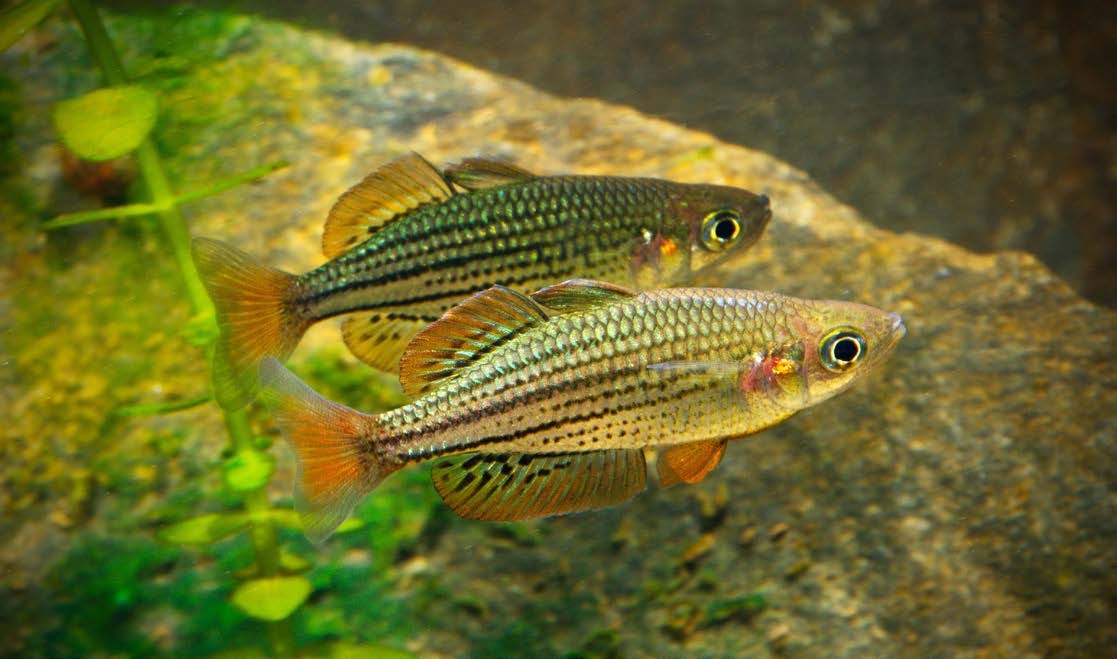
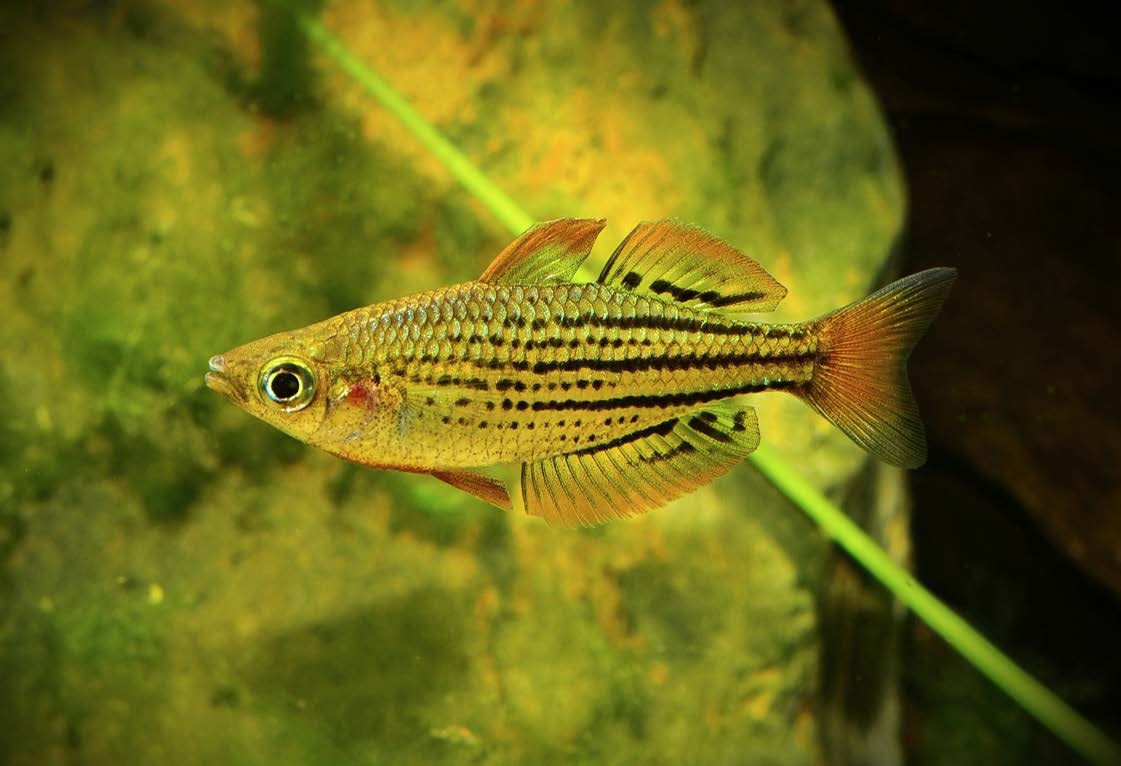
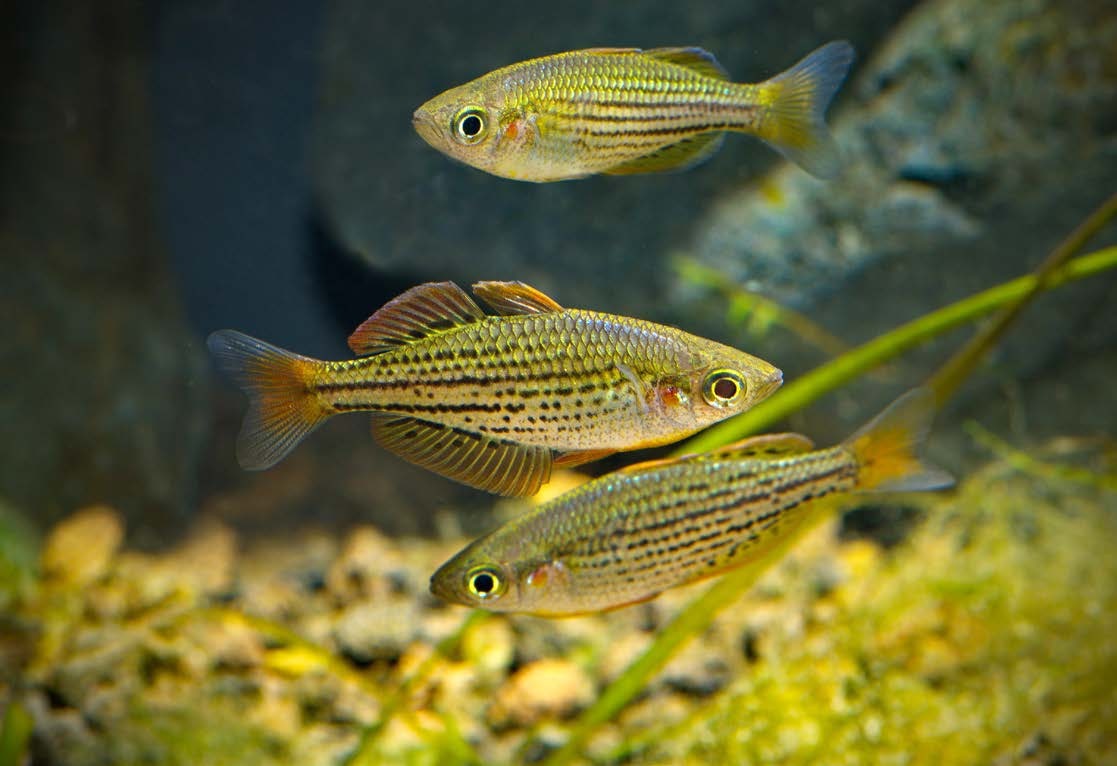
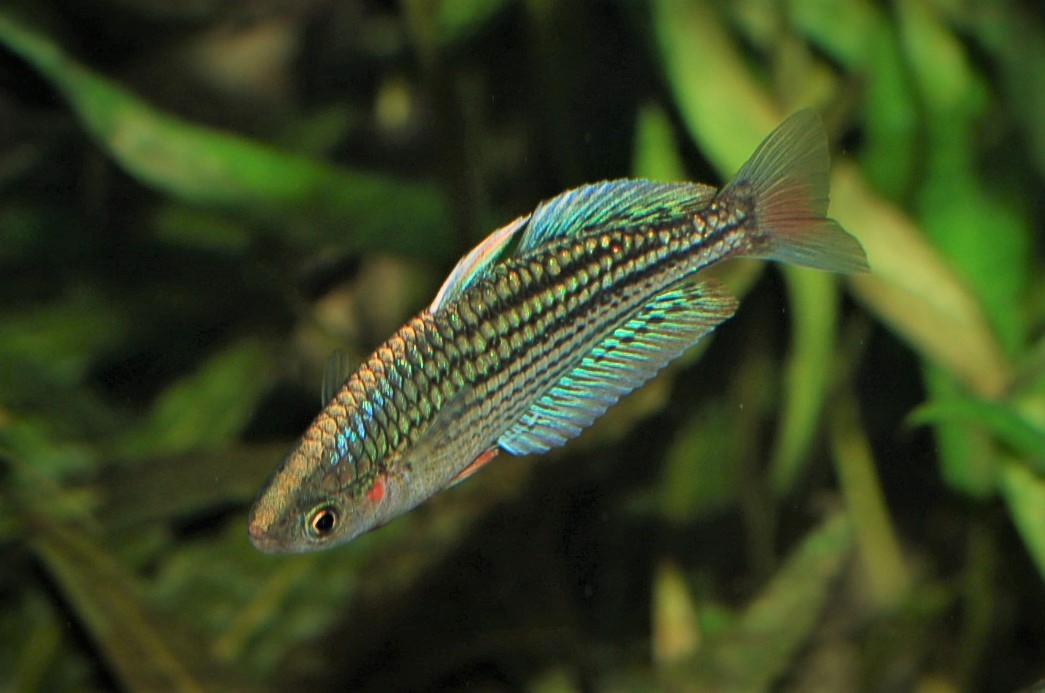
A small rainbowfish, wild fish typically under 35 mm SL and rarely to about 52 mm SL, though considerably larger in aquaria. Body bronze to brown above, paler below, with seven or eight dark brown stripes that are often faint or broken, especially in younger fish. Fins are orange to red, particularly in nuptial males, sometimes with rows of small spots or a fine line near the fin base, but never with a thick dark submarginal band. A nape stripe, ranging from whitish-yellow to orange-red, is flashed by courting and sparring males.
Comparison with the Other Former ‘Maccullochi’ Populations
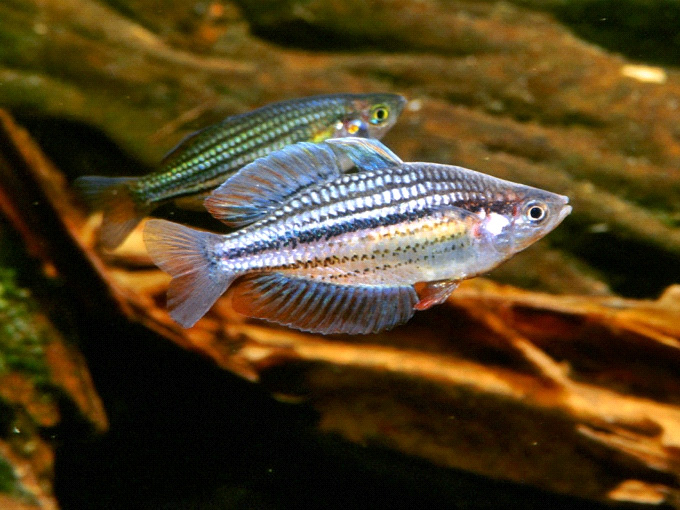
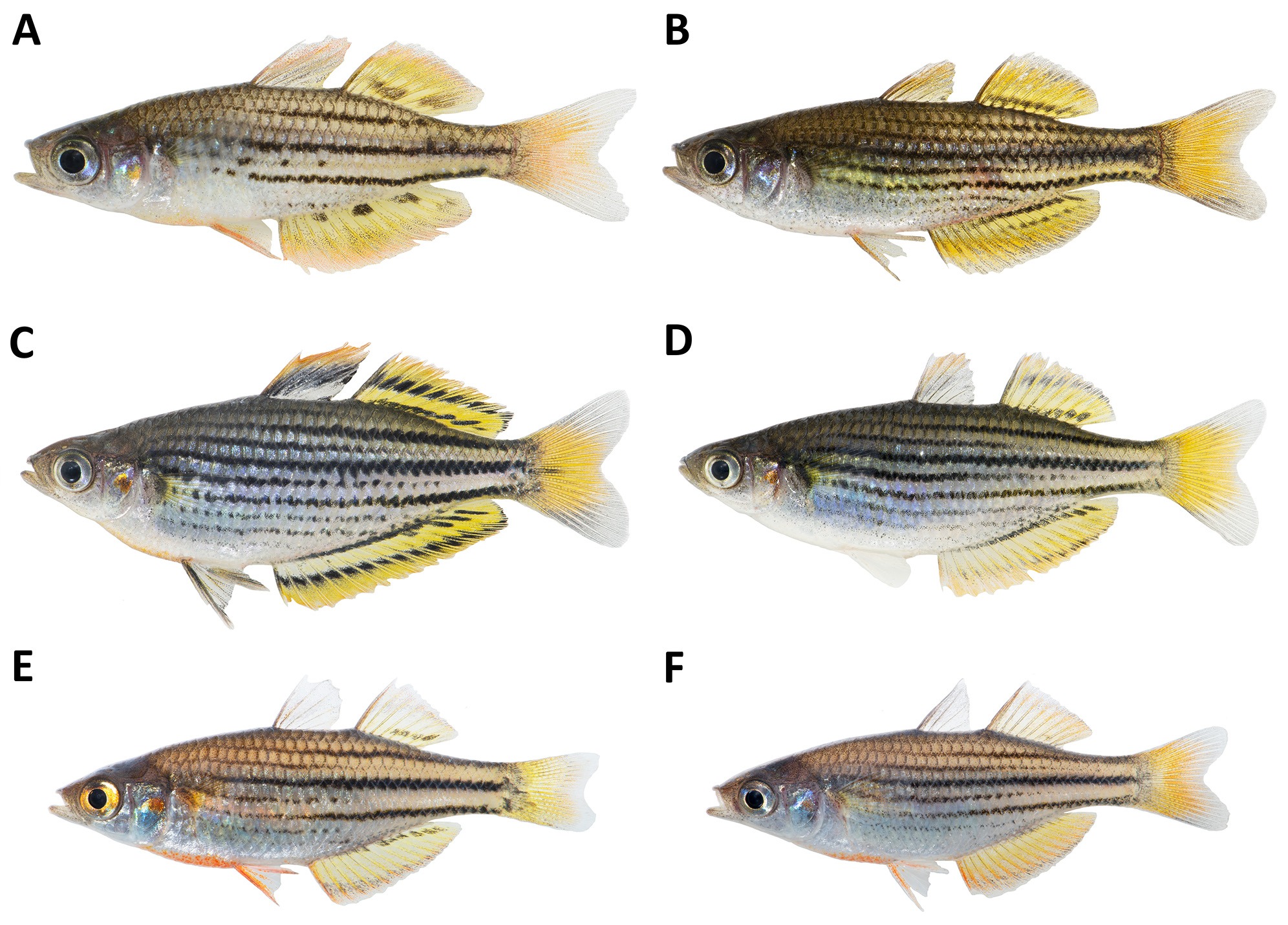
Melanotaenia maccullochi is most easily told from M. sahulensis by base body colour (brownish rather than silver-grey), stripe colour (brown and mostly faint rather than black and bold) and fin pattern (reddish and relatively plain rather than marked with a thick black submarginal band that creates a tri-tone effect). It is larger and less distinctively marked than the diminutive M. wilsoni, which also has a more prominent dark purple mid-lateral stripe and is confined to a tiny range in the Northern Territory, well separated from any Queensland population.
Taxonomic History
The three species of the M. maccullochi group are most easily compared side by side: the redescribed Melanotaenia maccullochi, the Cape York/New Guinea M. sahulensis and the Northern Territory M. wilsoni each have a distinctive combination of body and fin colour, scale counts and maximum size, detailed in the 2019 revision.
Remarks
Genetic and morphological data assembled over several decades, combined with a dedicated field survey of the Queensland populations (Martin & Barclay, 2019), resolved the long-suspected species-level differences within the old, broadly defined Melanotaenia maccullochi. The Wet Tropics population remains generally uncommon and is easily overlooked, in part because much of its swamp habitat is hard to access and because it often occurs as only a few individuals among large schools of the more common M. splendida.
Account compiled for Home of the Rainbowfish from M. P. Hammer, G. R. Allen, K. C. Martin, M. Adams & P. J. Unmack (2019), “Two new species of dwarf rainbowfishes (Atheriniformes: Melanotaeniidae) from northern Australia and southern New Guinea”, Zootaxa 4701(3): 201–234, K. C. Martin & S. Barclay (2019), “McCulloch’s Rainbowfish Melanotaenia maccullochi (Melanotaeniidae) in the Queensland Wet Tropics”, Fishes of Sahul 33(2): 1404–1416.
References
- Allen G.R. (1989) Freshwater fishes of Australia. T.F.H. Publications, Inc., Neptune City, New Jersey.
- Allen G.R., S.H. Midgley and M. Allen (2002) Field guide to the freshwater fishes of Australia. Western Australian Museum, Perth.
- Hammer M.P., G.R. Allen, K.C. Martin, M. Adams and P.J. Unmack (2019) Two new species of dwarf rainbowfishes (Atheriniformes: Melanotaeniidae) from northern Australia and southern New Guinea. Zootaxa 4701 (3): 201-234.
- Martin K.C. & S. Barclay (2019) McCulloch's Rainbowfish Melanotaenia maccullochi (Melanotaeniidae) in the Queensland Wet Tropics. Fishes of Sahul (33): 1404-1416.
- Ogilby J.D. (1915) On some new or little-known Australian fishes. Memoirs of the Queensland Museum 3: 117-129, Pls. 29-30.
- Pusey B., M. Kennard and A. Arthington (2004) Freshwater Fishes of North-Eastern Australia. CSIRO Publishing.
- Tappin A.R. (2011) Rainbowfishes - Their Care & Keeping in Captivity. Art Publications, Australia.