

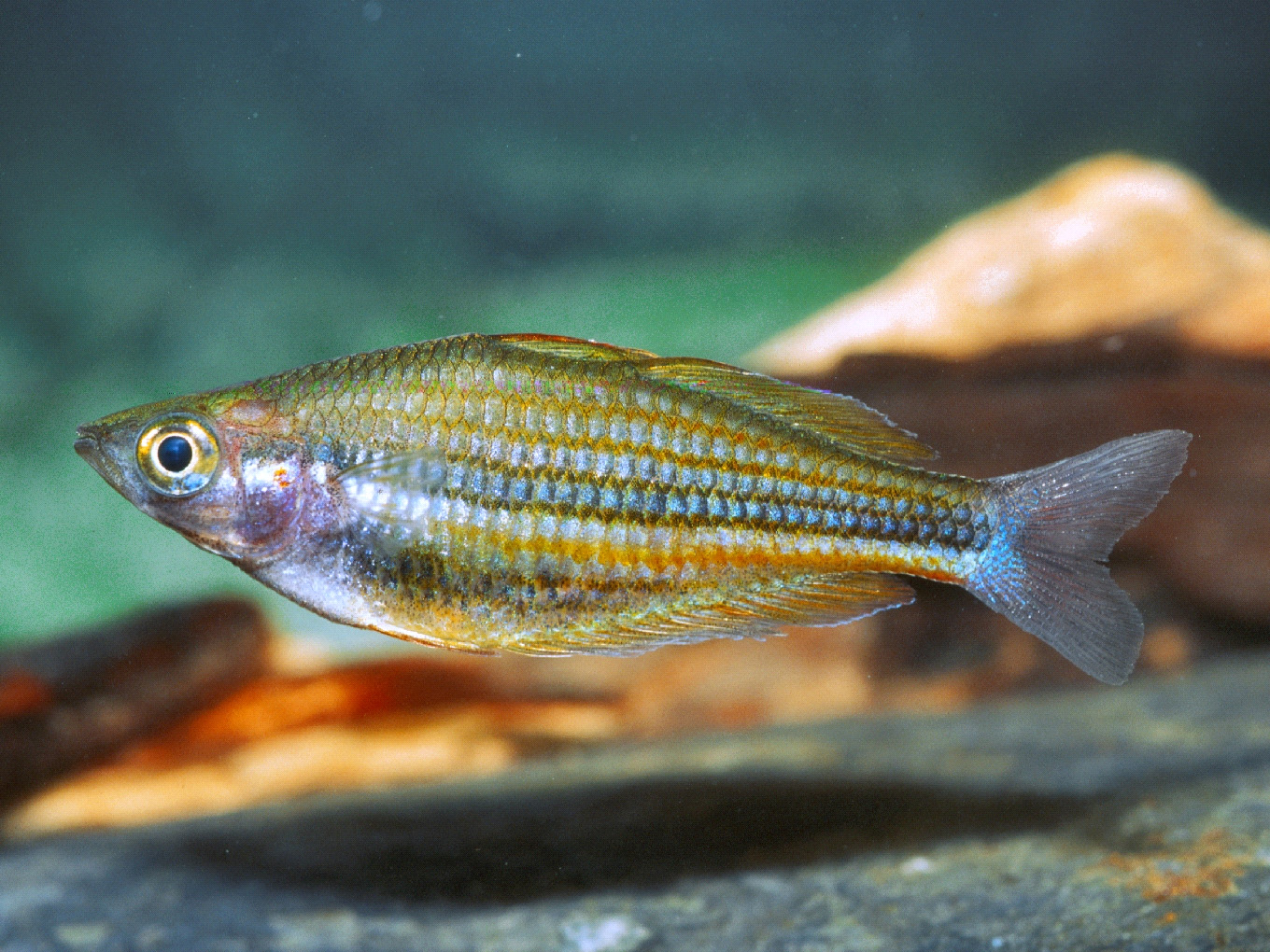
Melanotaenia sylvatica
Forest Rainbowfish
Species Summary
Melanotaenia sylvatica was described from 26 specimens collected in 1996 during a Conservation International fauna survey in the upper Lakekamu basin of southeastern Papua New Guinea. The Lakekamu basin covers 2500 km2 of pristine lowland alluvial rainforest, surrounded in the east, west and north by mountains. The Lakekamu basin is an undisturbed region with minimal human impact. The collection site is located approximately 150 km northwest of Port Moresby on the southern slope of the Central Dividing Range. Most of the basin is an extensive lowland alluvial plain over which the Lakekamu River and its tributaries meander. The collection sites were situated about 15–20 km above the Lakekamu River junction and 90–100 km upstream from the sea in the Sapoi River and its forest tributaries, close to the transition from lowland to mountainous terrain.
Melanotaenia sylvatica belongs to a species complex known as the “maccullochi group” (Allen 1981), which includes M. caerulea (Kikori River, New Guinea), M. maccullochi (northern Australia and Fly River, New Guinea), M. ogilbyi (Lorentz River, New Guinea), M. papuae (vicinity of Port Moresby, Papua New Guinea), and M. sexlineata (Fly River, New Guinea). The group is characterised by a relatively small maximum size, similar shape, and a relatively low number of dorsal, anal, and pectoral rays (7–11, 14–19, and 11–14 respectively), as well as a low number of cheek and predorsal scales (10–16 and 13–17 respectively). Although the members of the group have similar live colour patterns, each is clearly distinct (Allen 1995). Live colours are most similar to Melanotaenia caerulea, but it lacks the pronounced neon blue that covers much of the body. There are also differences in modal fin-ray counts between these two species. Preserved specimens, which show a distinct blackish midlateral stripe, closely resemble M. ogilbyi, but the two species have different live colours and there is a modal difference in the number of soft anal rays. The known geographic distributions of this pair are separated by a distance of approximately 900 km.
Melanotaenia sylvatica have body colour of yellowish-bronze with narrow brownish-orange stripes between each scale row. Greenish brown on upper back; midlateral row of scales on side grey to blackish, connected to similar coloured stripe extending from edge of eye; lower half of head and body silvery-white, usually with variable duskiness associated with edge of scales on side of abdomen; dorsal and anal fins yellow to translucent bronze, grey near outer margin with fine white border; caudal fin clear or slightly grey; pelvis fins pale yellow; pectorals clear or with slight yellow tint. May reach a maximum size of 6 cm, but usually less than 5 cm.
Typical of most members of the genus; males are generally deeper bodied and have a more elongate, somewhat pointed shape posteriorly on the soft dorsal and anal fins. In addition, the depressed first dorsal fin of adult males overlaps the second dorsal fin in males, but falls short of this point or barely reaches it in females. The body depth (as percentage of the standard length) of 13 males, 31.5–55.0 mm SL, ranged from 30.2–35.5 with an average of 32.7; that of 13 females, 36.6–50.6 mm S L , was 27.8–31.3 with an average of 29.5. The smallest gravid female examined was 36.6 mm SL. The smallest male exhibiting secondary sexual characteristics (elongated first dorsal fin and pointed shape posteriorly of anal and second dorsal fins) was 31.5 mm SL. Judging from the growth rates of closely related members of the “maccullochi group” sexual maturity is reached before the end of their first year.
Etymology
The species name sylvatica combines the Latin suffix -aticus, belonging to, with sylva, forest, referring to its typical forest-stream habitat.
Etymology compiled from C. Scharpf (2022), “Fishes of Sahul: An Etymological Survey (Part 5), the rainbowfishes (continued)”, Fishes of Sahul 36(4): 1968–1992, and etyfish.org.
Distribution & Habitat
Tributaries of the Lakekamu and Sapoi River drainage are located approximately 150-km northwest of Port Moresby on the southern slope of the Central Dividing Range, Papua New Guinea. Typical habitat consists of small (1–3 metre wide), clear, slow-flowing creeks in closed canopy forest over relatively flat terrain, but also found in side channels and quiet pools. These creeks typically have mud or gravel bottoms and are littered with leaves and log debris. One species of submerged aquatic plant, Hydrostemma motleyi (Nymphaeaceae), was common in many of the streams. The fish was most abundant in 0.5–1.0 metre deep pools behind fallen logs or buttress roots of large trees.
In addition to the primary forest habitat, M. sylvatica also occurs in the main Sapoi River below an altitude of about 50 metres. Above this altitude, the river undergoes a relatively quick transition from a slow-flowing lowland stream to a mountain torrent. The riverine habitat of M. sylvatica consists of deeper (to 3 metres), sand or gravel bottom pools, often behind log jams, either in shaded positions or in full sunlight. Two other species of rainbowfish, M. goldiei (abundant) and M. rubrostriatus (rare) share this habitat. Temperatures recorded in the habitats ranged from 20° to 29°C. Aquatic and terrestrial insects and various aquatic larval insects feature prominently in the diet of the rainbowfishes.
The fish fauna of the upper Lakekamu Basin is broadly typical of freshwater localities in New Guinea. It consists of approximately 23 species in 18 genera and 14 families and is dominated by catfishes, rainbowfishes, gobies and gudgeons. The majority of species recorded are distributed widely either across the southern portion of New Guinea or the combined northern Australia-southern New Guinea region. The rivers of the upper Basin are still pristine and essentially uncontaminated by introduced species.
Remarks
The species is named “sylvatica” (Latin: “of the forest”) with reference to its typical forest habitat. They are currently not available in the aquarium hobby.
References
- Allen G.R. (1980) A Generic Classification of the Rainbowfishes (Family Melanotaeniidae). Records of the Western Australian Museum 8(3): 449-490.
- Allen G.R. (1981) The "Maccullochi Species Group" of Rainbowfishes (Melanotaeniidae) with the Description of Melanotaenia papuae, new species. Revue Française d'Aquariologie 8(2): 47-56.
- Allen G.R. (1995) Rainbowfishes in Nature and in the Aquarium. (Tetra-Verlag: Germany.)
- Allen G.R. (1997) A new species of rainbowfish (Melanotaenia: Melanotaeniidae), from the Lakekamu Basin, Papua New Guinea. Revue française d'Aquariologie 24(1-2): 37-42.