

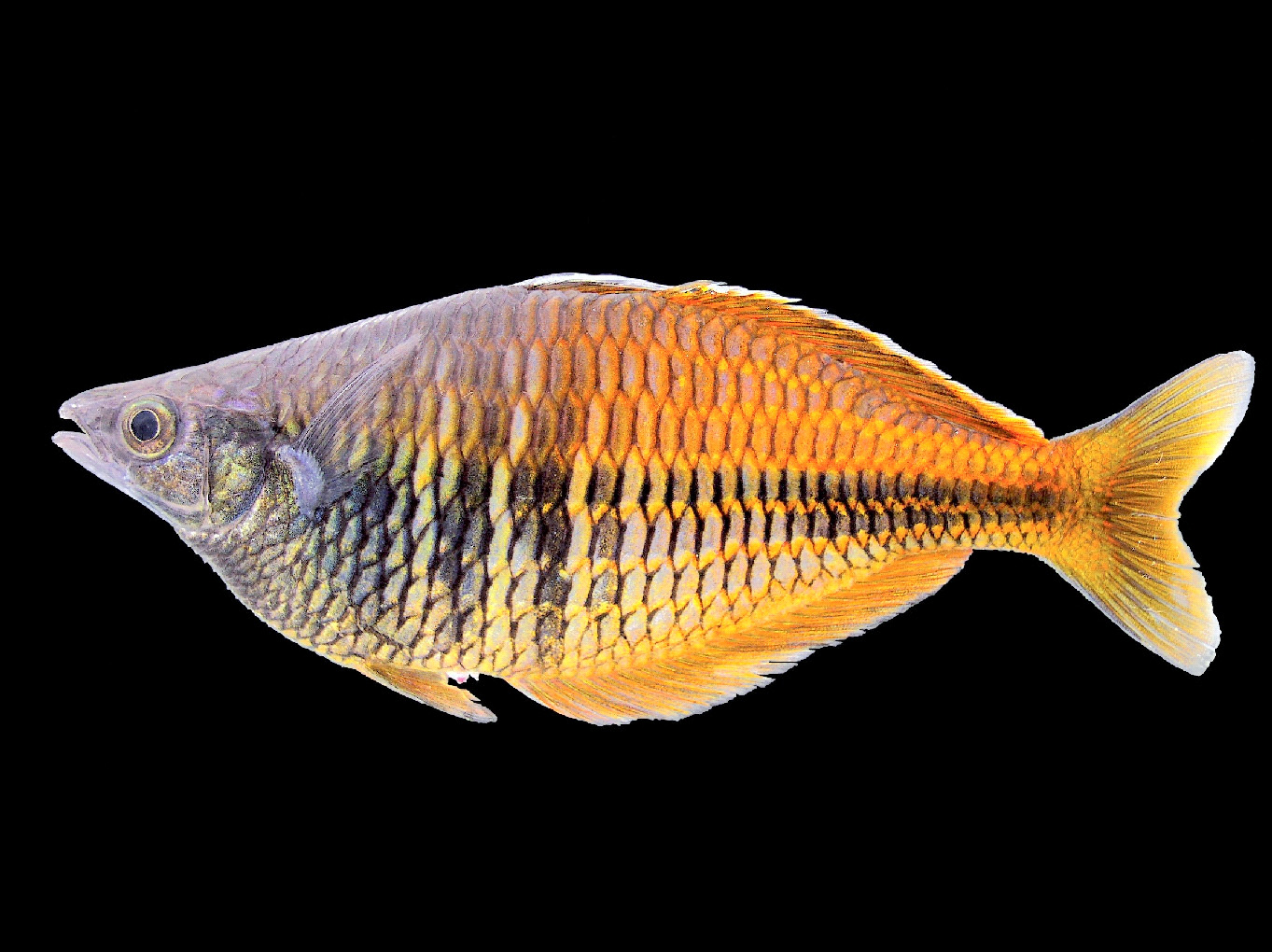
Melanotaenia ajamaruensis
Ajamaru Rainbowfish
Species Summary
From October 1954 through to May 1955 Marinus Boeseman took part in a collecting expedition for the Rijksmuseum van Natuurlijke Historie to Netherlands New Guinea (West Papua). Among the places he visited was Lake Sentani, Tami River, Biak Island, Lake Jamoer (Yamur), Wissel Lakes, Ajamaru Lakes, Lake Ajtinjo, Merauke and the Digul River. This collection included many rainbowfishes, but a thorough study of the collection or description of the fishes was never made by Boeseman.
As part of his preparation for the revision of the rainbowfish family, Gerald Allen studied the Boeseman collection of 1954–55 during 1975 and 1977. He discovered no less than four new rainbowfish species, which he described in 1980 together with Norbert Cross. These species were Melanotaenia boesemani, M. ajamaruensis, M. japenensis and Glossolepis pseudoincisus.
From field notes it was stated that Melanotaenia ajamaruensis have a metallic blue to yellowish or green with orange and yellow longitudinal stripes and dark scale edges. The body is ovate and laterally compressed. Mature males have a higher first dorsal fin, which overlaps the origin of the second dorsal fin when depressed. They grow to a length of around 11 cm; males are usually deeper bodied than females. They were named ‘ajamaruensis’ with reference to the Ajamaru Lakes, the type locality and only known collection site for this species at that time (see remarks).
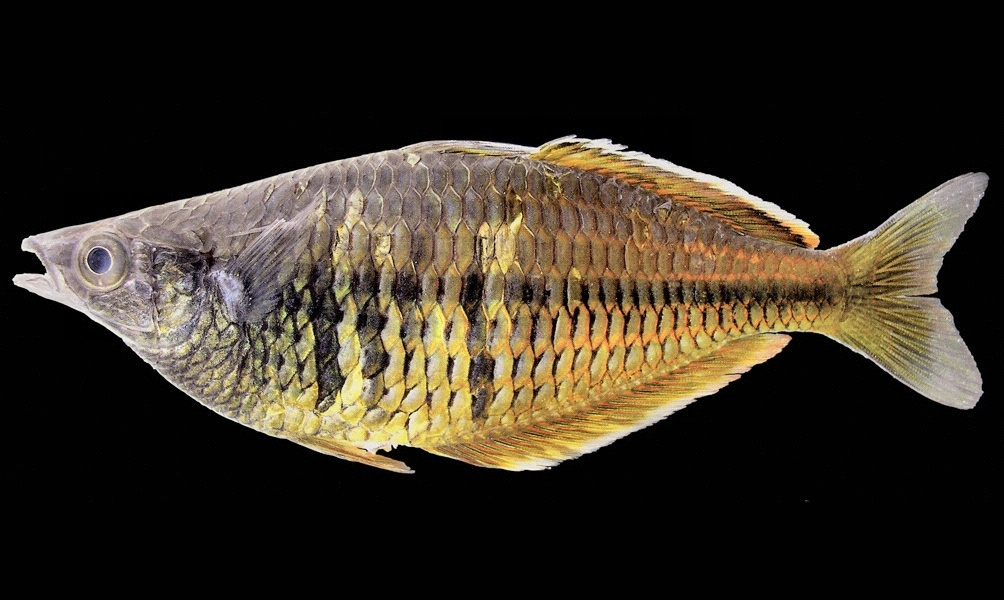
In 1980 Allen & Cross described M. ajamaruensis as a species of Melanotaenia with the following combination of characters: dorsal rays IV to VI, 15 to 19; anal rays I, 21 to 27; pectoral rays 13 to 15; horizontal scale rows 7 or 8; vertical scale rows 34 to 37; predorsal scales 13 to 16 preopercle scales 9 to 16; colour generally reddish-brown on back and anterior half of body grading to yellow or tan posteriorly with series of red-brown horizontal stripes on side; in life ground colour metallic blue to yellowish or green with yellow longitudinal stripes.
Melanotaenia boesemani is readily separable from M. ajamaruensis on the basis of soft ray counts for the second dorsal and anal fins. The former species has 10 to 14 (usually 12 or 13) dorsal rays and 17 to 23 (usually 18 to 21) anal rays compared with 15 to 19 (usually 15 to 17) and 21 to 27 (usually 22 to 24) for M. ajamaruensis. Although these species possess a similar colouration and general shape, the stripes on the sides tend to be more pronounced in M. ajamaruensis, particularly the mid-lateral one and the stripe just below it. Melanotaenia ajamaruensis further differs from M. boesemani by being more slender, and by having the first dorsal fin origin in front (by about one half eye diameter) of the anal fin origin compared to the approximately even position of these fins in M. boesemani.
Etymology
The species name ajamaruensis is a suffix denoting place, referring to the Ajamaru Lakes, Irian Jaya (now Papua), Indonesia, the type locality.
Etymology compiled from C. Scharpf (2023), “Fishes of Sahul: An Etymological Survey (Part 6), the rainbowfishes (continued)”, Fishes of Sahul 37(1): 2006–2022, and etyfish.org.
Distribution & Habitat
Melanotaenia ajamaruensis is a lake and stream dwelling rainbowfish found in relatively clear alkaline water, with abundant aquatic vegetation. Museum specimens were collected in March 1955 by Marinus Boeseman and his companions in the Ajamaru Lakes, a complex of lakes on the Ajamaru River in the centre of the Vogelkop Peninsula at the western extremity of New Guinea. The Ajamaru Lakes region is located about 120 km east-southeast of Sorong, at the headwaters of the Ajamaru River in a mountainous region of the Vogelkop Peninsula, West Papua. The region contains a number of small freshwater lakes and associated marshes. The largest lake, Lake Ajamaru drains east via the other two lakes (Lake Hain and Lake Ajtinjo) into an upper tributary of the Kais River that eventually flows into the Ceram Sea to the south.
Two species of rainbowfishes have been reported from these lakes: Melanotaenia ajamaruensis and Melanotaenia boesemani. It is possible that M. ajamaruensis inhabit other areas on the Vogelkop Peninsula, but most of the region remains unsampled.
Lake Ajamaru has an area of approximately 22 km2 and is located in a rather flat terrain, at about 250 metres altitude. The lake has variable depths with clear water and abundant vegetation. In the wetter months (April-June) the lake can rise by up to 5 metres from its dry season level; it never dries out completely, but the shoreline recedes several hundred metres. It has a muddy bottom, and the sediments of the shores are reportedly white, either sand or kaolin clay. The lakes and streams have a pH of 6.4–7.8 (de Vries, 1962) and temperate 26–27° Celsius. Heiko Bleher reported the water conditions as pH 9.0, hardness 5° dGH, and conductivity 145 mS/cm. When Marinus Boeseman collected his specimens, he reported a pH of 6.4–6.5.
Remarks
In November 1982, Gerry Allen had the opportunity to collect live specimens during a visit to the remote Vogelkop Peninsula in West Papua. Heiko Bleher, a well-known aquarium fish collector, had accompanied Gerry Allen on the trip and was able to transport a number of live specimens captured during the expedition back to Europe, whereupon they were subsequently bred and distributed in the aquarium hobby as M. boesemani. At the time it was thought that females of M. boesemani were M. ajamaruensis. The natural colours of M. ajamaruensis at the time remained unknown. The type specimens preserved in the Leiden museum were the only ones that had so far been collected.
In 2007, a number of surveys were conducted by the Papuan National Marine and Fisheries Research, the Academy of Fishery Sorong, and the Institut de recherche pour le développement (IRD) Jakarta in five bioregions of West Papua. During the survey some rainbowfish specimens were collected that were considered to fit the type specimens of M. ajamaruensis as described by Allen and Cross in 1980. They were collected in an upstream section of the Kaliwensi River, about 5 km west of Lake Ayamaru. The river was 10–15 metres wide; 1–3 metres deep. The water was clear and fastflowing over gravel and boulders with no aquatic vegetation. Water conditions reported were: Temperature 24.7°C; pH 7.88 and Conductivity 217 µS/cm.
This river is an old outlet to the western side of the lake, but does not flow into the lake. It is thought that it probably flowed into Lake Ayamaru some time in the distant past, but is only connected today by subterranean outlets. There is no connection between the lake and the river and M. boesemani doesn’t occur in the river. This is currently the only known location of M. ajamaruensis and it is thought that they no longer exist in Lake Ajamaru. The colouration of M. ajamaruensis can be much more intense than that shown in the accompanying photograph; displaying a brilliant red to red-orange colour (L. Pouyaud 2009, pers. comm.).
Melanotaenia ajamaruensis are available in the aquarium hobby in Europe, and probably also in the USA and Asia. However, it has not become widely available and is only being bred and traded within specialist circles (e.g. the IRG).
Note: The interesting thing about M. ajamaruensis is their remarkable similarity with M. boesemani. Since its introduction to the aquarium hobby, M. boesemani has steadily increased in popularity and today, it could be considered the most popular rainbowfish in the hobby. By 1989 Ajamaru villagers were catching so many live fish for the aquarium trade the species was on the brink of becoming endangered. An estimated 60,000 male rainbows were captured each month for shipment to Jakarta exporters. Eventually the Indonesian Government placed some controls on the activity (Polhemus et al. 2004).
Is it possible that specimens of M. ajamaruensis may have been mixed in with some of the early collections of M. boesemani from Lake Ajamaru—or perhaps M. ajamaruensis never occurred in Lake Ajamaru in the first place?
References
- Allen G.R. and N.J. Cross (1980) Description of Five New Rainbowfishes (Melanotaeniidae) from New Guinea. Records of the Western Australian Museum 8(3): 377-96.
- Allen G.R. and M. Boeseman (1982) A collection of freshwater fishes from western New Guinea with descriptions of two new species (Gobiidae and Eleotridae). Records of the Western Australian Museum, 10(2): 67-103.
- Boeseman M. (1956) The Lake Resources of Netherlands New Guinea. South Pacific Commission Quarterly Bulletin 6(1): 23-25.
- Boeseman M. (1956) Fresh-water sawfishes and sharks in Netherlands New Guinea. Science 123: 222-223.
- Boeseman M. (1963) Notes on the fishes of Western New Guinea. Zoologische Mededelingen Leiden 38(14): 221-242.
- Evers H. (2014) Boeseman's Rainbowfish and its rare new cousin. AMAZONAS 3(5): 42-51 [English edition].
- Pouyaud L. (2007) Expedition Papua 2007 Rapport De Mission. IRD Indonesie Department Resources Vivantes - UR 175.