

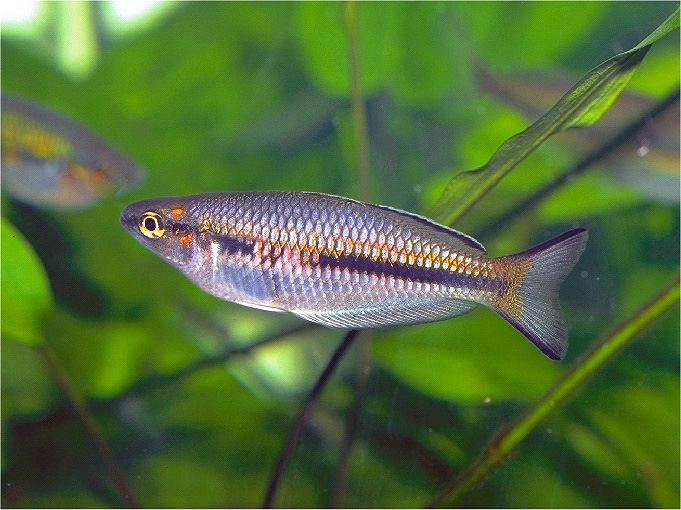
Melanotaenia arfakensis
Arfak Rainbowfish
Species Summary
mauve with silvery reflections. There is a bluish midlateral band, about one scale wide, and a narrow yellow-orange stripe between each horizontal scale row on the sides of the body. Fins are translucent with a bluish to mauve shading. The second dorsal fin has a sub-marginal band and narrow white margins. The caudal fin has black upper and lower margins. Males may reach a maximum size of 10 cm, but females are usually less than 8 cm. Males are more brightly coloured, larger, and deeper bodied than females.
Etymology
The species name arfakensis is a suffix denoting place, referring to the Arfak Mountains, the imposing backdrop to the type locality, Sub River, Irian Jaya (now Papua), New Guinea.
Etymology compiled from C. Scharpf (2023), “Fishes of Sahul: An Etymological Survey (Part 6), the rainbowfishes (continued)”, Fishes of Sahul 37(1): 2006–2022, and etyfish.org.
Distribution & Habitat
Melanotaenia arfakensis were originally collected by Gerald Allen in 1989 from the Prafi River, about 20–30 kilometres west of Manokwari, West Papua. This area is bordered on the western side by the Arfak Mountains. The mountains are a water catchment area for several river systems. The Arfak area is important historically and scientifically for being the site of the first extensive zoological expedition to West Papua led by d'Albertis and Beccari in 1872–73.
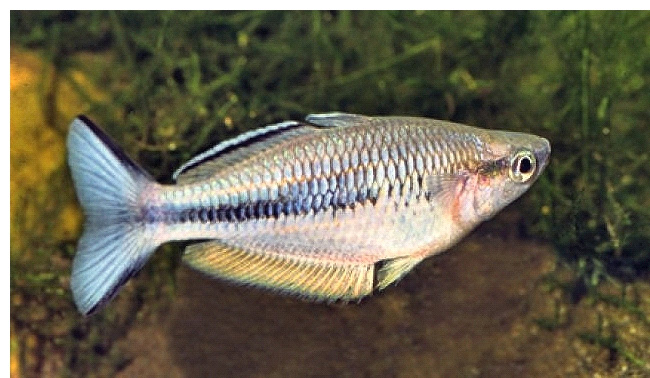
Melanotaenia arfakensis has been collected from a number of streams in the Prafi River. In Supsan Creek, a 4–5 metre wide tributary of the Prafi River the water conditions reported were: Temperature 25.4°C; pH 7.85 and conductivity 267 µS/ cm.
Melanotaenia arfakensis is a stream dwelling rainbowfish mainly found around sub-surface vegetation, submerged logs, or branches in small tributary streams, but can also occur in swamps and lagoons. Their natural environment is subjected to seasonal variations. An examination of their gut content show that their natural diet is dominated by insect groups belonging to Diptera, Ephemeroptera, Coleoptera, and Trichoptera. Spawning females produce between 23~1351 eggs with a relatively large diameter of 0.5~1.3 mm.
Remarks
Live specimens of Melanotaenia arfakensis were collected by Heiko Bleher in 1990 and introduced to the aquarium hobby.
References
- Allen G.R. (1990) Les poissons arc-en-ciel (Melanotaeniidae) de la Péninsule de Vogelkop, Irian Jaya, avec description de trois nouvelles espèces. Revue française d'Aquariologie 16(4): 101-112.