
Melanotaenia boesemani
Boeseman’s Rainbowfish
Species Summary
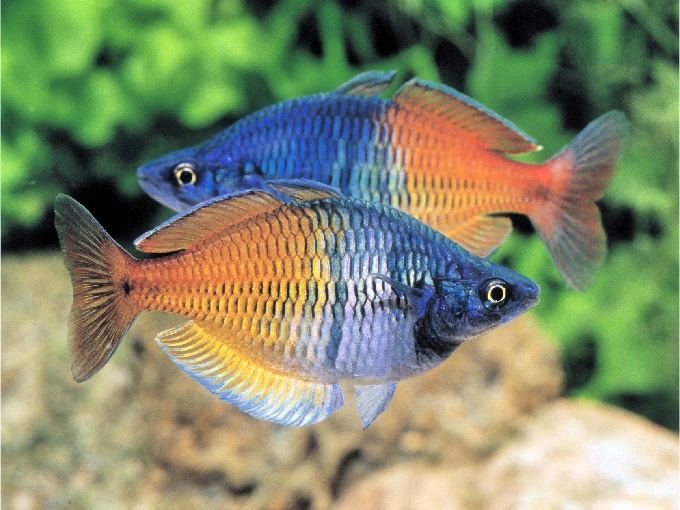
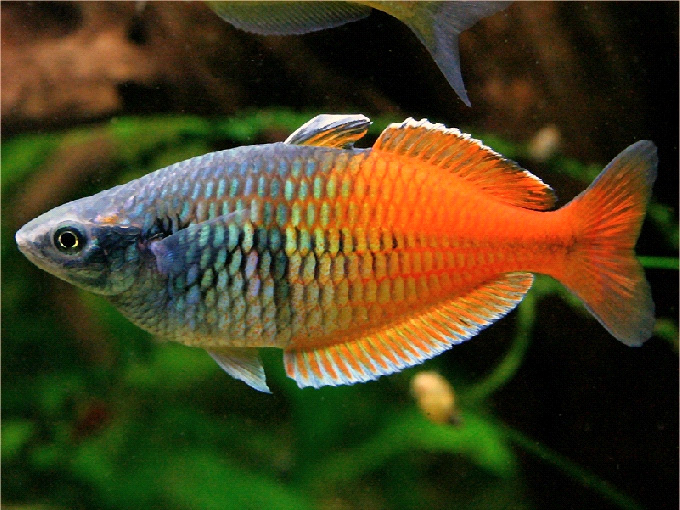
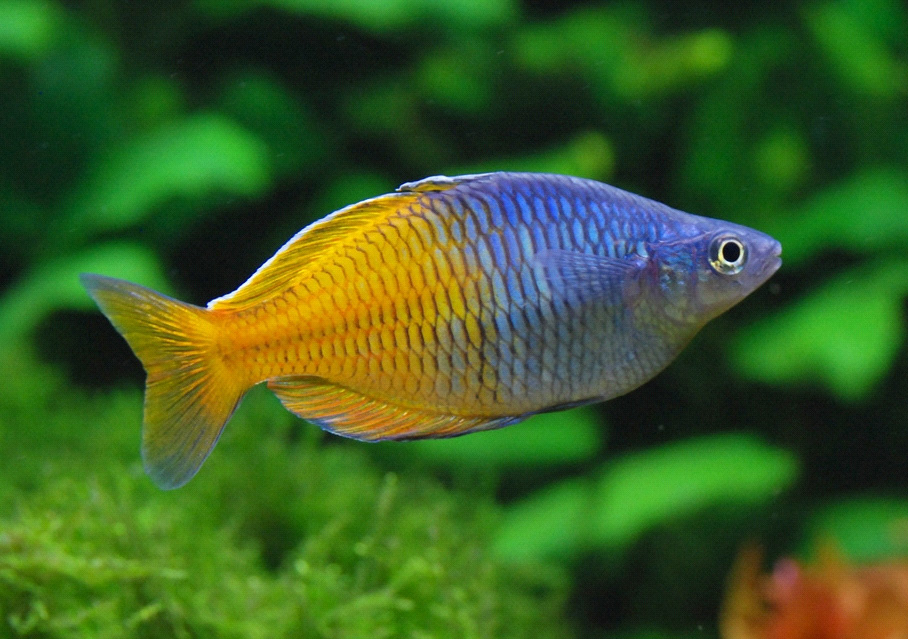
The colour pattern of male Melanotaenia boesemani is completely different from most other rainbowfishes and show a half-and-half colouration when fully matured. The head and front portion of the body are a brilliant bluish-grey, sometimes almost blackish, with the fins and posterior half of the body largely bright orange-red. Between these two areas, or roughly just behind the pectoral fin, there are alternating light and dark vertical bars. Their wild colouration can fade somewhat in captivity, possibly due to something lacking in the diet, or from the nature of captivity itself. They may reach a maximum size of 12 cm, but are usually less than 10 cm.
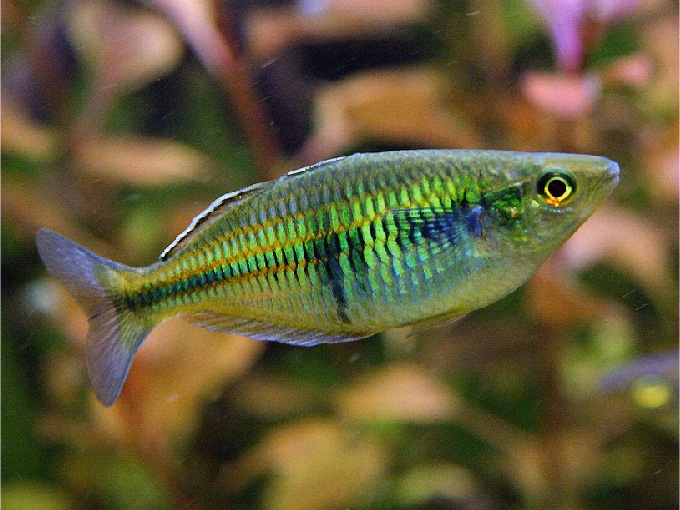
Males are easily distinguished from females by their different colour and longer and more elongated dorsal fin rays, and are usually much deeper bodied than females. Females display a broad dark mid-lateral stripe accompanied by a series of narrow yellow or reddish-orange longitudinal stripes corresponding with each scale row that deepen or lighten according to mood. Mature, older females often show colouration similar to subordinate males, but are usually easily identified by a shallower body/chest depth and smaller, more rounded fin edges.
Etymology
The species is named in honour of Marinus Boeseman (1916–2006), Curator of Fishes at the Rijksmuseum van Natuurlijke Historie (now Naturalis Biodiversity Center), Leiden, Netherlands, who collected the holotype in 1955.
Etymology compiled from C. Scharpf (2023), “Fishes of Sahul: An Etymological Survey (Part 6), the rainbowfishes (continued)”, Fishes of Sahul 37(1): 2006–2022, and etyfish.org.
Distribution & Habitat
Melanotaenia boesemani have been found in Lake Ajamaru and a few surrounding tributaries. They also occurs in Lake Ajtinjo, Lake Hain and Lake Uter. The lakes are located about 120 km east -southeast of Sorong, at the headwaters of the Ajamaru River in a mountainous region of the Vogelkop Peninsula, West Papua. The largest lake, Lake Ajamaru drains east via the other lakes into an upper tributary of the Kais River that eventually flows into the Ceram Sea to the south. The lakes are positioned centrally on the Ajamaru Plateau which extends for 20–30 km to the south and south-west of the lakes before giving way to a broad zone of relict alluvial landforms dissected by wide flooded river valleys.
Lake Ajamaru has an area of approximately 22 km2 and is located in a rather flat terrain, at about 250 metres altitude. The lake has variable depths with clear water and abundant vegetation. In the wetter months (April-June) the lake can rise by up to 5 metres from its dry season level; it never dries out completely, but the shoreline recedes several hundred metres. It has a muddy bottom, and the sediments of the shores are reportedly white, either sand or kaolin clay. The lakes and streams have a pH of 6.4–7.8 (de Vries, 1962) and temperate 26–27° Celsius. Heiko Bleher reported the water conditions as pH 9.0, hardness 5° dGH, and conductivity 145 mS/cm. When Marinus Boeseman collected his specimens, he reported a pH of 6.4–6.5.
In August 1959, G. A. Reeskamp surveyed the lakes with the objective of determining the potential fisheries of the lakes. He reported that the lakes were shallow and interconnected by channels that might perhaps be better termed as “broads”. The three lakes average approximately 7 feet. (2.13m) in depth and drain in an easterly direction into the Kais River. During the rainy season the water level rises to approximately 9 feet. (2.74m) and at the dry season large areas of these broads become dry. The greatest depth was found close to the southern margin of the lakes where a basin about 60 feet. (18.28m) diameter was discovered with a depth of approximately 20 feet. (6.09m). The outstanding characteristic of the lakes was the clearness of the water. Owing to the clarity of the water there is complete light penetration to the bottom with the resultant abundant bottom flora of aquatic plants. Samples of the waterplants were stiff to the touch, indicating a high lime content. The pH of the water was recorded as 7.8. Fish in these lakes appeared to be extremely scarce in relation to the large area of available water. In the shallow creeks along the margins, however, one obtains an impression of the fairly rich fauna but in the open water few fish may be seen and in general the fish appear to remain in the shallow margins of the lakes where food such as water insects, snails, fish fry, etc., are more plentiful.
The Ajamaru lakes only support a small number of fishes and most of these are of very small size and diversity. The Dutch introduced some larger fish species, such as Cyprinus carpio and labyrinth fishes into the lakes in the mid-1930s to provide new sources of animal protein. As early as 1938, Trichogaster pectoralis, Helostoma temminckii and Cyprinus carpio were introduced into Lake Ayamaru to supply the requirements of a Dutch military post in that area. The two first-mentioned species are still found there as a result of a highly successful acclimatisation. Cyprinus carpio was introduced to the lake in 1938, 1951 and 1969. Gambusia (affinis) was introduced in 1959 for malaria control.
Reeskamp reported that “the local natives benefited by the somewhat improved stocks of fish in the lake since the native species were apparently seriously depleted many year ago. Generally speaking, the methods of fishing are very primitive and there is considerable destruction of fish by poisons, locally known as “akar kajoe” or “akar boreh”, derived from the Derris (Derris elliptica). This system of fish poisoning seems to be increasing and must no doubt have disastrous results on the existing stocks and will inhibit any development unless it can be fully prevented. Very large numbers of fry are killed by the poison and it is certainly in the interests of the natives themselves that this practice should be prohibited.” Reeskamp also recommended that plant-eating fish should be introduced into the lakes to utilise the vast quantities of submerged aquatic vegetation.
Melanotaenia ajamaruensis, Melanotaenia boesemani, and Pseudomugil reticulatus have been reported from the lakes and surrounding streams.
The waterplant Ceratophyllum demersum has been recorded from the lake and Eichhornia crassipes was introduced in 1980s, but it covered only a small part of the lake. Formerly there were two species of submerged macrophyte (species not reported), but these disappeared or became very scarce after the introduction of Cyprinus carpio. As a result, one small species of fish local known as ‘bobok’ was reported to have become extinct because of the disappearance of its habitat (the submerged macrophytes). Heiko Bleher reported that the lake is almost filled with aquatic plants. Mainly Vallisneria, Ceratophyllum and Najas species.
Boeseman described Lake Ajtinjo as “... a widened river, flowing southeast, with a length of 4 km and strongly varying width with a maximum of about 350 m. At the north-western, end the principal river widens to become a lake which consists of two parts separated by considerable rapids and small cataracts; at the south -eastern end the lake abruptly stops, but a subterranean connection with the Kais River is supposed to exist here. The mountains at most places closely surround the lake which has steep and rocky shores, almost perpendicular at some places but elsewhere allowing some wider marshy banks. The water is clear, pH about 6.5, flowing rather strongly only at the narrower parts of the lake, including the upper reaches. The bottom is rocky, at most places covered with sand, stones or large rocks, but muddy at some places. Both the aquatic and terrestrial vegetation are dense, at least where the stony substratum allows growth.”
Remarks
Melanotaenia boesemani were originally collected from Ajtinjo Lake by Sten Bergman during the Swedish New Guinea Expedition 19481949. Specimens are maintained in the Swedish Museum of Natural History. From October 1954 through to May 1955 Marinus Boeseman took part in a collecting expedition for the ‘Rijksmuseum van Natuurlijke Historie’ to Netherlands New Guinea (West Papua) with L.D. Brongersma and L.B. Holthuis. His task was to provide a thorough knowledge of the fish fauna by intensively surveying as many rivers and lakes as possible in western New Guinea.
This task was taken to heart and in a relatively short period many localities were visited, resulting in a rich collection for the museum in Leiden. Among the places he visited was Lake Sentani, Tami River, Biak Island, Lake Jamoer (Yamur), Wissel Lakes, Ajamaroe (Ajamaru) Lake, Lake Ajtinjo (Aytinjo), Merauke and the Digul River. This collection included many rainbowfishes, but a thorough study of this material or description of these species was never made by Boeseman.
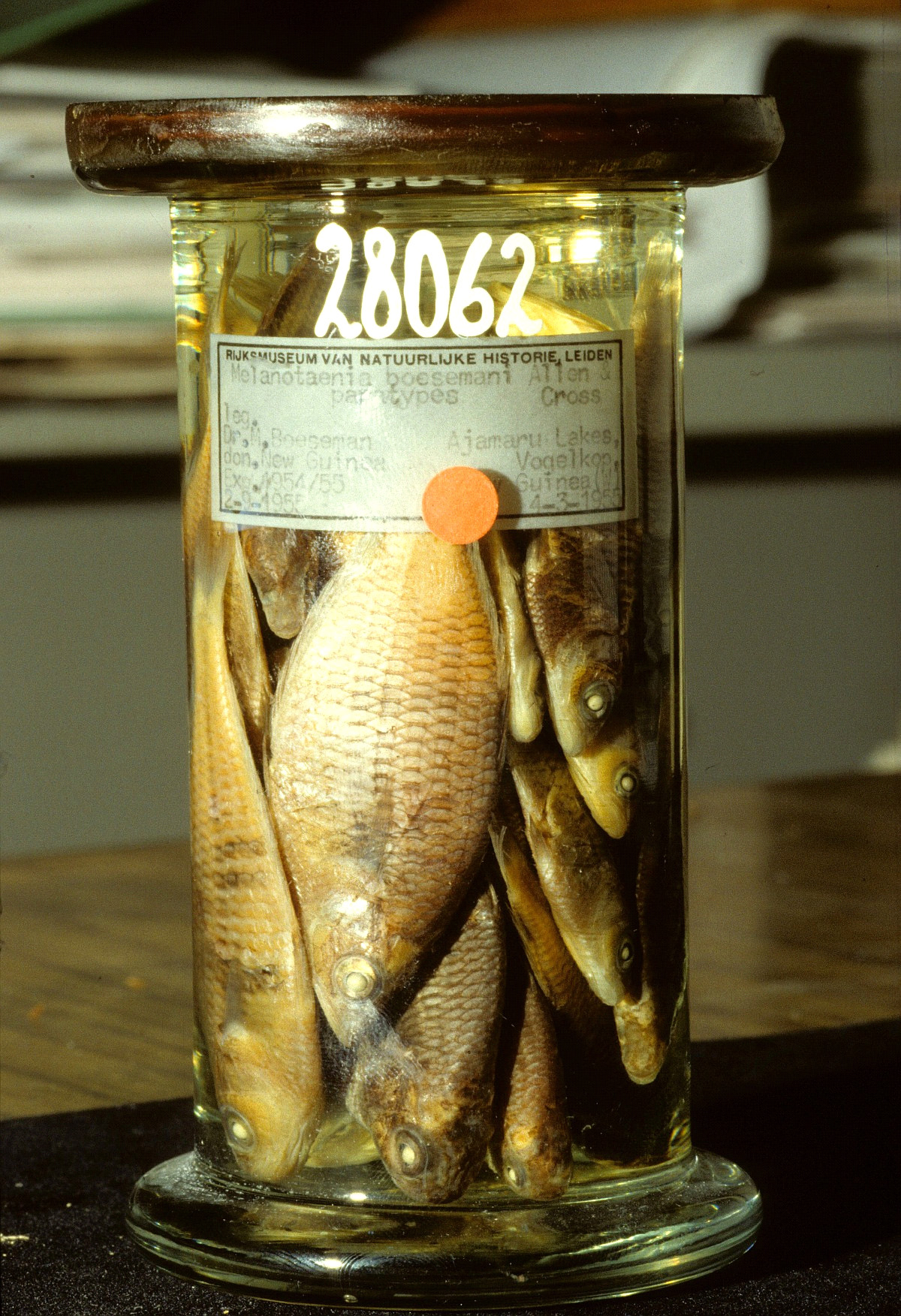
As part of his preparation for the revision of the rainbowfish family, Gerald Allen studied the Dutch collection of 1954– 55 during 1975 and 1977. He discovered no less than four new rainbowfish species, which he described in 1980 together with Norbert Cross. These species were Melanotaenia boesemani, M. ajamaruensis, M. japenensis and Glossolepis pseudoincisus. Melanotaenia boesemani and M. ajamaruensis were collected in March 1955 by Boeseman and his companions in the Ajamaru Lakes, a complex of lakes on the Ajamaru River in the centre of the Vogelkop Peninsula. Specimens of M. boesemani was also found in Lake Ajtinjo, 25 kilometres to the southeast of Ajamaru village and from ‘Djitmau’, about 3 km south of the Ajamaru Lakes. The specimens preserved in alcohol still showed the unusual colour pattern.
Melanotaenia boesemani is readily separable from M. ajamaruensis on the basis of soft ray counts for the second dorsal and anal fins. The former species has 10 to 14 (usually 12 or 13) dorsal rays and 17 to 23 (usually 18 to 21) anal rays compared with 15 to 19 (usually 15 to 17) and 21 to 27 (usually 22 to 24) for M. ajamaruensis. Although these species possess a similar colouration and general shape, the stripes on the sides tend to be more pronounced in M. ajamaruensis, particularly the midlateral one and the stripe just below it.
In November 1982, Gerry Allen had the opportunity to collect live specimens during a visit to the remote Vogelkop Peninsula. Heiko Bleher, a well-known aquarium fish collector, had accompanied Gerry Allen on the trip and was able to transport a number of live specimens captured during the expedition back to Europe, whereupon they were subsequently bred and distributed in the aquarium hobby. Some live specimens were also sent to Australia. In 1998, Heiko Bleher collected more live specimens of Melanotaenia boesemani from Aytinjo Lake and they too, have been distributed in the aquarium hobby.
Since its introduction to the aquarium hobby, M. boesemani has steadily increased in popularity and today, it could be considered the most popular rainbowfish in the hobby. By 1989 Ajamaru villagers were catching so many live fish for the aquarium trade the species was on the brink of becoming endangered. An estimated 60,000 male rainbows were captured each month for shipment to Jakarta exporters. Eventually the Indonesian Government placed some controls on the activity (Polhemus et al. 2004).
Other Notes
In 2007 surveys were conducted by the Papuan National Marine and Fisheries Research, the Academy of Fishery Sorong, and the Institute of Research for Development of France in five regions of West Papua. Fifteen species of rainbowfishes were collected during these expeditions. During the collecting trip to the Sorong region they collected 352 rainbowfishes, and among them were a number of undescribed species. Melanotaenia boesemani were collected from Lake Ajamaru, Lake Ajtinjo and Lake Uter.
Lake Uter was inhabited by thousands of M. boesemani. They also sighted Tilapia and Goldfish. Based on their observations, the specimens caught in the upstream Lake Uter were attacked by bacteria and fungi and were suffering from malnutrition. According to the local villagers the rainbowfishes started showing disease after the introduction of the goldfish and Tilapia a few years before. The M. boesemani specimens collected from Lake Ajamaru had bright yellow posterior, whereas specimens from Lake Uter had a body colour of skyblue and orange posterior.
Melanotaenia boesemani was named in honour of Dr. Marinus Boeseman, the collector of the type specimens. According to labels accompanying the type specimens the native name for this species is ‘sekiak’ and ‘ikan rascado’.
Marinus Boeseman was born on June 22, 1916 in Enkhuizen, a small port on the Zuiderzee in Holland. After the untimely death of his father, Marinus, aged 11, his two elder sisters and his mother moved to Oegstgeest, a neighbour town of Leiden where he continued his primary and secondary education. In 1935 he entered Leiden University to study biology. On November 1, 1947 he was appointed curator of fishes at the Rijksmuseum van Natuurlijke Historie in Leiden, and held that position until his retirement on 30 June 1981. He died on July 14, 2006 at the age of 90
References
- Allen G.R. and N.J. Cross (1980) Description of Five New Rainbowfishes (Melanotaeniidae) from New Guinea. Records of the Western Australian Museum 8(3): 377-96.
- Allen G.R. & M. Boeseman (1982) A collection of freshwater fishes from western New Guinea with descriptions of two new species (Gobiidae and Eleotridae). Records of the Western Australian Museum 10(2): 67-103.
- Allen G.R. (1984) Boeseman's Rainbowfish - The Pearl of Irian Jaya. Tropical Fish Hobbyist 32(6): 22-24.
- Boeseman M. (1956) The Lake Resources of Netherlands New Guinea. South Pacific Commission Quarterly Bulletin 6(1): 23-25.
- Boeseman M. (1956) Fresh-water sawfishes and sharks in Netherlands New Guinea. Science 123: 222-223.
- Boeseman M. (1963) Notes on the fishes of Western New Guinea. Zoologische Mededelingen Leiden 38 (14): 221-242.
- de Vries J. (1962) Review of Inland Fisheries in Netherlands New Guinea. South Pacific Commission Fisheries Technical Meeting (Noumea, 5-13 Feb 1962).
- Evers H. (2014) Boeseman's Rainbowfish and its rare new cousin. AMAZONAS 3(5): 42-51 [English ed.].
- Holthuis L.B. (1956) Native fisheries of freshwater Crustacea in Netherlands New Guinea. Nova Guinea (n.ser.) 7(2): 123-137.
- Kadarusman, Sudaro and Laurent Pouyaud (2007) Laporan Ekspedisi Ilmiah Rainbowfish Papua 2007 10 Mei - 14 Juni. IRD Indonesia.
- Reeskamp G.A. (1961) Report of a Preliminary Survey of the Ajamaroe Lakes, Netherlands New Guinea. Indo-Pacific Fisheries Council Occasional Paper 61/12. FAO.