

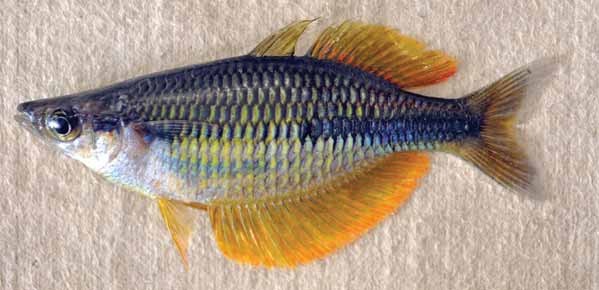
Melanotaenia flavipinnis
Misool Yellowfin Rainbowfish
Species Summary
Melanotaenia flavipinnis is a rainbowfish described in 2014 from Misool Island, in the Raja Ampat Islands off the Birds Head of western New Guinea — only the second rainbowfish species known from that island. Its entirely yellow dorsal, anal and pelvic fins are quite different from the paler, more translucent fins of M. misoolensis, the island’s other rainbowfish. Both a distinctive colour pattern and consistent scale and fin-ray counts distinguish it from its relatives, and it proves to be a relatively slender-bodied species in both sexes.
Etymology
The species name flavipinnis combines the Latin flavus, yellow, and pinnis, fin, referring to its yellow dorsal, anal and pelvic fins.
Etymology compiled from C. Scharpf (2023), “Fishes of Sahul: An Etymological Survey (Part 6), the rainbowfishes (continued)”, Fishes of Sahul 37(1): 2006–2022, and etyfish.org.
Distribution & Habitat
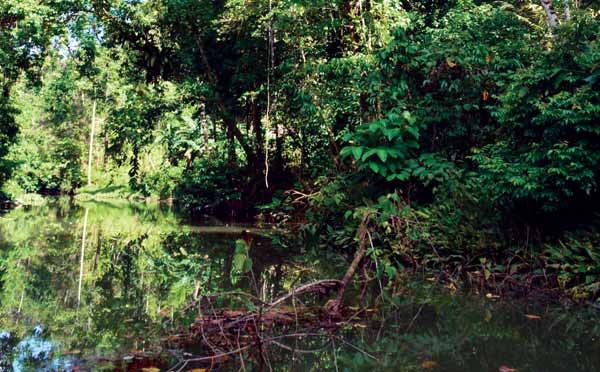
Melanotaenia flavipinnis is known only from the southeastern part of Misool Island, from two nearby drainages only about 4 km apart, the Gam River and Ifaupan Creek, which are separated from the Wai Tama system (home to M. misoolensis) elsewhere on the island by well-defined watershed boundaries. The type locality is a narrow stream only 1–2 m wide and generally under 0.5 m deep, with a very gradual gradient, flowing through second-growth forest about 3.5 km upstream from the sea, over a bed of sand and gravel.
Description
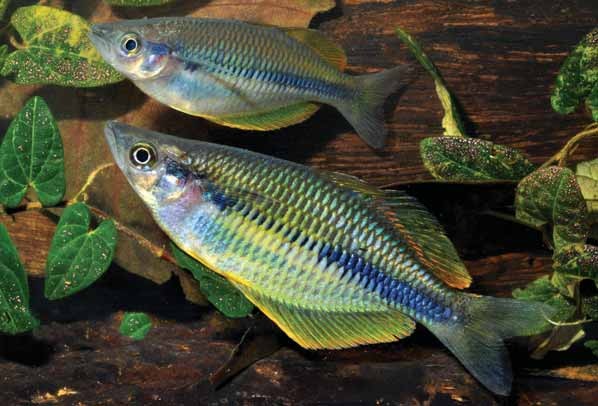
A moderately slender rainbowfish, adult males with greatest body depth only 2.8–3.3 in SL. In life it is generally greenish above with a faint yellow stripe between each horizontal scale row, and a prominent dark blue mid-lateral stripe along the rear half of the body, one to two scale rows wide. A dark blue stripe also crosses the upper operculum, continuing just above and behind the pectoral-fin base. The dorsal, anal and pelvic fins are yellow throughout, distinguishing it at a glance from most of its relatives. The first dorsal fin is set well behind the anal-fin origin (over about the fifth or sixth anal ray), and the anal fin is conspicuously rounded, with the longest rays clearly exceeding the depth of the caudal peduncle — both vomerine and palatine teeth are present.
Comparison with Similar Species
Melanotaenia flavipinnis differs from its only island companion, M. misoolensis, mainly in colour pattern and fin proportions: M. misoolensis has whitish to translucent dorsal and anal fins that only grade to pale yellow at their tips (rather than solid yellow throughout), whitish rather than yellow pelvic fins, a large red opercular spot rather than white, and no yellow body colour. Its mid-lateral stripe is also more irregular, broken by isolated dark patches, and its first dorsal and anal fins are positioned roughly opposite each other rather than offset as in Melanotaenia flavipinnis. Morphologically the new species is even more similar to M. salawati of neighbouring Salawati Island — sharing overlapping scale and fin-ray counts, a posteriorly-set first dorsal fin and elongate anal-fin rays — though M. salawati has generally less vivid colouration and on average more cheek scales (16–19 versus 11–16). Despite the strong resemblance, genetic data confirm all three as separate species.
Account compiled for Home of the Rainbowfish from G. R. Allen, R. K. Hadiaty & P. J. Unmack (2014), “Melanotaenia flavipinnis, a new species of Rainbowfish (Melanotaeniidae) from Misool Island, West Papua Province, Indonesia”, aqua, International Journal of Ichthyology, 20(1): 35–52.
References
- Allen G.R., R.K. Hadiaty and P.J. Unmack (2014) Melanotaenia flavipinnis... aqua, 20(1): 35-52.