

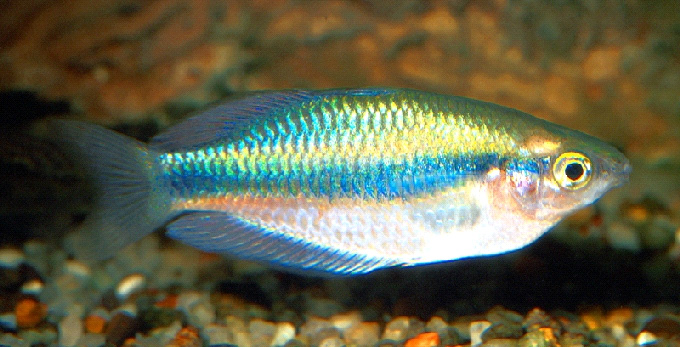
Melanotaenia catherinae
Waigeo Rainbowfish
Etymology
The species is named in honour of de Beaufort’s wife Catherine, who helped her husband on the expedition during which the holotype was collected.
Etymology compiled from C. Scharpf (2023), “Fishes of Sahul: An Etymological Survey (Part 6), the rainbowfishes (continued)”, Fishes of Sahul 37(1): 2006–2022, and etyfish.org.
Synonymy
- Rhombatractus catherinae de Beaufort, 1910
- Melanotaenia catherinae Allen, 1980
Species Summary
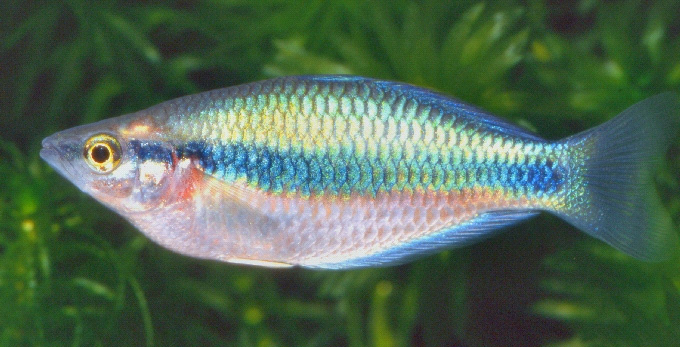
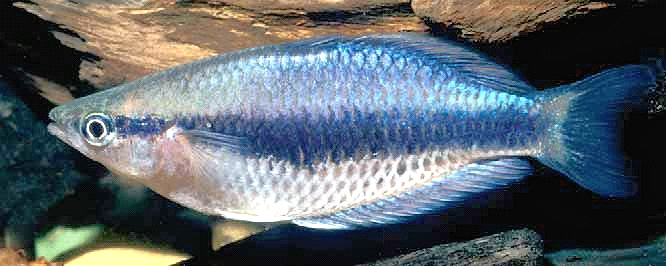
Melanotaenia catherinae are bluish to purplish brown on the back and white on the lower side with a blue midlateral band up to 2½ scales wide. Dorsal and anal fins bluish with a maroon-red wash on the margins. They may reach a maximum size of 10 cm, but usually less than 8 cm. They are closely related to Melanotaenia synergos, which is found on Batanta Island. The two species share similar meristic and morphological features. However, they differ in modal counts for pectoral-fin rays and lateral scales. They also exhibit slight colour pattern differences related to the width of the dark midlateral stripe, which is generally narrower in M. synergos, covering one and a half scale rows for most of its length versus 2 to 3 scale rows for M. catherinae. Moreover, the midlateral stripe of Melanotaenia synergos is nearly covered entirely by the pectoral fin, whereas it is broadly exposed (at least one scale row) above the pectoral fin of Melanotaenia catherinae. Analysis of genetic relationships indicates a close relationship between the two species.
Original Description Dorsal profile nearly straight, sloping down from dorsal to snout, a little more convex in large specimens. Ventral profile strongly convex in large specimens. Height in smaller specimens (to 100 mm.) 2.5−3.2, 3−3.75 in length with caudal, in specimens above 100 mm. 2.2−2.5, 2.7─3 in length with caudal. Head 3.2−3.7, 4−4.5 in length with caudal. Eye 3−3.8, about 1.5 in interorbital space, which is about equal to postorbital part of head. Snout rather obtuse, 2.6−3 in head and only a little longer than eye.
Upper jaw prominent. Mouth opening reaching to vertical through front border of eye. Conical teeth in several rows in the jaws, extending to the outside of the lips, which are thickened, especially in their anterior part. A patch of teeth on the vomer and perhaps a few on the hinderpart of the palatines, none on tongue. Two rows of scales on suborbital part of cheeks. Operculum with large scales, excepting the superior ones, which are small. Dorsal separated by 16 scales from occiput. Spine of first dorsal scarcely longer than that of second dorsal, shorter than postorbital part of head and much shorter than that of anal, which is about equal to eye. Origin of anal opposite to that of first dorsal. Length of base of anal longer than distance between origin of first dorsal and end of second dorsal. Pectorals longer than head without snout. Scales nearly smooth, with indication of crenulations. Caudal peduncle longer than high in small specimens, in large specimens considerably higher than long. In life, the colour of the lateral band is dark-blue and the scales have wine-red margins, which form about 8 longitudinal stripes. Proximal part of anal and second dorsal wine-red.
Distribution & Habitat
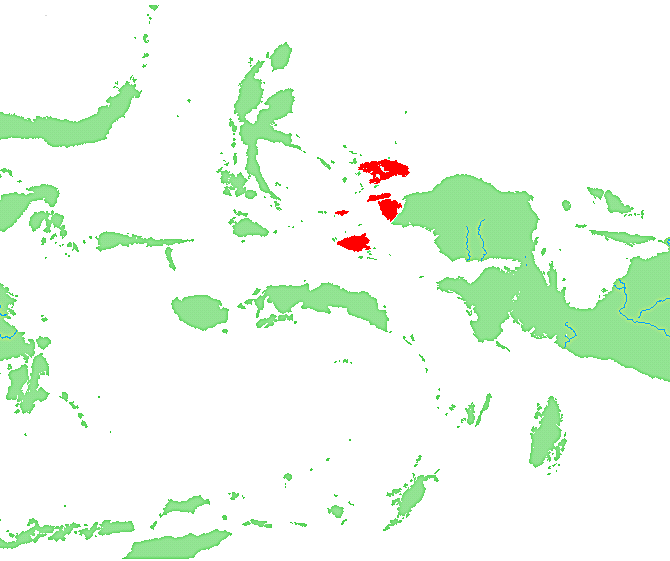
Melanotaenia catherinae is so far found only on Waigeo and Batanta Islands in the Raja Ampat Group lying immediately west of the Vogelkop Peninsula, West Papua. Raja Ampat is a group of islands located to the west of Sorong, on the northwest tip of the mainland of New Guinea. The Raja Ampat Islands are situated immediately west of the New Guinea mainland. The type-locality was a brook flowing into the Rabiai River, on Waigiou (Waigeo) Island. However, they have been collected from several streams including the Rabiai River, Wai Semie, Wai Meniel and Waiwo Creek. Waiwo Creek is a small clear-water stream (4-5 metre wide) flowing over pebble and boulder substrate, north of Saonek Island. Water conditions reported: Temperature 27.0°C; pH 8.3; Conductivity 390 µS/cm.
Remarks
Melanotaenia catherinae were collected from Waigeo Island by Sten Bergman during the Swedish New Guinea Expedition in 1948-1949. Specimens are maintained in the Swedish Museum of Natural History. The first aquarium specimens were imported to Germany by Heiko Bleher in 1992, where they were bred and distributed internationally.
References
- Allen G.R. (1991) Field guide to the freshwater fishes of New Guinea. Christensen Research Institute, Madang, Papua New Guinea.
- Allen G.R. & P.J. Unmack (2008) A new species of rainbowfish (Melanotaeniidae: Melanotaenia), from Batanta Island, western New Guinea. Aqua, International Journal of Ichthyology 13 (3-4): 109-120.
- de Beaufort L.F. (1910) Weitere Bestätigung einer zoogeographischen Prophezeiung. Zoologischer Anzeiger. 36 (12/13): 249-252.