
Hydra
Hydra are small aquatic invertebrates commonly found in most unpolluted freshwater environments in both tropical and temperate regions of the world. They belong to the same group of animals as the marine jellyfishes, corals, and sea anemones. Hydra are commonly found hanging inconspicuously from drifting and stationary vegetation or from the waters surface film in most freshwater habitats. They are often unintentionally introduced to the aquarium with live foods, snails, driftwood, plants, gravel and water collected from natural freshwater environments.
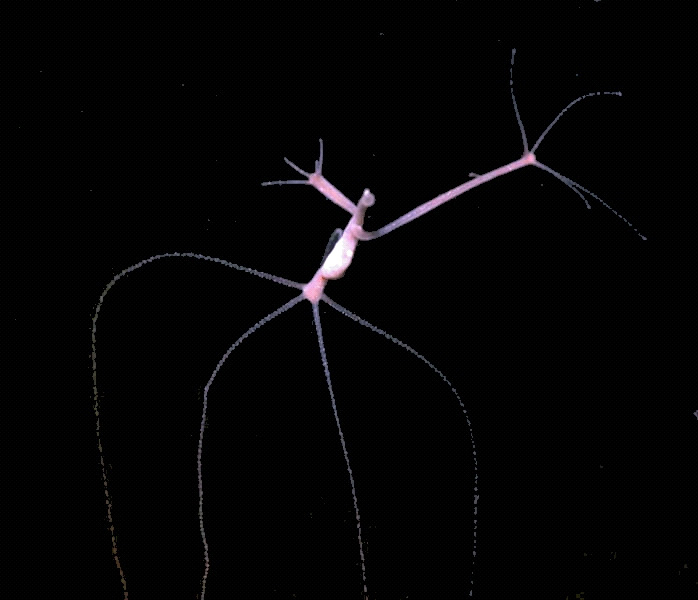
Hydra are about 1 to 25 mm long and have a flexible cylindrical body secured by a simple adhesive basal disc by which the animal anchors itself to a surface. Gland cells in the basal disc secrete a sticky fluid that allows for its adhesive properties. On the opposite end are from five to twelve arms or tentacles, gently swaying in the water current. If the hydra is disturbed the tentacles can be retracted to small buds and the body column itself can be retracted to a small gelatinous sphere, making them almost impossible to see. They are generally sedentary or sessile, but do occasionally move quite readily. They do this by bending over and attaching themselves to the substrate with mouth and tentacles and then release the foot, which provides the usual attachment. The body then bends over and makes a new place of attachment with the foot. By this process of “somersaulting”, hydra can move several centimetres in a day. Hydra may also move by amoeboid motion of their bases, or by simply detaching from the substrate and floating away in the current. They float at the surface of the water buoyed up by gas bubbles given out by the basal disc. They remain in a free-floating stage until they find a spot that is suitable for their needs.
Hydra are strictly carnivorous, feeding mainly on small crustaceans, insect larvae, worms or other tiny aquatic animals. In aquaria, they will thrive on any similar live food being fed to rainbowfish larvae - including the rainbowfish larvae. Any aquarists who feed copious amounts of live brine shrimp nauplii or similar live foods will eventually find colonies of hydra in their aquarium. To capture these minute forms of life hydra extend their body to maximum length and then slowly extend their tentacles. Despite their simple construction, the tentacles are extraordinarily extensible and can be four to five times the length of the body, sometimes extending to a length of 5 cm. Once fully extended, the tentacles are slowly swept around waiting for contact with a suitable prey animal. Each tentacle, or cnida (plural: cnidae), is embedded with highly specialised stinging cells called cnidocytes. Cnidocytes contain specialised structures called nematocysts which look like miniature light bulbs with a coiled thread inside. At the narrow outer edge of the cnidocyte is a short trigger hair. Upon contact with prey, the contents of the nematocyst are explosively discharged; firing a dart-like thread containing neurotoxins into whatever triggered the release. Once stimulated, the nematocysts take only three milliseconds to release fully.
Judging from its incredible potency and speed of paralysis and death, the poison is believed to be a nerve toxin. They have four different types of nematocysts, some stinging and paralysing the prey, whilst others discharge threads which coil round the prey and hold it. Small animals paralysed by the stinging cells are brought to the digestive centre by the tentacles and devoured. The mouth of the hydra is located at the centre of the tentacles. The body is hollow and the inner layer of cells digests the food by engulfing it. With prey almost as large as itself, the hydra stretches so thin in getting its digestive gut around it that the prey animal appears to be covered with a thin transparent film; only the tentacles tell you that you are looking at a hydra, although they generally keep their tentacles coiled up. A hydra that has recently fed will be shorter and more rounded than one that is hungry.
In aquaria, hydra can be found attached to plants, gravel, stones, the sides of the aquarium, filter equipment, etc. They are most commonly found attached to the stems of waterplants or the undersides of floating leaves or plants such as duckweed. Unless they occur in large colonies or are coloured, most hydra in a normal aquarium will go unnoticed. However, within the confines of a small fry-raising tank, these little monsters can be deadly, and can ingest a large batch of newly hatched rainbowfish larvae in less than a week. Hydra can kill larvae up to a size of around 10 to 15 mm. Newly hatched larvae of rainbowfishes and blue-eyes are bite-size for the average hydra. Larger larvae may often pull away from the stinging tentacles, but will usually die in any case. Juveniles over 15 mm, however, generally don’t seem to have any problems.
Hydra only seems to appear in fry-raising tanks being fed brine shrimp nauplii or similar live foods. They don’t seem to appear in fry-raising tanks that are fed primarily a dry or liquid diet. However, once you start feeding large amounts of brine shrimp nauplii, it isn’t long before hydra appear. Hydras have however, been known to feed on the organic material off the substrate when live food supply is insufficient. This behaviour however, is not considered normal. Usually you do not notice them unless a heavy infestation has become established. They are usually brown in colour or transparent and are not readily seen against a background of natural coloured gravel or on plants. The best way to avoid introducing them into fry-growing tanks is to sterilise the tank and filter equipment with a chlorine solution before they are used.
Finding a few hydra in your regular aquarium doesn’t mean that the aquarium is unhealthy. Actually, it means you have a normal healthy aquarium, since hydra will not live in water of poor quality.
The name “Hydra” is derived from a monster in Greek mythology. One of the twelve tasks imposed on Hercules was to slay the Hydra of Lerna. It had nine serpent-like heads, one of which was immortal. So potent was its venom that even its smell was fatal to those who passed too close. Worst of all was that for every head Hercules cut off, two more grew in its place. He finally triumphed by cauterising the wounds with a firebrand as he chopped away. Just like the legendary monster, a single hydra may be cut into many pieces and if each piece contains a portion of the two body layers, ectoderm, and endoderm, it will develop into a complete animal.
A number of different species of hydra are known, and they come in a variety of different colours such as green, grey, black, brown, pink, orange, and transparent.
Hydra viridissima (formally Chlorohydra viridissima) is referred to as the green hydra due to the presence of a symbiotic green alga (Chlorella vulgaris) in the gastrodermal cells of the animal. The algae make use of those substances that the hydra would normally excrete, such as carbon dioxide, phosphates and nitrogenous substances in this symbiotic relationship. For its part, hydra benefits by receiving the oxygen produced by photosynthesis. If there is a food shortage, the hydra will digest the plant cells and later ingest more living algae, which it does not digest. Due to the presence of these symbiotic algae, this hydra is attracted by light, contrary to other species and can survive long periods without food. Their distribution is considered ubiquitous throughout Australian freshwater systems.
Hydra are considered to be hermaphrodites and reproduces both asexually and sexually. Asexual reproduction takes place in a process known as budding; the hydra simply forms a bud on the side of its body. Buds are produced every two to three days under favourable conditions. Hydra often has four buds at a time. These simple organs are no more than lumps attached to the body of the female hydra. The embryo secretes around itself a hard, sticky shell and is carried by the female until the young hydra develop tentacles, and then breaks off, fully prepared to exist in its own. All hydra species have been observed to go through occasional sexual phases. One thing that can cause sexual reproduction is when environmental conditions become unsuitable. They produce eggs which form on the external surface of the stalk. The fertilised eggs secrete a tough outer coating and, as the adult dies, these resting eggs fall to the bottom of the lake or stream to await better conditions, whereupon they hatch into miniature adults.
The growth rate of hydra populations is closely related to conditions such as temperature, water quality and quantity of food. Habetha et al. (2003) analysed the population growth of Hydra viridissima fed Artemia salina. They observed that the population fed daily doubled in 3 days; those fed once a week, in 14 days, and those fed once a fortnight, in 31 days.
Freshwater hydra as a whole, are relatively little known in Australia in spite of being common organisms in most freshwater habitats. In Australia there are at least 4 species: Hydra attenuata, Hydra hexactinella, Hydra oligoactis and Hydra viridissima.
Treatment In the past, the only way I found to eradicate hydra successfully was to sterilise the tank with a chlorine solution. Some copper medications claim that they will kill hydra but they can also be deadly to the fry. Other treatments usually recommended include ammonium nitrate, quinine sulphate, raising the temperature to 40°C for 15 minutes or more, lowering the pH, or adding salt until the hydra are killed. An even more elaborate treatment I read once was the use of a 9V battery connected to leads that fed into the aquarium water. Most of these treatments simply do not work and in addition, they can be harmful to the young rainbowfish fry.
Dactycid® is a very effective drug treatment against hydra and all species of internal worms (hookworms and roundworms) including Camallanus cotti, flukes and planarians. Use according to manufacturer recommendations.
Flubendazole is another veterinary drug and can be found under a number of synonyms: Fluvermal; Flubenol; Flumoxal and Flumoxane. Flubendazole 5% is very effective in killing hydra and is very safe to use with small rainbowfish fry used at 1–2 mg/L. I have used both these products with rainbowfish fry only 10 days old, without any problems. Pre-dissolve the flubendazole 5% in a container with some aquarium water, and then pour it in the aquarium. After 5–7 days, following treatment, do a 50% waterchange.
Flubendazole is a “wettable powder” and as such does not completely dissolve. It may leave a white residue in the aquarium, but this can easily be removed with following waterchanges. Remove any deposit of white powder left on the aquarium walls with a sponge and siphoning the bottom with a gravel siphon. I did not have any problems with the residue and it also had no effects on brine shrimp nauplii when fed to the fry. However, these chemicals can be very toxic to snails.
Flubendazole (15%) is specifically designed and developed for aquatic use. This medication will kill flukes, camallanus worms, tapeworms, anchor worms and other helminthics commonly found in tropical and coldwater fish. It has also been used successfully with ‘skinny disease’ in clown loaches. However, it can be toxic to snails and is harmful to scaleless fish species. One should follow the manufacturer’s instructions for treatment, as different manufacturers use different chemicals and concentrations of the active ingredients.
Flubendazole may not be available in Australia; I obtained the chemical directly from Europe. However, a number of other products have been reported to have similar effects on hydra and other worms. Panacur (fenbendazole) a similar chemical, has also been reported as an effective control for hydra used at 2 mg/L. This chemical is available in various formulations and trade names. Praziquantel is another chemical that is very effective for control of hydra used at 1–2 mg/L, while having a wide margin of safety for fish. It is available as an aquarium formulation under a number of brand names. However, before using any of these products consult a veterinarian.