
Outdoor Ponds
In suitable climates, rainbowfishes can be maintained and will breed in outdoor ponds. Although a tropical to subtropical group, all rainbowfishes can handle temperatures down to 20°C, and even as low as 10°C for short periods without problems. If you live in a cooler climate you could maintain your rainbowfishes in an outside pond during the summer, as they will all benefit from even a short period outdoors.
Generally, rainbowfishes kept in outdoor ponds develop better colouration and will often grow to a size not attained in aquariums. This is because in a pond situation the rainbowfishes have access to the full range of natural pond organisms for feeding. In general, rainbowfishes should have at least some live foods to be healthy and grow rapidly.
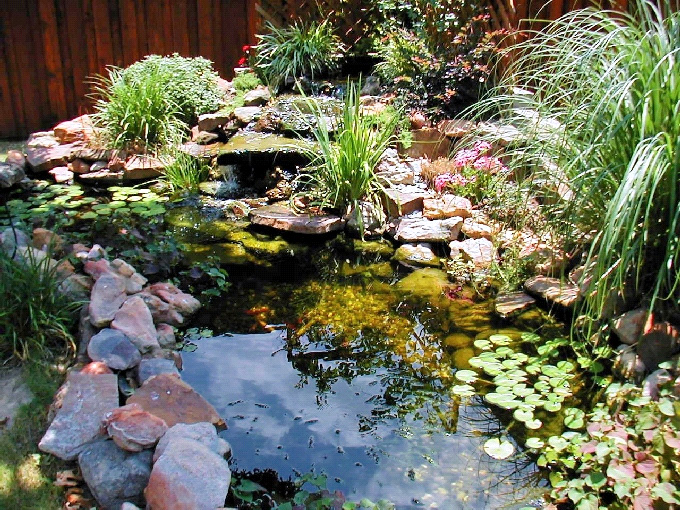
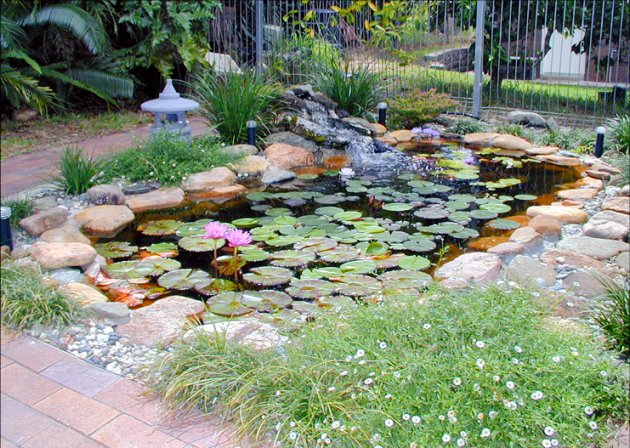
An ornamental pond or watergarden provides a wonderful opportunity to enjoy both the natural beauty of rainbowfishes and waterplants. The soothing, visual beauty of ponds is enhanced by waterplants, with an ever-changing view as the rainbowfishes swim among the plants, and the play of light and shadows are reflected in the water. Rainbowfishes are naturally camouflaged and difficult to see from the surface, but the inclusion of waterplants will assist in preventing predation by birds and other animals.
All fish tend to prey on each other, and the larger naturally eat the smaller. Nevertheless, some small fry will survive and the overall number will increase if part of the pond is thickly planted. Waterplants serve many roles in ponds; they produce oxygen, which is used by the fish, and help remove waste nutrients. They provide cover for small fish, spawning habitat for adult fish, and home for small aquatic animals, which can be food for the fish. On the negative side, plants while creating habitat/shelter for small fish also provide an ideal habitat for dragonfly larvae, and other aquatic creatures, which can be highly predatory on fry.
Plants available for use in ponds are many, but there are certain considerations to be taken into account. Such things as water depth, amount of sunlight, and whether the plant chosen will survive in the pond, need to be considered. Floating leafed and submerged plants are necessary for a healthy pond and must be included in your selection.
Pond size and construction is also very important. The smaller the pond, the greater the impact seasonal and diurnal temperature fluctuations have and the less stable the overall pond environment will be. Minimum size for a healthy balanced pond is considered to be about 5 m2 of surface area. Another important factor in the overall health of the pond is the depth. Depth of the pond should range from 45 to 60 cm. Greater depths are not necessary and may cause maintenance problems.
Locate your pond to avoid direct sunlight at midday during the warmest months. Rainbowfishes can become stressed by high temperatures unless shade is provided by waterplants. A minimum of 5 to 6 hours of direct sunlight each day is recommended for the best growth and establishment of all waterplants. However, there are endless options for planting a pond and its surrounding area.
Floating leafed plants are usually waterlilies. Plant enough to cover 50 to 75 percent of the surface area of the pond to keep the growth of algae in check. Submerged plants are the oxygenators of the pond - a must if your pond is to be healthy and support fish.
Free-floating plants, such as Azolla, Lemna, or Ricciocarpus species, though not necessary, add the finishing touch to the natural appearance of the pond. These plants move with the breeze and produce an ever-changing pattern in the pond. However, floating plants can smother the air/water interface resulting in reduced oxygen/carbon dioxide exchange and aeration. Surprisingly a cover of floating plants does not reduce evaporation, as people believe; it actually increases evaporation due to the transpiration/respiration cycle and is called evapotranspiration. They also reduce the amount of light penetration into the water column due to the effects of shading as well as competing for nutrients, resulting in lower phytoplankton productivity in the natural food chain.
Bog or marginal plants are also suitable for the pond. These plants can generally tolerate as little as three hours of direct sunlight. Some grow best in constantly moist to boggy soils, while others actually grow in standing water. There are many different species of bog plants with varying heights, textures, and colours to their foliage. Waterplants, just like other garden plants, will need periodic pruning, dividing, repotting, and fertilising. Fertilisers used in the pond should be slow release pellets that can be pushed into the base of the plants. Caution should be used, as any fertiliser leaching out into the water will cause an algal bloom.
Ponds can be built out of several types of materials. Some of the more common construction materials are earth, liners, fibreglass, and concrete. Choice of construction materials should take into account the life expectancy of the material and installation requirements. The liner is generally the most important and most expensive component of a watergarden.
Some examples of material in order of life expectancy are: PVC (fish grade) – 7 to 15 years Butyl or Rubber (fish grade) – 30 years Fibreglass – 50 years Concrete – Lifetime, if done correctly.
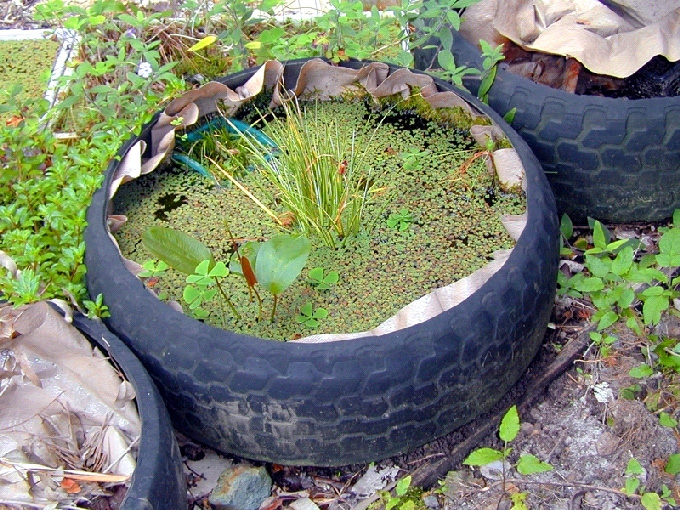
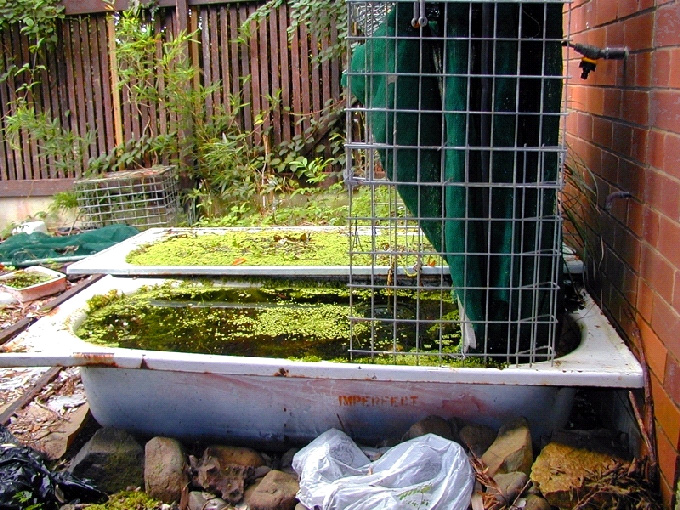
Ponds can be relatively expensive to build and maintain, although many hobbyists start with little expense by using an old wash tub, bath or wading pool. However, it doesn’t matter whether your pond is an old truck tyre or a backyard masterpiece with waterfalls and hidden lights, good water quality must be maintained. If not, the pond declines in beauty and the fish become stressed and susceptible to diseases. Once the basics of water quality are understood and practiced, maintenance will become second nature and require only a few hours per week.
The most common water quality problems are oxygen depletions and the build-up of toxic nitrogenous wastes. Oxygen depletions occur because the total amount of plant and animal life has exceeded the carrying capacity of the pond or because of an excessive rate of decomposition. Fish gasping at the surface is almost a sure sign of oxygen depletion. Oxygen consumption depends on the respiration of aquatic organisms, including plants, and the aerobic decomposition of organic material by bacteria; these rates also increase with temperature. This balance needs to be clearly understood; a satisfactory oxygen level recorded during the day is no guarantee that the levels will be maintained during the night. Moderate levels recorded on a warm, sunny afternoon will almost always indicate that severe oxygen deficiencies will occur during the night. Also, lower than expected daytime pH values due to high levels of CO2 may indicate high levels of bacterial respiration which could lead to low night-time oxygen levels.
The other common water quality problem is the accumulation of toxic wastes such as ammonia and nitrites. This problem occurs because of over-feeding, rapid decomposition, or biofiltration failure. Nitrification is a well-studied biological process that aerobically transforms ammonium and nitrite into nitrate, which is far less toxic to aquatic animals. In earthen ponds, complete nitrification of ammonium to nitrate occurs naturally in the sediments and to lesser extent in the water columns. This process, however, is not entirely possible in the case of plastic lined ponds, which are often reported to encounter excessive nitrite accumulation in water. Fish health survival is generally believed to be better in ponds where substrates are used than in ponds without substrates. Waterplants are active biological filters, and, if a balance is maintained between the number of plants, the number of fish, and the amount of nutrients the pond receives, no other filtration should be necessary. Ponds with abundant waterplants and a modest number of fish should become a balanced system on its own. The key is to maintain water quality and relatively clear water so your fish can be seen and enjoyed.
The Pond Ecosystem
All factors occurring in the pond, whether physical, chemical or biological, influence the pond ecosystem. The pond ecosystem is of course extremely complicated and intricate. As aquarists, we need to manipulate the ecosystem so as to produce an optimal environment for the rainbowfishes. Food is just one component of this complex system. Periphyton is a complex mixture of tiny aquatic plant and animal organisms, and detritus that is attached to submerged surfaces in most aquatic ecosystems. It serves as an important food source for invertebrates and fish. It can also absorb contaminants; removing them from the water-column. The periphyton is also an important indicator of water quality. Periphyton communities are being used in aquaculture ponds for the removal of solid and dissolved pollutants. Their performance in filtration is established and their application as food is being researched. There is growing evidence that periphyton can have a positive effect on fish health. It can act as an antibiotic against a variety of disease-causing bacteria present in ponds, or as a kind of vaccine for fish that feed on it.
Some ponds will support adequate periphyton communities without any assistance. However, most ponds require some form of fertilising in order to promote periphyton development. A better understanding of the pond ecosystem will assist in the management of the pond to promote the natural blooming of favourable periphyton species. Different periphyton species have widely varying abilities and demands for nutrient uptake and light utilisation. Parameters that will influence the periphyton ecology will include fertilisation (nutrients), temperature and light.
When ponds are first filled with water, there are few living organisms and few nutrients. The water rapidly gains nutrients, particularly if soluble inorganic fertilisers are added. It also gains nutrients, but more slowly, as organic fertilisers are decomposed by bacteria. Phytoplankton and other bacteria rapidly use the released nutrients. Within a few days, growing populations of phytoplankton may provide a green tinge or “algae bloom” to the water. What turns the pond green is innumerable single celled algae. These are present in all water and will create a bloom in any water left undisturbed in full sunlight. The long filamentous algae that grow on the bottom and sides of the pond are not responsible for the discolouration of the pond. However, if you feel the algae is unsightly and needs to be removed, manually pull one end loose and roll it up on a stick, or just pull it up by the handful. Some rainbowfish species will eat filamentous algae, but don’t expect it to be rapidly consumed. In time the waterplants will cover most of the pond’s surface denying light to the algae.
Established waterplants will eventually out-compete the algae for the available CO2 and soluble nutrients. Sometimes the pond will suddenly clear overnight as the algae succumb and sink to the bottom. Occasionally throughout the pond’s life, this algal bloom may reoccur for a short time. This may happen when the temperature of the water is increasing, or the nutrient levels are up. Algal blooms of short duration are to be expected. This indicates that there is a growing food base for single-celled protozoans and other zooplankton. In many ponds the water first appears brownish. This happens when the bacterial food levels are large enough to cause huge protozoan or rotifer blooms without much phytoplankton being present. Water quality in ponds changes continuously and is affected by physical and biological characteristics. With this in mind water quality should be monitored regularly.
It is important to maintain the pond properly during each season, paying attention to the specific requirements, since the tasks differ widely from one season to the next. In long periods of hot, dry weather, you may need to top up the water level in the pond. Use stored rainwater, if possible. Water from the house supply is likely to have higher chlorine/chloramine content in summer, and topping up with it may encourage alga blooms, and induce stress in the fish. If tap water is all you have available, introduce it in small quantities - no more than 5% of the total pond volume, and no more than once a week.
Feeding Fish
Rainbowfishes may have to be fed some artificial feeds because some ponds just won’t have enough natural foods to sustain ideal growth. Large amounts of artificial feeds however, should not be used to feed rainbowfishes in outdoor ponds as it can be detrimental for water quality and is an ineffective feeding method. Feed just a small amount more than they immediately consume and later check to see if the additional feed is eaten. Adjust the amount of feed offered accordingly. The pond will need to be inspected periodically to check natural food populations.
Rainbowfishes should be removed from the ponds, or restocked at lower densities, at the time when the natural food in the pond can no longer support the number of fish. It is not possible however; to give daily dietary requirements for feeding rainbowfishes in ponds as the dietary requirements under these conditions will depend on stocking density, and the availability of natural food organisms. Feeding should be reduced at water temperatures above 32°C. At high temperatures rainbowfish do not feed well and are easily stressed by poor water quality. Also, do not feed at water temperatures below 10°C. Rainbowfishes will not feed at lower temperatures because their metabolism decreases.
The natural food items that are available in ponds can be divided into three broad categories, these being plant material (phytoplankton), animal material (zooplankton) and detritus (decomposing fragments of organic material derived from both plants and animals), as well as organisms that are not easily classified into any of these groups (such as protozoans and bacteria). Rainbowfishes will feed on all these organisms.
There are a number of different species of aquatic animals that will inhabit the pond. The most important live food found in a pond is aquatic insect larvae and zooplankton. These animals are very high in protein which is necessary for the growth of rainbowfishes. Zooplankton consists mostly of rotifers, cladocerans or copepods. The ability of rotifers and cladocerans to reproduce parthenogenetically (asexually) enables them to react quickly to favourable and unfavourable environmental conditions.
Rotifers (40–600 µm) have the shortest life span (5–12 days) and can reach their peak reproductive level in about 3 –5 days. At 20–25°C, the egg-to-egg span is 1–3 days. Cladocerans (0.2–3.0 mm) and copepods (0.3–3.0 mm) have similar life spans of approximately 40–50 days, but with different peak reproductive periods. Egg-to-egg generation times are 7–14 days for copepods compared to 6 –8 days for cladocerans at 20–25°C. To reach their peak reproductive capacity, cladocerans require 14–15 days while copepods require 24 days at 20–25°C. Copepods, which have only sexual reproduction, require longer periods to increase their population levels.
Cladocerans are desirable live food since they have high protein value and are readily consumed by most rainbowfishes. However, cladoceran populations usually decline rapidly when subjected to predation in ponds. On the other hand, copepods, because they are swift swimmers are better able to maintain their populations during the later stages of pond culture.
Rotifers are often the earliest visible zooplankton to appear in ponds. Rotifers feed on bacteria and phytoplankton, and then reproduce to form huge populations. That usually happens 2–3 weeks after the ponds are filled and when water temperature is 20–28°C. As rotifers eat their own food supply the population drops drastically. Then copepod nauplii, adult copepods and cladocerans make their appearance. Together, copepods and cladocerans prevent a re-bloom of the smallest rotifers. However, modest populations of larger rotifers may appear after several weeks, particularly when the fish prey on the rotifers’ competitors and predators - cladocerans, copepods and aquatic insect larvae. Rotifers hatch from “resting eggs” that survived on the pond bottom during unfavourable conditions. Most of them hatch into females that reproduce asexually until pond conditions become unfavourable. Then sexual reproduction occurs and resting eggs are again produced.
For larger juvenile rainbowfishes, the smallest rotifers may not provide enough nutrients to make chasing and ingesting them worth the effort. Juvenile rainbowfishes are more predatory than the adults and require a higher proportion of animal protein in their diets. Most juvenile rainbowfishes will eat zooplankton. For the small rainbowfishes, such as the newly hatched larvae, small rotifers may be the only zooplankton small enough to eat. Although copepod nauplii can also be important first foods for rainbowfish larval. Protozoans may also be eaten, but little is known about their contribution to rainbowfish larvae diets.
Although little live phytoplankton is eaten directly by rainbowfishes, it is one of the most important components of the pond food chain. Plant material can come from many sources including microalgae, aquatic plants, reeds and rushes. With all of these fresh plant materials, especially ones containing low protein, the actual nutrient value to rainbowfishes is relatively low. In many cases when they are eating plant material they are only acquiring a few vitamins and minerals.
Microalgal species can vary significantly in their nutritional value, and this will change under different culture conditions. Nevertheless, microalgae can offer an excellent nutritional food for larval rainbowfishes, either directly or indirectly (through enrichment of zooplankton). Plant materials become far more nutritious after they have been in the pond for a couple of weeks after they begin to decompose. At this stage they are colonised by tiny aquatic animals, bacteria and fungi and begin to break down into detritus.
As plants decompose they become broken down into tiny fragments. The fragments become colonised by bacteria and fungi which feed off the decomposing material. These tiny fragments and the microscopic plants, animals, bacteria and fungi associated with them are known as ‘detritus’. Detritus is a major component of the diet of rainbowfishes at all stages of their life cycle. The tiny plant fragments themselves are not very nutritious but the micro-organisms associated with them are a readily digestible, nutritious, protein rich food source. The naturally occurring detrital food available can be supplemented by adding small amounts of organic plant materials such as hay and lucerne which will break down most rapidly and effectively to form healthy detrital communities.
Outdoor Growing Ponds
Outdoor ponds are also perfect for raising newly-hatched rainbowfish larvae and/or juveniles. An abundance of zooplankton is particularly important for larvae to develop into juveniles and for juveniles to develop into sub-adults. Rainbowfish larvae will feed on zooplankton through to the transition to adults. The larvae are not particular about the types of live foods they eat, but the organisms must be small enough to fit into their mouths.
The successful rearing of rainbowfish larvae in an outdoor pond does however, requires specific management of the pond to enhance phytoplankton and hence zooplankton development. The aim of pond rearing therefore is to maintain high densities of desirable zooplankton species until the fish are removed from the pond or weaned onto artificial feeds. These ponds are usually fertilised with organic or inorganic nutrients to encourage the development of phytoplankton blooms which, in turn, produce zooplankton blooms upon which the stocked larvae feed.
Rainbowfishes larvae can be hatched or transferred directly into outdoor ponds to feed on these naturally produced live foods. However, there may be some advantages in having an initial 10–15 day rearing phase indoors, before moving them into on-growing ponds. Larvae can be stocked at densities of ~100 larvae/m2 of pond surface area.
The proper timing of fish stocking is also important for optimum growth of the fish. The pond must contain the appropriate type and size of food when the fish are stocked. Larger juveniles (>25 mm) stocked into ponds with very tiny zooplankton may grow slowly because the fish must expend so much energy to catch an adequate amount of food. Likewise, if the zooplankton is mostly too large for larvae rainbowfishes to eat they may starve. Most rainbowfish larvae (4–6 mm or less) fall into this category.
When ponds are filled and fertilised, the plant and animal populations that invades or hatches from within the pond pass through a somewhat predictable change in sizes and species. At first there are usually a few small species in large concentrations. Later there will be many species in an array of sizes, but each in moderate concentrations. The average size of organisms also gets larger with time. The early community is unstable and great changes can occur quickly; later, the greater diversity of organisms makes the community more stable.
Although some protozoans may be large enough for tiny rainbowfish larvae to eat, it is the next stages in succession that are of greatest importance for growth. To maximize survival, stock any larvae just as populations of zooplankton small enough for the larvae to eat are rapidly increasing. The larvae will then have the right size food for rapid growth and can better escape from any carnivorous aquatic predators that may begin to populate the pond. Stocking even larger juveniles into a pond that has been established for some extended period of time can result in predation.
In an established pond, a variety of fish predators would have colonised the pond and begun to reproduce. These include insects such as back-swimmers, diving beetles and whirligig beetles. Later, even larger insects such as water scorpions, giant water beetles and the larval stages of dragonflies will appear. Insects begin to colonise as soon as ponds are filled during the warmer months. However, it usually takes several weeks for their populations to reach levels threatening to small fish. Rainbowfishes are active predators and are well adapted to catching the smaller free swimming forms of aquatic insect larvae. Rainbowfishes will also seek out and eat aquatic worms, snails, ants and flying insects of allochthonous origin that may have fallen into the pond. These organisms form a significant component of the diet of rainbowfishes.
Predation
Many species of aquatic insects are predatory, particularly species of the dragonflies, damselflies and beetles. Certain species of dragonfly larvae are major predators of small fish in ponds and when abundant can be a major threat to the survival of larvae and fry. In fry rearing ponds, aquatic insects, particularly when abundant, can compete with fish for food, such as zooplankton, or even prey directly on fish larvae and small fry. Most aquatic bugs (hemipterans) are carnivores, feeding by piercing the body of their prey with their mouth-parts and sucking out the body fluids. Larger species especially the Giant Waterbugs, Water Scorpions and Backswimmers, can prey on small fish. However, if there is an abundance of food in the ponds, predation by aquatic bugs is reduced. Some beetle species have predatory larvae, especially the dytiscids, which are notorious for their ability to attack and eat small fish.
Pond Fertilisation
The purpose of fertilisation is to promote an algal “bloom” without necessarily trying to promote a particular alga species. There is no point in fertilising ponds that have very low pH values (<5.0) or very low total alkalinity (<20 mg/ L). Alkalinity stabilises pH and facilitates the uptake of inorganic carbon by algae. Carbon can also be supplied to the algae when carbon dioxide is released following the decomposition of organic fertilisers. Likewise ponds with very high clay turbidity will not respond to fertilisation. However suspended clay particles can provide suitable sites for active bacterial colonisation and these ponds often have very good natural zooplankton populations.
The dynamic characteristics of zooplankton populations have led commercial aquaculturists to use particular fertilisation techniques and species-specific zooplankton inoculations in culture ponds. The intent of these management techniques is to maintain high densities of desirable zooplankton species in the ponds. Some aquaculturists have had considerable success in managing zooplankton populations through phytoplankton management. The most important diet component of these animals has been shown to be small algae (1–25 µm). Algae larger than 50 µm or algae with spines or in colonies are usually rejected.
Fertilisers may be either inorganic or organic based. Inorganic fertilisers are those that take the form of granular or liquid fertilisers having high phosphorus content and, to a smaller degree, nitrogen (phosphorus is often the limiting nutrient in freshwater). The premise behind using inorganic fertilisers is that by applying needed nutrients, phytoplankton populations’ increase. These increased populations of phytoplankton will then increase the number of zooplankton in the pond, which then eat the phytoplankton. However, it has been shown that large phytoplankton populations alone do not necessarily increase zooplankton populations; zooplankton will eat more fungi and bacteria associated with decaying organic substances than phytoplankton directly. In fact, these large populations of phytoplankton often lead to reduced water quality.
Organic fertilisers may be animal manures, hay and lucerne (ground or meal), or soybean meal. Organic fertilisers should have small particle sizes to allow rapid decomposition. They can be broadcast over the pond or placed in porous mesh bags for slow release into the water; this will help prevent the organic matter from floating around the pond. Another method is to pre-soak the dry material for several hours, and then distribute the wet material over the bottom, allowing it to slowly decompose. As previously indicated, zooplankton will consume fungi and bacteria associated with decaying organic material. However, be aware that the use of organic matter may cause pH fluctuations, dissolved oxygen and ammonia problems during the initial decomposition.
Ponds should be fertilised as they are being filled. Using a combination of organic and inorganic fertiliser results in a greater diversity of plankton than if either fertiliser type is used alone, and reduces the potential for a bloom and bust
(crash). Organic fertilisers are the basis of the food chain that nourishes bacteria, protozoans, zooplankton, and eventually the fish. As organic fertilisers decompose, their nutrients are used by phytoplankton, which will be consumed by the rainbowfish larvae and smaller juveniles.
The phytoplankton will also be eaten by protozoans and/or zooplankton before they are eaten by the fish. Nutrients from organic fertilisers are released over time, so they produce less drastic changes in plankton populations than do inorganic fertilisers. Inorganic fertilisers add nutrients to the pond instantly. A phytoplankton-based food chain can develop very rapidly without the need for bacterial action. However, the nutrients are often used up very rapidly by the phytoplankton, and the risk of a bloom and bust is greater than it is with organic fertilisers.
Fertiliser nutrients are used quickly in the pond environment. Some nutrients are trapped in the bottom sediment or otherwise lost from the water. Therefore, nutrients should be replenished often. Frequent applications of small amounts are more effective than a single large application for maintaining a constant supply of food organisms.
The succession patterns and species composition of zooplankton in natural environments may not be the same as in intensively fertilised culture ponds. In a study of fertilised culture ponds without fish, it was found that copepod adults and nauplii, and daphnia populations reached maximum mean densities in an average of 23.5 days. Rapid population declines of copepod adults and nauplii occurred in 5.3 days, respectively, while daphnia and bosmina populations decreased significantly within 7.3 days after reaching maximum densities.
Aquaculturists have different recommendations concerning the time between filling the ponds and fish stocking. Some recommend that culture ponds be filled 2–3 weeks prior to stocking to allow time for maturation of zooplankton populations. However, not all fish species require the same size of prey at the onset of feeding. For instance, some species have very small mouths that require them to consume small prey, such as rotifers and early instars of cladocerans. Improved survival may be achieved by stocking these fish species into culture ponds filled only 2–3 days before stocking.
Cladocerans, which are coloured a deep red are often indicators of low dissolved oxygen conditions, and quickly become clear when placed into well-oxygenated waters. This coloration is based on the increased amount of haemoglobin that these animals have to compensate for low oxygen levels in the environment; however, this increased amount of haemoglobin comes at a cost. The increased number of diapause eggs in cladocerans also indicates another indication of poor environmental conditions. These diapause eggs are often quite large and dark and are produced when these animals are forced to undergo sexual reproduction in preparation of unfavourable environmental conditions. When cladocerans are food-limited, they mature at a smaller size and produces smaller offspring.
Cladoceran populations also consist of smaller individuals in water bodies with large populations of vertebrate predators. In these situations, smaller species or smaller individuals within a given species have improved chances of escaping predation than larger individuals (based on prey visibility). However, smaller animals can also be selected when predators are other invertebrates, such as Chironomid larvae, or backswimmers.
It is not the intention of this section to discuss the cultivation of aquatic plants, their structure, or classification. These details are readily available in any basic aquatic plant book. Nevertheless, since the natural environment of all rainbowfishes includes waterplants; live, flourishing plants are an important part of maintaining a wholesome captive environment.
Aquatic plants are recognised as an integral component of natural aquatic ecosystems because they increase habitat diversity and directly modify aquatic habitats. They are important habitats for the swarms of tiny animals that inhabit waterbodies. The cyclical uptake and release of carbon dioxide and oxygen during photosynthesis and respiration produce cyclic fluctuations in the concentrations of these gases and hence cyclic fluctuations in dissolved oxygen concentration and pH. Aquatic macrophytes further alter in-stream habitat by reducing water velocities, stabilising river substrates and influencing water temperatures. In Australia’s inland river systems, where relatively few waterplants now grow, there are relatively few aquatic animals. Rainbowfishes that do live in these river channels cluster around submerged snags and tree roots.
In their natural environment rainbowfishes use aquatic plants for shelter and refuge, as a food source either directly or indirectly, in the form of epiphyton (periphyton) and associated invertebrates, and as spawning and nursery sites. Rainbowfishes larvae need aquatic macrophytes as shelter and protection from predation or to avoid cannibalism. In general the macrophyte habitat not only provides protection from predators, but also rich foraging microhabitats for larvae rainbowfishes, allowing higher growth rates and fecundity, and lower mortality. Rainbowfishes that inhabit aquatic plant habitats feed mainly on autochthonous items, represented by diatoms, chlorophytes, microcrustaceans, and aquatic insect larvae.
In an aquarium, living plants serve most of the same functions that they do in nature. Plants provide shelter, shade, and for some rainbowfishes - food, especially the duckweeds. Plants in an aquarium also contribute to the oxygen content of the water and assists in maintaining water quality. In addition to this, plants provide huge surface area for colonisation by other micro flora and fauna. In tanks where plants are growing well, rainbowfishes behave more normally and display better colouration. Finally, aquatic plants add to the beauty, interest, and naturalness of the aquarium.
Aquatic plants are not difficult to keep healthy and attractive, as long as their basic requirements are met. As is the case with terrestrial plants, these include adequate light and fertilisation, a suitable growing medium, proper water conditions and temperature. The importance of proper lighting cannot be over-estimated, but too much light is almost as bad as too little light. Keep the aquarium well away from a window or natural light and use artificial light. In this way you can control the light independently of the vagaries of natural weather; and should not be affected by a rampant growth of algae.